
France and Germany Reach Bilateral Accord on EU Automotive Emissions Targets
Why it matters
This bilateral accord aims to bolster Europe's automotive industry against external competition while maintaining ambitious climate goals.
What happened (in 30 seconds)
- France and Germany reached a bilateral agreement on October 16, 2026, to modify EU automotive emissions targets.
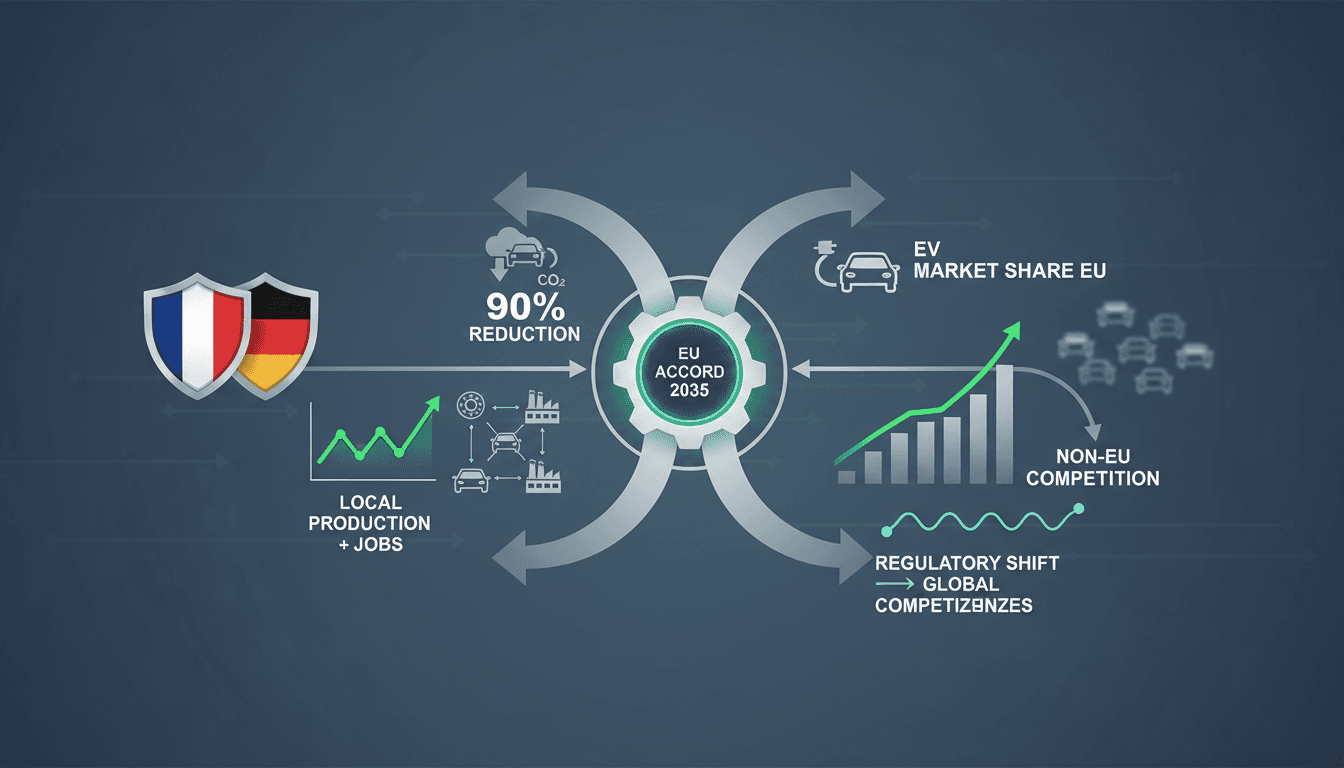
- The deal sets a 90% CO2 emissions reduction target for new cars by 2035 without mandatory offsets.
- European auto stocks rose nearly 2% following the announcement, reflecting investor optimism.
The context you actually need
- Intensifying competition from Chinese electric vehicle imports has pressured European manufacturers to adapt quickly.
- Germany's major manufacturers (Volkswagen, BMW, Mercedes-Benz) sought flexibility in emissions regulations to protect jobs and production.
- France's push for stricter local content requirements aims to ensure that Europe remains a manufacturing hub rather than an assembly point for imported vehicles.
What's really happening
On October 16, 2026, France and Germany announced a significant bilateral agreement aimed at reshaping the future of the European automotive industry. This pact modifies the EU's decarbonization framework, setting a target for a 90% reduction in CO2 emissions from new cars by 2035. Notably, this target will not require mandatory offsets, which could ease the burden on manufacturers transitioning to electric vehicles (EVs).
The agreement also introduces 'Made in Europe' criteria for public procurement and subsidies, which mandates a high level of European content in vehicles to qualify for government contracts. This move is designed to protect local jobs and production capabilities amid rising competition from non-EU manufacturers, particularly in the electric vehicle sector.
The backdrop to this agreement includes a series of discussions that began in the summer of 2026, where both nations recognized the urgent need to adapt to a rapidly changing automotive landscape. Germany's automotive giants have been under pressure due to high transition costs associated with electrification and the rigid timelines set by the EU Green Deal, which mandates a near-total phase-out of internal combustion engines by 2035.
By allowing for technological flexibility and favorable treatment for plug-in hybrids, the accord aims to provide a competitive edge to European manufacturers. This is particularly crucial as the automotive sector faces challenges from cheaper imports and the need for significant investment in new technologies.
The immediate market reaction was positive, with European automotive stocks rising nearly 2% following the announcement, indicating investor confidence in the long-term viability of the European automotive industry under this new framework. However, the agreement still requires broader approval from other EU member states and the European Parliament, which could introduce uncertainties in its implementation.
Who feels it first (and how)
- Automotive manufacturers: Companies like Volkswagen, BMW, and Mercedes-Benz will benefit from regulatory flexibility and potential subsidies.
- Workers in the automotive sector: Job security may improve as production remains in Europe rather than shifting to lower-cost regions.
- Consumers: Vehicle pricing and availability may be affected as manufacturers adjust to new regulations and local content requirements.
What to watch next
- EU parliamentary approval: The agreement must gain support from other EU member states and the European Parliament, which will determine its final implementation.
- Market response: Continued fluctuations in European automotive stocks will indicate investor confidence in the sector's adaptation to these new regulations.
- Impact on EV pricing: Changes in production costs due to local content requirements could influence the pricing of electric vehicles across Europe.
The agreement sets a 90% CO2 emissions reduction target for new cars by 2035 without mandatory offsets.
European automotive stocks will continue to react to developments surrounding the agreement and its approval process.
The extent to which other EU member states will support or oppose the agreement and its implications for the broader EU automotive market.
Frequently Asked Questions
- Why it matters?
- This bilateral accord aims to bolster Europe's automotive industry against external competition while maintaining ambitious climate goals.
- What happened (in 30 seconds)?
- France and Germany reached a bilateral agreement on October 16, 2026, to modify EU automotive emissions targets. The deal sets a 90% CO2 emissions reduction target for new cars by 2035 without mandatory offsets. European auto stocks rose nearly 2% following the announcement, reflecting investor optimism.
- What's really happening?
- On October 16, 2026, France and Germany announced a significant bilateral agreement aimed at reshaping the future of the European automotive industry. This pact modifies the EU's decarbonization framework, setting a target for a 90% reduction in CO2 emissions from new cars by 2035. Notably, this target will not require mandatory offsets, which could ease the burden on manufacturers transitioning to electric vehicles (EVs). The agreement also introduces 'Made in Europe' criteria for public proc
- Who feels it first (and how)?
- Automotive manufacturers: Companies like Volkswagen, BMW, and Mercedes-Benz will benefit from regulatory flexibility and potential subsidies. Workers in the automotive sector: Job security may improve as production remains in Europe rather than shifting to lower-cost regions. Consumers: Vehicle pricing and availability may be affected as manufacturers adjust to new regulations and local content requirements.
- What to watch next?
- EU parliamentary approval: The agreement must gain support from other EU member states and the European Parliament, which will determine its final implementation. Market response: Continued fluctuations in European automotive stocks will indicate investor confidence in the sector's adaptation to these new regulations. Impact on EV pricing: Changes in production costs due to local content requirements could influence the pricing of electric vehicles across Europe.
U.S. business news, corporate developments, and economy.
"The Wall Street Journal is respected for deep financial and economic reporting with a center-right editorial perspective."
— A47 Editor
France and Germany Reach Deal to Protect Europe’s Car Industry
France and Germany have reached a significant agreement aimed at protecting Europe's struggling auto industry, allowing for more flexibility in decarbonization rules and providing incentives for investment. This deal is seen as a crucial step to supp...
Global political, business, and cultural coverage from WSJ international desks.
"The Wall Street Journal offers extensive international reporting with a reputation for financial insight and a center-right editorial stance."
— A47 Editor
France and Germany Reach Deal to Protect Europe’s Car Industry
France and Germany have reached a significant agreement aimed at protecting Europe's struggling automotive sector by easing EU car emissions rules. This deal, confirmed recently, introduces more flexibility in decarbonization regulations and offers i...
European current affairs, EU politics, and regional developments.
"France 24 is viewed as a globally focused outlet with balanced coverage and a European perspective."
— A47 Editor
France and Germany agree to ease EU car emissions rules in new deal
France and Germany have reached an agreement to ease EU car emissions rules, aiming to support the struggling automotive sector in Europe. The deal, confirmed on Friday, includes backing for looser emissions regulations and emphasizes the importance ...
Top international stories selected by The Guardian editors.
"The Guardian is known for its progressive editorial stance and in-depth analysis."
— A47 Editor
France drops opposition to UK being included in ‘Made in Europe’ legislation
France has dropped its opposition to the UK being included in the EU's 'Made in Europe' legislation, contingent on the UK aligning with the EU's stance on tariffs for Chinese electric vehicles (EVs). This shift marks a significant change in France's ...