
Finland and Norway Open Direct Channel to Putin Ahead of US-Brokered Abu Dhabi Ukraine Talks
Why it matters
The move establishes an active Northern European diplomatic channel to Moscow ahead of US-brokered negotiations in Abu Dhabi, directly altering how border security, energy assets, and Baltic supply routes are negotiated.
What happened (in 30 seconds)
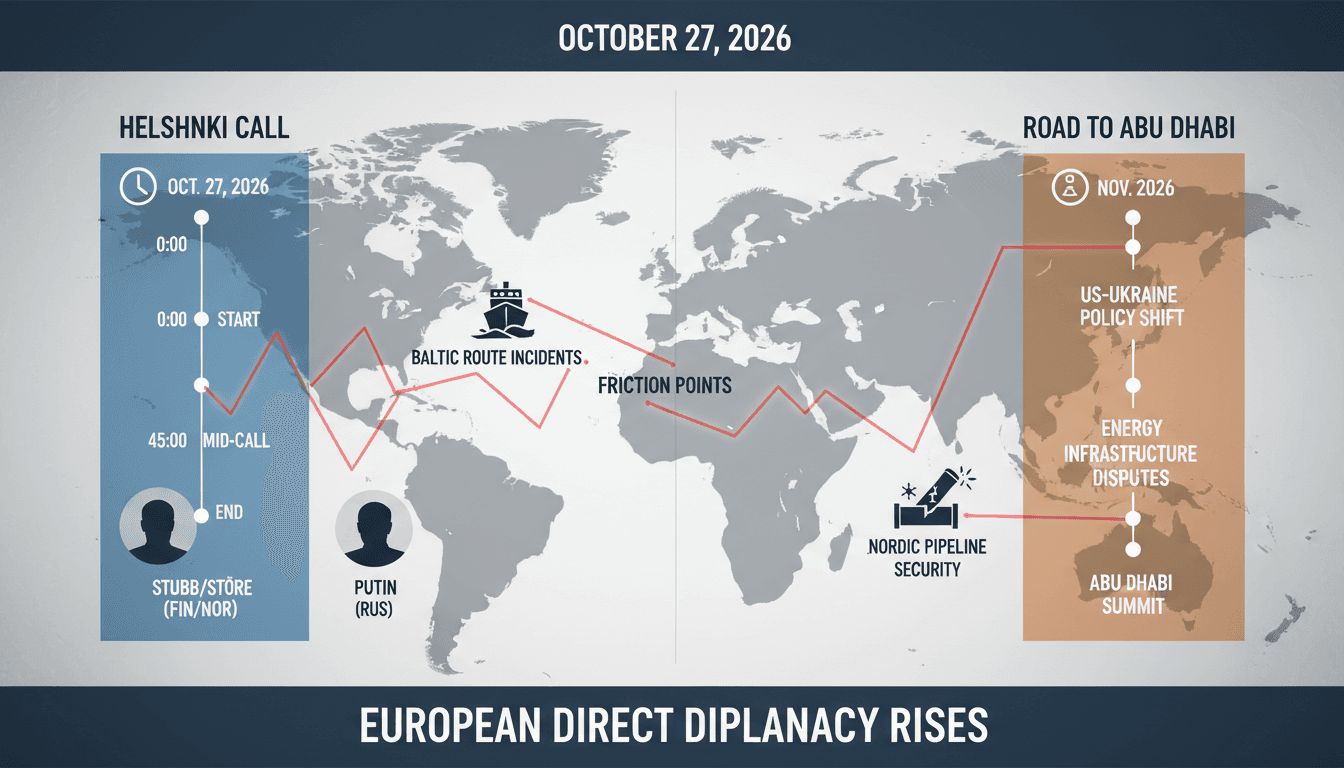
- A 90-minute joint phone call: On October 27, 2026, Finnish President Alexander Stubb and Norwegian Prime Minister Jonas Gahr Støre held an extended direct discussion with Russian President Vladimir Putin from Helsinki.
- Coordination with key partners: The Nordic leaders initiated the discussion in their national capacities, synchronizing the strategy with both Ukrainian President Volodymyr Zelenskyy and the United States prior to and immediately following the call.
- Preparatory diplomacy for Abu Dhabi: The conversation addressed regional de-escalation, maritime security in the High North and Baltic Sea, and protection parameters for energy and food infrastructure ahead of planned talks in the United Arab Emirates.
The context you actually need
- A shift in Western diplomatic isolation: European heads of state had maintained an operational taboo on direct bilateral engagement with Moscow since the 2022 invasion of Ukraine, leaving strategic communication largely dormant.
- Shifting policy parameters in Washington: The initiative unfolded against significant policy adjustments by the US administration under President Donald Trump, which introduced diesel stock releases and sanctions waivers that strained traditional Washington-Kyiv coordination.
- Border-state exposure drove the initiative: Finland and Norway share direct land and maritime boundaries with Russia, giving them unique structural exposure to security volatility in the Arctic and Baltic basins following prior preparatory meetings in Oslo involving US envoy Steve Witkoff.
What's really happening
The Helsinki-to-Moscow call represents an incentive-driven pivot by European states bordering Russia to establish direct communication lines before multi-party talks convene in Abu Dhabi. While Western European capitals historically maintained diplomatic distance to preserve a unified front, frontline states face distinct geographic realities. Finland shares a 1,340-kilometer land border with Russia, and Norway manages sensitive Arctic maritime jurisdictions in the High North. For Helsinki and Oslo, preserving baseline channels on border friction, critical energy infrastructure, and navigation in the Baltic Sea outweighs the political comfort of total isolation.
This diplomatic channel reflects changing leverage points within the broader Western alliance. As the United States adjusted policy through diesel stock releases, sanctions waivers, and bilateral engagements led by envoy Steve Witkoff, the baseline assumptions underpinning European security policy shifted. Nordic leadership recognized that if Washington intended to broker terms in Abu Dhabi, regional border states required direct input with Moscow rather than relying solely on external intermediaries. By coordinating the call with President Zelenskyy both before and after the 90-minute session, President Stubb and Prime Minister Støre sought to insulate themselves from charges of fragmentation while ensuring Ukrainian security terms remained prominent.
The trade-off, however, exposes structural friction across European capitals. While Kyiv officially acknowledged the outreach, reactions from regional neighbors highlighted diverging strategic calculations. Swedish Prime Minister Ulf Kristersson signaled low expectations, Danish Prime Minister Mette Frederiksen stressed the requirement for unified European positions, and Polish Prime Minister Donald Tusk urged procedural caution. In Vilnius, Lithuanian Foreign Minister Kestutis Budrys warned that direct discussions without unified leverage risk diluting the broader deterrence framework.
Moscow's response underlines the structural challenge of these talks. Russian official statements reiterated that any lasting diplomatic settlement requires full accounting of Russian strategic interests and root causes. Russian officials downplayed the novelty of the call, indicating that dialogue alone does not equate to concessions on contested positions. By stepping forward, Finland and Norway took on significant regional political exposure: attempting to de-risk essential energy corridors and maritime passages without fragmenting the collective deterrence posture that European states have spent four years constructing.
Who feels it first (and how)
- Nordic infrastructure and energy operators: Norwegian offshore natural gas extractors and Finnish grid networks face direct operational implications from agreements or breakdowns regarding Baltic and High North infrastructure protection.
- Gulf-based diplomatic and trade brokers: Officials and commercial entities in Abu Dhabi coordinating upcoming multilateral talks gain immediate relevance as the central venue connecting European, US, and Russian positions.
- Baltic and Nordic maritime logistics fleets: Commercial shipping operators running dry-bulk, fuel, and container lines through the Baltic Sea face shifting risk premiums based on whether these channels ease naval friction.
- Eastern European policy planners: Defense ministries in Poland and the Baltic states must rapidly calibrate whether bilateral outreach by Nordic neighbors weakens collective negotiating leverage.
What to watch next
- The Abu Dhabi negotiating agenda: Specific terms table-set during the Helsinki call—including energy transit protocols and food security provisions—will indicate whether Nordic priorities influenced the primary US-brokered framework.
- Baltic Sea operational conduct: Commercial shipping incident reports and Russian naval posture around critical subsea cables will demonstrate whether the 90-minute discussion established practical de-escalation on the water.
- European coordination meetings: Subsequent multilateral statements from Nordic-Baltic defense forums will reveal whether Copenhagen, Stockholm, and Warsaw adopt this communication format or consolidate around strict non-engagement.
The joint phone call lasted 90 minutes on October 27, 2026; discussions centered on energy infrastructure, food logistics, and High North/Baltic stability; and follow-up briefings occurred directly with President Zelenskyy.
The dialogue will accelerate reliance on the Abu Dhabi diplomatic summit as the primary forum for substantive negotiations, shifting mediation dynamics away from continental European capitals.
Whether the Nordic intervention will yield concrete operational restraint regarding energy assets and Arctic transit, or simply widen public divisions between frontline Nordic states and cautious Eastern European partners.
Frequently Asked Questions
- Why it matters?
- The move establishes an active Northern European diplomatic channel to Moscow ahead of US-brokered negotiations in Abu Dhabi, directly altering how border security, energy assets, and Baltic supply routes are negotiated.
- What happened (in 30 seconds)?
- A 90-minute joint phone call: On October 27, 2026, Finnish President Alexander Stubb and Norwegian Prime Minister Jonas Gahr Støre held an extended direct discussion with Russian President Vladimir Putin from Helsinki. Coordination with key partners: The Nordic leaders initiated the discussion in their national capacities, synchronizing the strategy with both Ukrainian President Volodymyr Zelenskyy and the United States prior to and immediately following the call. Preparatory diplomacy for Abu D
- What's really happening?
- The Helsinki-to-Moscow call represents an incentive-driven pivot by European states bordering Russia to establish direct communication lines before multi-party talks convene in Abu Dhabi. While Western European capitals historically maintained diplomatic distance to preserve a unified front, frontline states face distinct geographic realities. Finland shares a 1,340-kilometer land border with Russia, and Norway manages sensitive Arctic maritime jurisdictions in the High North. For Helsinki and O
- Who feels it first (and how)?
- Nordic infrastructure and energy operators: Norwegian offshore natural gas extractors and Finnish grid networks face direct operational implications from agreements or breakdowns regarding Baltic and High North infrastructure protection. Gulf-based diplomatic and trade brokers: Officials and commercial entities in Abu Dhabi coordinating upcoming multilateral talks gain immediate relevance as the central venue connecting European, US, and Russian positions. Baltic and Nordic maritime logistics fl
- What to watch next?
- The Abu Dhabi negotiating agenda: Specific terms table-set during the Helsinki call—including energy transit protocols and food security provisions—will indicate whether Nordic priorities influenced the primary US-brokered framework. Baltic Sea operational conduct: Commercial shipping incident reports and Russian naval posture around critical subsea cables will demonstrate whether the 90-minute discussion established practical de-escalation on the water. European coordination meetings: Subsequen
Global news coverage with extensive reporting on Middle Eastern conflicts and geopolitics.
"Al Jazeera is a Qatar-based broadcaster known for wide regional coverage and alternative perspectives."
— A47 Editor
Norway and Finland hold rare phone call with Putin: What that means
Norway and Finland held a rare phone call with Russian President Vladimir Putin, aimed at influencing US-brokered talks in Abu Dhabi to end the war in Ukraine. The Nordic leaders, Finnish President Alexander Stubb and Norwegian Prime Minister Jonas G...
Comprehensive coverage of Middle Eastern and global issues.
"Al Jazeera is a prominent voice from the Global South, especially the Middle East, with an emphasis on underreported stories."
— A47 Editor
Norway and Finland hold rare phone call with Putin: What that means
Norway and Finland held a rare phone call with Russian President Vladimir Putin, aimed at influencing US-brokered talks in Abu Dhabi to end the war in Ukraine. The Nordic leaders, Finnish President Alexander Stubb and Norwegian Prime Minister Jonas G...
RT is a Russian state-funded network covering global events from a Russian perspective.
"RT is widely criticized for promoting pro-Kremlin narratives and is considered by many to be a state propaganda outlet."
— A47 Editor
Two European leaders called Putin. Why did it cause such a stir?
Finland's President Alexander Stubb and Norwegian Prime Minister Jonas Gahr Støre held a rare call with Russian President Vladimir Putin on ending the war in Ukraine, a contact that drew significant attention because direct Western engagement with Mo...
Editor-curated FT homepage stories spanning markets, business, world, and opinion.
"The Financial Times is a globally respected business publication with a centrist/center-left tone and strong markets focus."
— A47 Editor
Putin lectures Nordic leaders on Russian history
Putin lectured Nordic leaders on Russian history during a call with Western European leaders who were seeking to revive Ukraine peace talks, according to the Financial Times, with the base report describing the call as an extended tangent that shifte...
International coverage of politics, culture, and current affairs.
"BBC News is widely regarded as a reputable international news organization, known for its impartial tone and public service mandate."
— A47 Editor
Norway and Finland leaders hold rare call with Putin
Finnish President Alexander Stubb and Norwegian leaders held a rare call with Russian President Vladimir Putin, with Stubb stating that an end to the conflict in Ukraine "will not be achieved through silence," according to BBC News coverage of the ca...
Capitol Hill news, legislation, and policy insight.
"The Hill specializes in U.S. politics and policy, with a focus on Capitol Hill developments and a reputation for insider reporting."
— A47 Editor
Denmark, Estonia express skepticism over Finland and Norway's call with Putin
Denmark and Estonia have expressed skepticism over Finland and Norway's direct call with Russian President Vladimir Putin, amid heightened tension between Moscow and Kyiv. Estonian Foreign Affairs Minister Margus Tsahkna wrote on X that only increase...
RT is a Russian state-funded network covering global events from a Russian perspective.
"RT is widely criticized for promoting pro-Kremlin narratives and is considered by many to be a state propaganda outlet."
— A47 Editor
Nordic call to Putin opens rift in Europe on Ukraine
Denmark has publicly criticized a call between Finnish President Alexander Stubb, Norwegian Prime Minister Jonas Gahr Støre and Russian President Vladimir Putin, a move that has exposed divisions among European backers of Ukraine over whether and how...
Capitol Hill news, legislation, and policy insight.
"The Hill specializes in U.S. politics and policy, with a focus on Capitol Hill developments and a reputation for insider reporting."
— A47 Editor
Finland's Stubb and Norway PM call Putin in break with previous European stance
Finnish President Alexander Stubb and Norwegian Prime Minister Jonas Gahr Støre initiated a direct call with Russian President Vladimir Putin on Tuesday morning, amid broader diplomatic efforts to wind down Russia's yearslong war with Ukraine. In a j...
Global news coverage with extensive reporting on Middle Eastern conflicts and geopolitics.
"Al Jazeera is a Qatar-based broadcaster known for wide regional coverage and alternative perspectives."
— A47 Editor
Russia targets Kyiv as Finnish, Norwegian leaders hold rare call with Putin
Russian ballistic missile strikes hit Kyiv, killing one person and wounding eight, as Finnish and Norwegian leaders held a rare call with Vladimir Putin pushing for direct discussions to end the war in Ukraine. Kyiv's mayor said medical facilities an...
Comprehensive coverage of Middle Eastern and global issues.
"Al Jazeera is a prominent voice from the Global South, especially the Middle East, with an emphasis on underreported stories."
— A47 Editor
Russia targets Kyiv as Finnish, Norwegian leaders hold rare call with Putin
Russian ballistic missile strikes hit Kyiv, killing one person and wounding eight, as Finnish and Norwegian leaders held a rare call with Vladimir Putin pushing for direct discussions to end the war in Ukraine. Kyiv's mayor said medical facilities an...
UAE-based English-language newspaper covering regional politics, economics, and global affairs.
"The National reflects Emirati policy perspectives while maintaining international editorial standards."
— A47 Editor
Finland and Norway leaders speak to Putin before Ukraine peace talks
Finland and Norway's leaders held a rare phone call with Russian President Vladimir Putin ahead of US-brokered Ukraine peace talks in Abu Dhabi, aiming to press for direct discussions to end the war. The call came as Russian ballistic missile strikes...
Global coverage of politics, crises, and international affairs.
"HuffPost provides progressive-oriented reporting on international developments, often focusing on humanitarian and social justice issues."
— A47 Editor
Leaders Of Norway, Finland Hold Rare Call With Vladimir Putin
Finnish President Alexander Stubb and Norwegian Prime Minister Jonas Gahr Støre held a rare call with Russian President Vladimir Putin, according to the Kremlin and international coverage, to discuss Ukraine peace talks and regional security, marking...
Domestic Russian news, politics, and society.
"RT is widely criticized for promoting pro-Kremlin narratives and is considered by many to be a state propaganda outlet."
— A47 Editor
Putin holds call with leaders of Norway, Finland – Kremlin
Russian President Vladimir Putin held a phone call with Finnish President Alexander Stubb and Norwegian Prime Minister Jonas Gahr Støre, during which they discussed Ukraine peace talks and regional security, according to the Kremlin. The call was des...
Macro commentary, policy analysis, growth/inflation themes, and global outlooks.
"Contextual macro coverage that complements day-to-day market headlines."
— A47 Editor
Finnish and Norwegian leaders hold phone call with Putin on Ukraine war
Finnish and Norwegian leaders held a phone call with Russian President Vladimir Putin on the war in Ukraine, according to Investing.com. The base report is brief and does not detail the specific positions or outcomes discussed during the call.