
Israel October 2026 Election Yields Hung Parliament as Netanyahu Bloc Falls Eight Seats Short of Majority
Why it matters
A divided 120-seat legislature without a clear 61-seat path freezes policy implementation and introduces an extended window of political uncertainty across regional commercial ecosystems.
What happened (in 30 seconds)
- The vote concluded without a winner: Israel’s October 27, 2026 legislative election resulted in a hung parliament where no single political bloc secured the 61-seat threshold required to build a majority government.
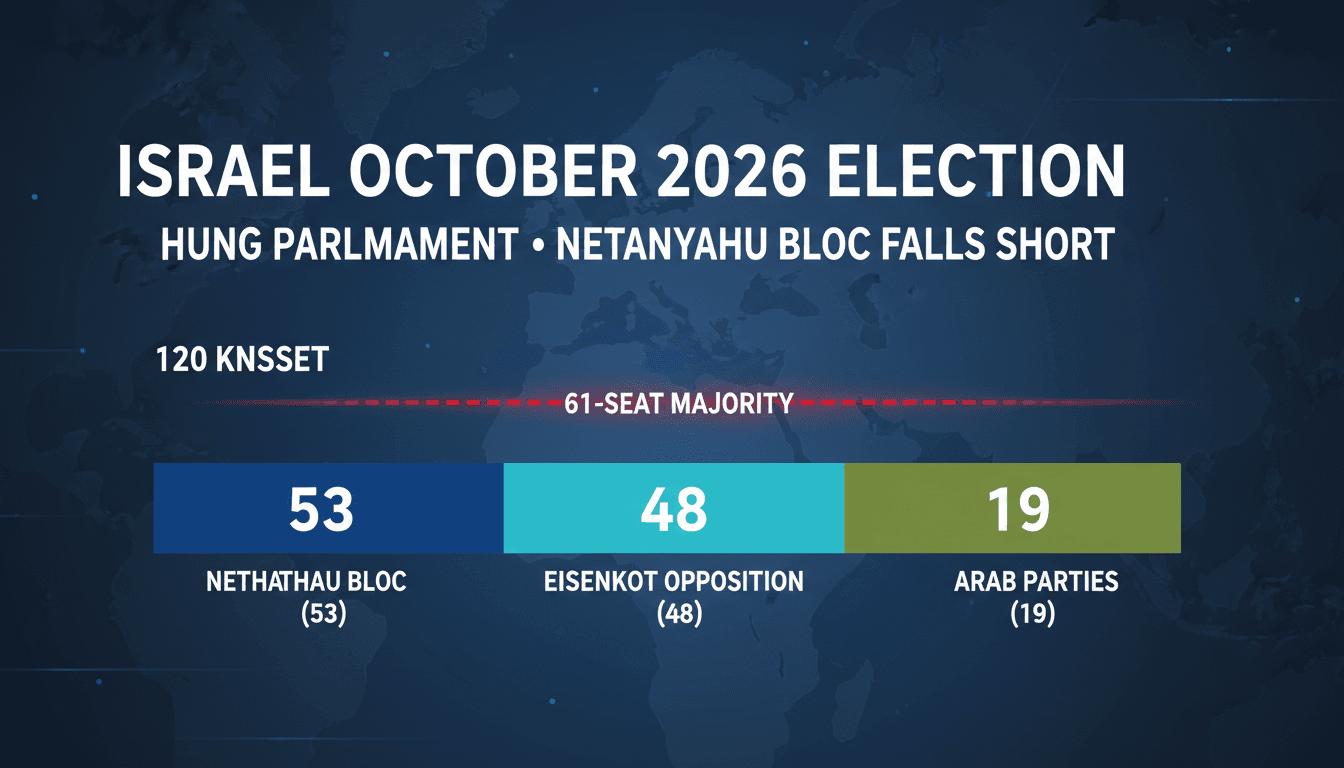
- The seat distribution split three ways: Benjamin Netanyahu’s right-wing bloc secured 53 seats, the opposition bloc led by Gadi Eisenkot captured 48 seats, and combined Arab parties obtained 19 seats from a 77.9 percent voter turnout.
- The mandate shifted to the presidency: President Isaac Herzog opened formal consultations to assign a candidate a 28-day coalition-building window, while Netanyahu remains in place as caretaker prime minister.
The context you actually need
- The structural threshold remains 61: In the 120-member Knesset, passing budgets and forming an executive cabinet requires an absolute majority of 61 seats, leaving Netanyahu eight seats short and Eisenkot 13 seats short.
- Mutual vetos restrict coalition mathematics: Netanyahu has ruled out partnerships with Arab parties, while Eisenkot’s opposition alliance faces internal resistance to incorporating Arab factions or relying on external support.
- Prior cycles created a recurring pattern: Narrow majorities and structural fragmentation have repeatedly forced Israeli politics into extended caretaker governance and recurring electoral cycles when coalition talks fail.
What's really happening
The mechanics behind this hung parliament come down to structural coalition math and non-overlapping political red lines. With 53 seats belonging to Netanyahu’s camp, 48 to Eisenkot’s opposition, and 19 held by the combined Arab parties (Ra’am and the Joint List), neither major Jewish-led faction possesses an organic pathway to the 61-seat target.
The structural barrier is not merely the gap between tallies, but the reciprocal disqualification protocols observed by the primary party leaders. For Netanyahu, bridging the eight-seat deficit requires either peeling defectors away from Eisenkot’s coalition or brokering agreements with figures like Avigdor Lieberman and Naftali Bennett. However, with opposition factions maintaining their refusal to enter a Netanyahu-led cabinet and Netanyahu formally excluding the 19 seats held by Arab parties, the right-wing bloc lacks an obvious route to expand its baseline.
Conversely, Eisenkot faces an identical mathematical bottleneck. While the arithmetic of combining his 48 seats with the 19 seats of the Arab parties would yield 67 seats—comfortably clearing the 61-seat threshold—internal resistance within his own broader opposition tent prevents formal integration. Key figures such as Lieberman have maintained strict boundaries regarding government composition. Even though Arab factions have indicated openness to arrangements prioritizing public investment and civil equity to prevent a right-wing government, the domestic political cost within the Jewish opposition factions makes a stable, formal governing coalition difficult to execute.
This leaves President Isaac Herzog managing a structured constitutional calendar. Herzog will designate a candidate who receives an initial 28-day window, with the legal option of an extension. If the first nominee fails to assemble 61 votes, the mandate rotates. If consecutive rounds collapse, the Knesset dissolves automatically, triggering a return to the ballot box within approximately 100 days.
In the interim, the caretaker administration retains executive authority but operates under statutory constraints, preventing long-term budgetary planning or structural policy shifts. For external counterparties, this translates into an operational pause: bilateral economic dialogues, institutional agreements, and investment initiatives remain on standby until an executive with legislative backing is ratified.
Who feels it first (and how)
- Regional cross-border trade managers: Companies operating across UAE-Israel trade corridors face delayed bilateral working groups and administrative hold-ups while ministries remain under caretaker oversight.
- Institutional investors and public market allocators: Portfolio managers tracking Middle East sovereign and equity risk must price in extended legislative uncertainty, which analysts note can weigh on local asset confidence over prolonged periods.
- Infrastructure and public finance contractors: Enterprises reliant on domestic state tenders or statutory budget approvals encounter capital freezes until a government establishes a functioning fiscal agenda.
What to watch next
- The presidential designation decision: Watch which leader President Herzog tasks with the primary 28-day mandate following party consultations, as this reveals the initial defect-or-align incentives.
- Defection signals within Eisenkot’s camp: Monitor whether individual opposition lawmakers or factions break ranks to deliver Netanyahu the eight seats he requires to reach 61.
- The 100-day election trigger: Track the statutory calendar; if no nominated candidate can assemble a coalition across the allowed negotiation periods, a snap election will be mandated within 100 days.
The election finalized with a 77.9 percent turnout, placing Netanyahu at 53 seats, Eisenkot at 48 seats, and Arab parties at 19 seats, leaving all coalitions short of 61.
Government formation will exhaust the full 28-day statutory negotiation window (and possible extensions) as parties leverage the threat of repeated elections to extract concessions.
Whether the opposition bloc can resolve internal resistance to broker external voting arrangements with Arab parties, or if the impasse will trigger a second national election.
Frequently Asked Questions
- Why it matters?
- A divided 120-seat legislature without a clear 61-seat path freezes policy implementation and introduces an extended window of political uncertainty across regional commercial ecosystems.
- What happened (in 30 seconds)?
- The vote concluded without a winner: Israel’s October 27, 2026 legislative election resulted in a hung parliament where no single political bloc secured the 61-seat threshold required to build a majority government. The seat distribution split three ways: Benjamin Netanyahu’s right-wing bloc secured 53 seats, the opposition bloc led by Gadi Eisenkot captured 48 seats, and combined Arab parties obtained 19 seats from a 77.9 percent voter turnout. The mandate shifted to the presidency: President I
- What's really happening?
- The mechanics behind this hung parliament come down to structural coalition math and non-overlapping political red lines. With 53 seats belonging to Netanyahu’s camp, 48 to Eisenkot’s opposition, and 19 held by the combined Arab parties (Ra’am and the Joint List), neither major Jewish-led faction possesses an organic pathway to the 61-seat target. The structural barrier is not merely the gap between tallies, but the reciprocal disqualification protocols observed by the primary party leaders. F
- Who feels it first (and how)?
- Regional cross-border trade managers: Companies operating across UAE-Israel trade corridors face delayed bilateral working groups and administrative hold-ups while ministries remain under caretaker oversight. Institutional investors and public market allocators: Portfolio managers tracking Middle East sovereign and equity risk must price in extended legislative uncertainty, which analysts note can weigh on local asset confidence over prolonged periods. Infrastructure and public finance contracto
- What to watch next?
- The presidential designation decision: Watch which leader President Herzog tasks with the primary 28-day mandate following party consultations, as this reveals the initial defect-or-align incentives. Defection signals within Eisenkot’s camp: Monitor whether individual opposition lawmakers or factions break ranks to deliver Netanyahu the eight seats he requires to reach 61. The 100-day election trigger: Track the statutory calendar; if no nominated candidate can assemble a coalition across the al
Global news coverage with extensive reporting on Middle Eastern conflicts and geopolitics.
"Al Jazeera is a Qatar-based broadcaster known for wide regional coverage and alternative perspectives."
— A47 Editor
How can Israel break its election deadlock?
Israel's national election on October 27, 2026, the first since the October 7, 2023 Hamas attacks, ended without a clear winner, with no party or bloc reaching the 61 seats required in the 120-seat Knesset to form a government. Coverage from multiple...
Comprehensive coverage of Middle Eastern and global issues.
"Al Jazeera is a prominent voice from the Global South, especially the Middle East, with an emphasis on underreported stories."
— A47 Editor
How can Israel break its election deadlock?
Israel's national election on October 27, 2026, the first since the October 7, 2023 Hamas attacks, ended without a clear winner, with no party or bloc reaching the 61 seats required in the 120-seat Knesset to form a government. Coverage from multiple...
International stories from NPR’s global desk.
"NPR is an American public media organization known for thoughtful reporting and a slightly left-leaning editorial tone."
— A47 Editor
Israel is in a political deadlock. What comes next?
Israel's national election on October 27, 2026, the first since the October 7, 2023 Hamas attacks, ended in a deadlock with neither Prime Minister Benjamin Netanyahu's bloc nor the opposition bloc led by Gadi Eisenkot reaching the 61 seats needed for...
International coverage of politics, culture, and current affairs.
"BBC News is widely regarded as a reputable international news organization, known for its impartial tone and public service mandate."
— A47 Editor
How could Israel break election deadlock? Here are four scenarios
Israel's national election on October 27, 2026, the first since the October 7, 2023 Hamas attacks, ended without a clear winner, leaving neither Prime Minister Benjamin Netanyahu's bloc nor the opposition bloc led by former IDF chief of staff Gadi Ei...