
Netanyahu Bloc Falls Eight Seats Short of Knesset Majority as Fragmented October 2026 Election Result Triggers Coalition Negotiations
Why it matters
A fragmented 120-seat Knesset leaves neither major bloc with a viable governing path, guaranteeing months of tactical bargaining that leaves regional security postures fluid and institutional planning stalled.
What happened (in 30 seconds)
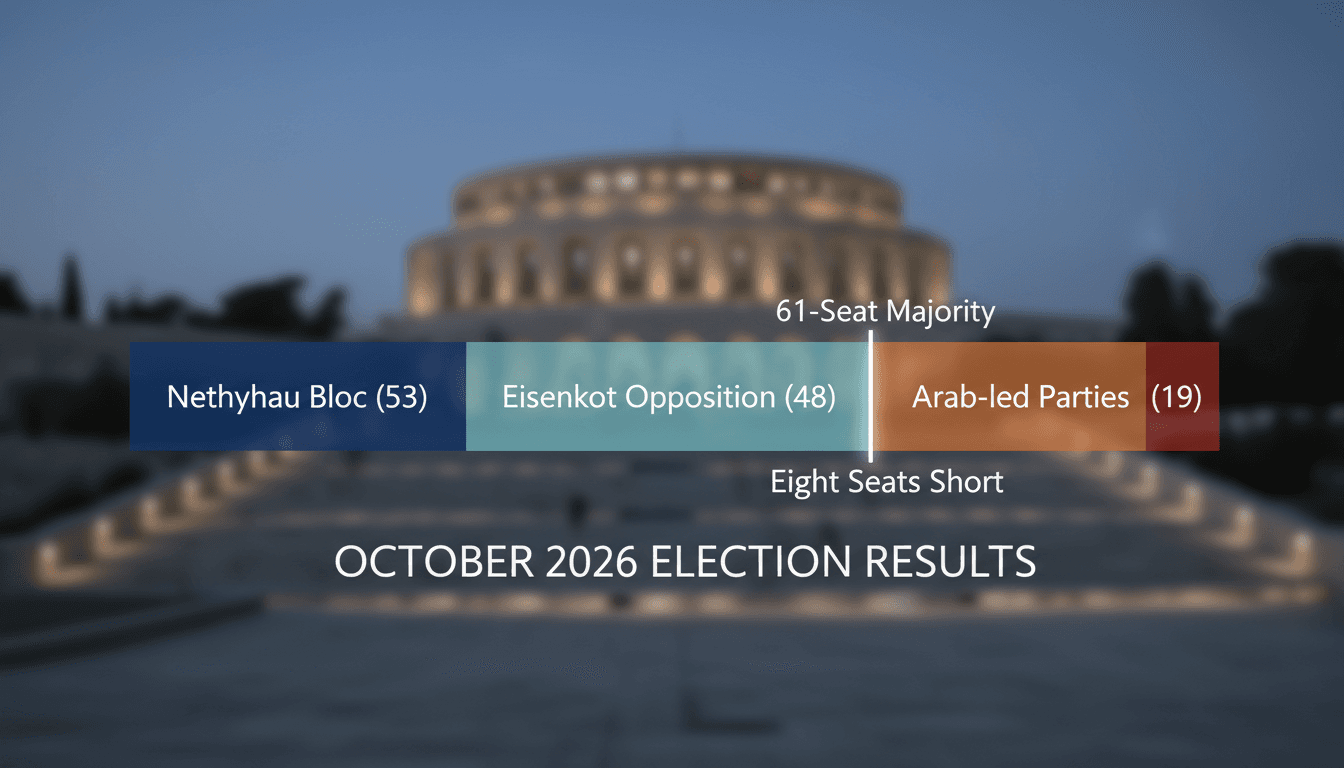
- Netanyahu lost his working majority: Prime Minister Benjamin Netanyahu’s right-wing alignment won 53 seats—falling 8 seats short of the 61-seat threshold and dropping 15 seats from its prior 68-seat coalition.
- The opposition stalled at 48: The primary challenger bloc, anchored by Gadi Eisenkot’s Yashar party alongside Yair Lapid and Naftali Bennett, secured 48 seats, leaving it mathematically incapable of forming a government on its own.
- Arab-led factions captured 19 seats: High voter participation of 77.7% to 77.9% lifted Arab-led lists (Joint List at 11, Ra'am at 8) into a decisive mathematical position, despite persistent cross-coalition resistance to formal alliances.
The context you actually need
- Security reshaped the ballot: The vote followed systemic regional escalation dating back to the October 7, 2023 attacks, testing public confidence in war management across Gaza, Lebanon, and Iran.
- Domestic fault lines eroded the base: Contentious policies regarding ultra-Orthodox military draft exemptions, coupled with judicial and governance disputes, splintered Netanyahu’s former 68-seat legislative buffer.
- A 15-seat contraction altered the field: Likud retained single-party primacy with 27 seats, but aggregate declines across partners Shas (6), United Torah Judaism (7), Otzma Yehudit (7), and Religious Zionism (6) eliminated executive unilateralism.
What's really happening
The October 27 election dismantled executive stability without installing a functional alternative. In a 120-seat legislature, power belongs exclusively to whoever assembles 61 seats. The math now forces an ideological stalemate.
Netanyahu’s faction commands 53 seats: Likud (27), Shas (6), United Torah Judaism (7), Otzma Yehudit (7), and Religious Zionism (6). To govern, this group requires 8 additional mandates. However, securing those seats demands concessions that directly contradict the coalition's foundational platform. Courting secular-nationalist factions like Avigdor Liberman’s Yisrael Beytenu (7 seats) requires immediate reforms to ultra-Orthodox military draft exemptions. Granting those exemptions causes the ultra-Orthodox parties—controlling 13 aggregate seats—to exit.
On the other side, Gadi Eisenkot’s bloc controls 48 seats: Yashar (21), B'Yachad (12), Democrats (8), and Yisrael Beytenu (7). Even if this bloc consolidates every secular and centrist mandate, it sits 13 seats away from a majority. The only arithmetic route to 61 runs through the Arab-led parties, which reached a historic collective total of 19 seats (Joint List with 11, Ra'am with 8).
Yet formal alignment between secular right-wing figures such as Liberman and Arab-led factions remains structurally constrained by party platforms and previous public commitments. While Ra'am demonstrated coalition viability in prior legislative cycles, expanding an alliance to include the Joint List presents deep legislative frictions around national security mandates and regional policy.
This leaves the political system paralyzed in place. President Isaac Herzog must assign the first mandate to assemble a cabinet ahead of the November 10 Knesset swearing-in. If that candidate fails within statutory windows, the mandate rotates. If secondary talks collapse, the system defaults to repeat parliamentary elections in early 2027.
Throughout this sequence, Netanyahu remains in place as caretaker prime minister. Caretaker administrations operate under reduced legislative scope: they cannot easily pass broad statutory overhauls or long-range fiscal frameworks. For regional capital allocators, this ensures policy drift, unresolved security calculations, and repeated election cycles instead of structural closure.
Who feels it first (and how)
- Gulf financial hubs (including Dubai): Investment desks and macro funds monitoring Gulf cross-border capital flows must price persistent regional security variables and potential headline volatility into risk models.
- Energy and commodities traders: Continued executive ambiguity in Jerusalem sustains tactical hedging around regional shipping lanes, pipeline security, and infrastructure risk across the Eastern Mediterranean.
- Israeli fiscal and domestic agencies: Government ministries face frozen structural budgets and legislative inertia, delaying long-term fiscal planning and industrial programs until a confirmed cabinet takes office.
- Defense and security planners: Operational command structures must operate under an extended caretaker administration, complicating formal negotiations on long-range defense integration and multi-year procurement schedules.
What to watch next
- President Herzog’s mandate designation: The timeline and recipient of the initial mandate to form a cabinet determine whether early talks pursue a national unity arrangement or attempt narrow cross-bloc defections.
- The November 10 Knesset assembly: The formal swearing-in reveals speaker nominations and early floor alignments, serving as the first live test of voting coordination between Eisenkot's bloc and non-aligned factions.
- Ultra-Orthodox legislative demands: Watch whether Shas and United Torah Judaism alter draft exemption red lines to negotiate with centrist partners, or if their demands preserve the arithmetic impasse toward early 2027 repeat elections.
The Central Elections Committee confirmed final tallies: Netanyahu’s bloc holds 53 seats, the Eisenkot opposition holds 48, Arab-led parties hold 19, and voter turnout settled between 77.7% and 77.9%.
The legislative deadlock will resist early resolution, prolonging Netanyahu’s caretaker tenure into early 2027 while party leaders exhaust iterative coalition mandates.
Whether cross-bloc red lines against integrating Arab-led factions into voting arrangements will soften under pressure to avoid a return to national ballots.
Frequently Asked Questions
- Why it matters?
- A fragmented 120-seat Knesset leaves neither major bloc with a viable governing path, guaranteeing months of tactical bargaining that leaves regional security postures fluid and institutional planning stalled.
- What happened (in 30 seconds)?
- Netanyahu lost his working majority: Prime Minister Benjamin Netanyahu’s right-wing alignment won 53 seats—falling 8 seats short of the 61-seat threshold and dropping 15 seats from its prior 68-seat coalition. The opposition stalled at 48: The primary challenger bloc, anchored by Gadi Eisenkot’s Yashar party alongside Yair Lapid and Naftali Bennett, secured 48 seats, leaving it mathematically incapable of forming a government on its own. Arab-led factions captured 19 seats: High voter participat
- What's really happening?
- The October 27 election dismantled executive stability without installing a functional alternative. In a 120-seat legislature, power belongs exclusively to whoever assembles 61 seats. The math now forces an ideological stalemate. Netanyahu’s faction commands 53 seats: Likud (27), Shas (6), United Torah Judaism (7), Otzma Yehudit (7), and Religious Zionism (6). To govern, this group requires 8 additional mandates. However, securing those seats demands concessions that directly contradict the coa
- Who feels it first (and how)?
- Gulf financial hubs (including Dubai): Investment desks and macro funds monitoring Gulf cross-border capital flows must price persistent regional security variables and potential headline volatility into risk models. Energy and commodities traders: Continued executive ambiguity in Jerusalem sustains tactical hedging around regional shipping lanes, pipeline security, and infrastructure risk across the Eastern Mediterranean. Israeli fiscal and domestic agencies: Government ministries face frozen s
- What to watch next?
- President Herzog’s mandate designation: The timeline and recipient of the initial mandate to form a cabinet determine whether early talks pursue a national unity arrangement or attempt narrow cross-bloc defections. The November 10 Knesset assembly: The formal swearing-in reveals speaker nominations and early floor alignments, serving as the first live test of voting coordination between Eisenkot's bloc and non-aligned factions. Ultra-Orthodox legislative demands: Watch whether Shas and United To
24/7 international news from a French perspective in multiple languages.
"France 24 is viewed as a globally focused outlet with balanced coverage and a European perspective."
— A47 Editor
Israel elections: Difficult negotiations lie ahead after Netanyahu's bloc lost majority
Israel's final official election results confirmed that Prime Minister Benjamin Netanyahu's bloc won 53 seats in the October 27, 2026 vote, leaving it eight short of the 61-seat majority needed to govern. The opposition bloc won 48, and the outcome m...
International coverage of politics, culture, and current affairs.
"BBC News is widely regarded as a reputable international news organization, known for its impartial tone and public service mandate."
— A47 Editor
Netanyahu's bloc leading Israel election but short of majority, partial results show
Netanyahu's Likud and its allies were set to win 53 seats in the 120-seat Knesset with 99% of ballots counted, leaving the bloc short of the 61-seat majority needed to govern after Israel's October 27, 2026 general election, the first national vote s...
Regional coverage and analysis focused on politics, diplomacy, and business across the Middle East.
"Al-Monitor is known for analytical reporting on Middle East politics and policy developments."
— A47 Editor
Benjamin Netanyahu: Israel's longest-serving PM fights to survive
Israeli voters went to the polls on October 27, 2026, in the first national election since Hamas's October 7, 2023 attack, a vote widely framed as a referendum on Prime Minister Benjamin Netanyahu, who has governed Israel on and off for years. Hard-f...
European coverage of Middle East politics and security issues.
"France 24 offers international reporting with a European editorial perspective."
— A47 Editor
Israelis await final election results as difficult choices lie ahead
Israelis awaited final results from the October 27, 2026 national election, the first since Hamas's October 7, 2023 attack, as counting showed neither Prime Minister Benjamin Netanyahu and his allies nor the opposition parties seeking to oust him lik...
Coverage of current events and conflicts in the Middle East.
"France 24 is viewed as a globally focused outlet with balanced coverage and a European perspective."
— A47 Editor
Israelis await final election results as difficult choices lie ahead
Israelis awaited final results from the October 27, 2026 national election, the first since Hamas's October 7, 2023 attack, as counting showed neither Prime Minister Benjamin Netanyahu and his allies nor the opposition parties seeking to oust him lik...
Focused political reporting and governmental affairs.
"NBC News is a mainstream media outlet known for comprehensive national and international news coverage with a centrist to slightly left-leaning editorial tone."
— A47 Editor
Netanyahu Leads With Most Votes Counted in Israeli Election
Netanyahu's Likud party appears to have prevailed in Israel's first national election since the Oct. 7, 2023 attacks, with most ballots counted, according to NBC News. The vote was widely framed as a referendum on Netanyahu's leadership after three y...
Regional coverage and analysis focused on politics, diplomacy, and business across the Middle East.
"Al-Monitor is known for analytical reporting on Middle East politics and policy developments."
— A47 Editor
Explainer-How could Israel break the election deadlock?
Israel's October 27, 2026 general election, the first national vote since Hamas's October 7, 2023 attacks, produced no clear winner, leaving Prime Minister Benjamin Netanyahu in office as caretaker while an opposition majority in parliament seeks to ...