
Syria Weighs Accession to Mecca Joint Defence Pact Amid Gulf Security Tensions
Why it matters
The formal inclusion of post-transition Syria into a mutual defence framework with Saudi Arabia, Türkiye, and Pakistan would cement a unified security perimeter across the Levant, South Asia, and the Arabian Peninsula.
What happened (in 30 seconds)
- Damascus initiated formal evaluation: On October 31, 2026, Syrian Foreign Minister Asaad al-Shaibani announced at the IISS Manama Dialogue in Bahrain that Syria is assessing accession to the Mecca Joint Defence Agreement.
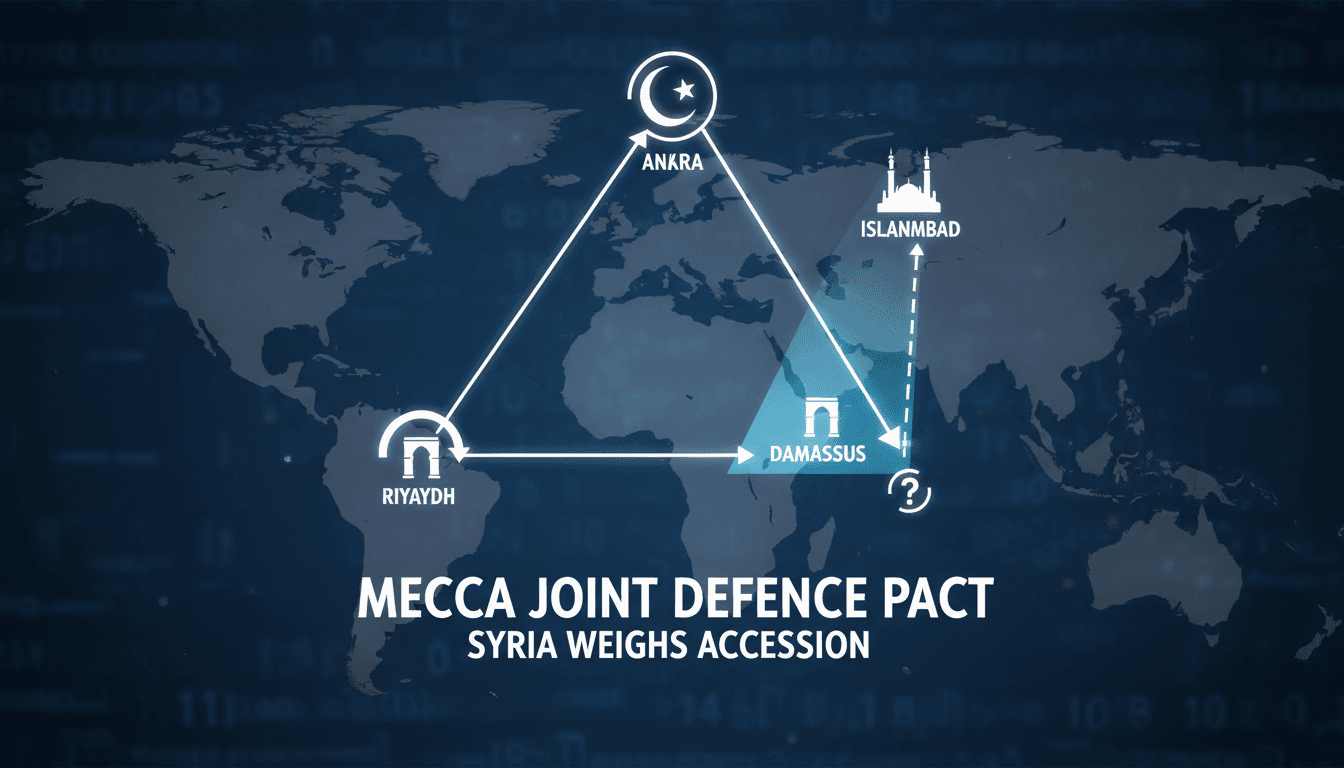
- A collective deterrence structure: Signed on August 7, 2026, between Saudi Arabia, Türkiye, and Pakistan, the agreement establishes an Article 5-style clause where an armed strike against one signatory represents an attack on all.
- No accession timeline established: Formal entry requires consensus and ratifying approvals from the three founding states, with no binding calendar or final application submitted as of early November 2026.
The context you actually need
- The post-Assad governance reset: Syria operates under a transitional government headed by President Ahmed al-Sharaa following the fall of Bashar al-Assad in December 2024, leaning heavily on financial and diplomatic backing from Riyadh and Ankara.
- Ongoing territorial exposure: Syria recorded over 1,000 Israeli strikes across its territory in less than two years, prompting the transitional administration to seek formal mutual defence pacts rather than relying on unilateral deterrence.
- Cross-regional security pressures: The foundational pact emerged in August 2026 largely in response to recurring Houthi drone and missile strikes targeting Saudi Arabian infrastructure, creating shared strategic incentives between Gulf capitals and Damascus.
What's really happening
The operational mechanism driving Syria's overtures to the Mecca Joint Defence Agreement is rooted in structural balance-of-power incentives rather than diplomatic symbolism. For Syria's transitional leadership under President Ahmed al-Sharaa, sovereignty preservation requires an external security umbrella. Having documented over 1,000 strikes within its borders in under two years, Damascus lacks the standalone air defence and deterrence infrastructure to secure its borders while rebuilding institutional capacity.
By aligning with the August 7, 2026 pact signed by Saudi Arabia, Türkiye, and Pakistan, Damascus aims to integrate into a trilateral military apparatus with substantial conventional deterrence. The founding agreement codifies that an armed assault on any single signatory acts as an assault on all members. For Syria, this clause would dramatically shift external cost-benefit calculations regarding cross-border strikes on Syrian installations.
From the perspective of founding members, the incentives operate through geopolitical consolidation and buffer preservation. Saudi Arabia and Türkiye serve as primary patrons of Syria’s post-December 2024 political structure. Leaving Damascus outside a formal security architecture leaves an open corridor of instability on the northern edge of the Arabian Peninsula. By incorporating Syria, Riyadh links its northern and southern security fronts, seeking to insulate trade routes and regional hubs from external asymmetric disruptions, including ongoing missile and drone threats originating from Yemen.
For Türkiye, a codified Syrian entry aligns with Ankara’s objective of long-term border stability and coordinated northern Levantine security management. For Pakistan, extending security commitments via Riyadh builds on long-standing bilateral defence pacts while standardizing regional mutual protection protocols.
However, accession introduces institutional friction. Mutual defence obligations are non-trivial: extending a collective defence guarantee to Syria means that founding signatories could theoretically be triggered into action by border incidents involving Damascus. The deliberate absence of a defined timeline underscores that founding members must evaluate whether Syria represents a strategic defensive buffer or an operational liability that could draw tripartite forces into active regional friction.
Who feels it first (and how)
- Aviation and Maritime Logistics Planners: Operators of Red Sea and Arabian Gulf transport corridors face revised regional war-risk insurance premiums as mutual deterrence structures standardize protection over critical airspace and maritime routes.
- Infrastructure and Construction Financiers: Capital allocators focused on Syrian reconstruction assess lower jurisdictional operational risk if Damascus secures institutional security guarantees from Ankara and Riyadh.
- Corporate Risk Officers in Regional Hubs: Multinationals managing Middle East headquarters out of Dubai experience greater macro continuity, as coordinated deterrence dampens the probability of localized conflicts spilling across the wider peninsula.
- Defence and Procurement Analysts: Regional military procurement teams must monitor interoperability protocols between Turkish NATO-standard hardware, Pakistani systems, and Saudi operations integrating with Syrian forces.
What to watch next
- Founding Member Ratification Signals: Official diplomatic communiqués from Riyadh, Ankara, or Islamabad confirming receipt of an accession bid will determine if accession moves from exploratory discussions to concrete legal protocol.
- Tripartite Security Working Groups: Formation of joint military committees or intelligence-sharing platforms between Syrian defence officials and the three pact members will indicate operational alignment ahead of formal entry.
- Regional Deterrence Testing: The frequency and intensity of cross-border strikes against Syria or Houthi missile launches toward Saudi territory will gauge whether the alliance's collective defence posture deters external operations.
Foreign Minister Asaad al-Shaibani confirmed Syria's evaluation of the Mecca pact on October 31, 2026, following preliminary discussions in Pakistan in August 2026; the founding agreement was enacted on August 7, 2026, by Saudi Arabia, Türkiye, and Pakistan.
Formal accession will require a structured transition phase featuring conditional security metrics, given Syria's ongoing exposure to cross-border strikes and rebuilding military forces.
Whether all three founding members—specifically Pakistan and Türkiye—will unanimously endorse extending binding Article 5-style defence obligations to Syrian sovereign territory without explicit operational caveats.
Frequently Asked Questions
- Why it matters?
- The formal inclusion of post-transition Syria into a mutual defence framework with Saudi Arabia, Türkiye, and Pakistan would cement a unified security perimeter across the Levant, South Asia, and the Arabian Peninsula.
- What happened (in 30 seconds)?
- Damascus initiated formal evaluation: On October 31, 2026, Syrian Foreign Minister Asaad al-Shaibani announced at the IISS Manama Dialogue in Bahrain that Syria is assessing accession to the Mecca Joint Defence Agreement. A collective deterrence structure: Signed on August 7, 2026, between Saudi Arabia, Türkiye, and Pakistan, the agreement establishes an Article 5-style clause where an armed strike against one signatory represents an attack on all. No accession timeline established: Formal entry
- What's really happening?
- The operational mechanism driving Syria's overtures to the Mecca Joint Defence Agreement is rooted in structural balance-of-power incentives rather than diplomatic symbolism. For Syria's transitional leadership under President Ahmed al-Sharaa, sovereignty preservation requires an external security umbrella. Having documented over 1,000 strikes within its borders in under two years, Damascus lacks the standalone air defence and deterrence infrastructure to secure its borders while rebuilding inst
- Who feels it first (and how)?
- Aviation and Maritime Logistics Planners: Operators of Red Sea and Arabian Gulf transport corridors face revised regional war-risk insurance premiums as mutual deterrence structures standardize protection over critical airspace and maritime routes. Infrastructure and Construction Financiers: Capital allocators focused on Syrian reconstruction assess lower jurisdictional operational risk if Damascus secures institutional security guarantees from Ankara and Riyadh. Corporate Risk Officers in Regio
- What to watch next?
- Founding Member Ratification Signals: Official diplomatic communiqués from Riyadh, Ankara, or Islamabad confirming receipt of an accession bid will determine if accession moves from exploratory discussions to concrete legal protocol. Tripartite Security Working Groups: Formation of joint military committees or intelligence-sharing platforms between Syrian defence officials and the three pact members will indicate operational alignment ahead of formal entry. Regional Deterrence Testing: The frequ
Global news coverage with extensive reporting on Middle Eastern conflicts and geopolitics.
"Al Jazeera is a Qatar-based broadcaster known for wide regional coverage and alternative perspectives."
— A47 Editor
Syria considering entry into Mecca defence pact, says foreign minister
Damascus is evaluating whether to join the Mecca defence pact, the alliance binding Turkiye, Saudi Arabia and Pakistan, according to Syria's foreign minister, as reported by Al Jazeera.
Comprehensive coverage of Middle Eastern and global issues.
"Al Jazeera is a prominent voice from the Global South, especially the Middle East, with an emphasis on underreported stories."
— A47 Editor
Syria considering entry into Mecca defence pact, says foreign minister
Damascus is evaluating whether to join the Mecca defence pact, the alliance binding Turkiye, Saudi Arabia and Pakistan, according to Syria's foreign minister, as reported by Al Jazeera.
English-language reporting on Saudi politics, policy, and society.
"Saudi Gazette reflects mainstream Saudi institutional perspectives."
— A47 Editor
Syria considering joining Makkah alliance, minister says
Syrian Foreign Minister Asaad Al-Shaibani said Saturday at the Manama Dialogue 2026 that Damascus is evaluating joining the Makkah alliance, a regional pact of Saudi Arabia, Türkiye and Pakistan, while stressing the region's need for joint deterrence...
UAE-based English-language newspaper covering regional politics, economics, and global affairs.
"The National reflects Emirati policy perspectives while maintaining international editorial standards."
— A47 Editor
Syria in negotiations about joining Makkah pact, says Foreign Minister
Syria is in negotiations about joining the Makkah defence pact, according to its Foreign Minister, as reported by The National. The base story centres on Damascus weighing membership in the alliance that binds Saudi Arabia, Turkiye and Pakistan.