
Tusk Demands Polish President Confirm Sejm-Elected Constitutional Tribunal Judges Amid Escalating Judicial Standoff
Why it matters
The confrontation directly tests the legal mechanics of post-populist judicial reform in the European Union, demonstrating how institutional co-habitation can stall court operations and legal enforcement.
What happened (in 30 seconds)
- Prime Minister Tusk issued a direct demand: On November 2, 2026, Polish Prime Minister Donald Tusk publicly called on President Karol Nawrocki to confirm judges elected by the Sejm to the Constitutional Tribunal, citing constitutional requirements.
- Physical and leadership confrontations erupted at the court: Acting judge Anna Korwin-Piotrowska suspended Tribunal President Bogdan Święczkowski on October 31, 2026, leading to police deployments, street protests, and President Nawrocki cutting short an official trip to Senegal to enter the Warsaw building.
- Brussels intervened with institutional backing: On November 1, 2026, the European Commission formally supported the Sejm’s parliamentary authority over judicial appointments, countering the conservative opposition’s accusations of an unconstitutional takeover.
The context you actually need
- A decade-long structural dispute: The roots trace to 2015, when the Law and Justice (PiS) administration seated aligned judges on the Constitutional Tribunal, prompting repeated European Court rulings against Poland over judicial independence breaches.
- A divided executive architecture: Tusk’s pro-European coalition returned to power in December 2023 with a pledge to restore the rule of law, but the election of PiS-backed Karol Nawrocki to the presidency in 2025 created a persistent veto against parliamentary appointments.
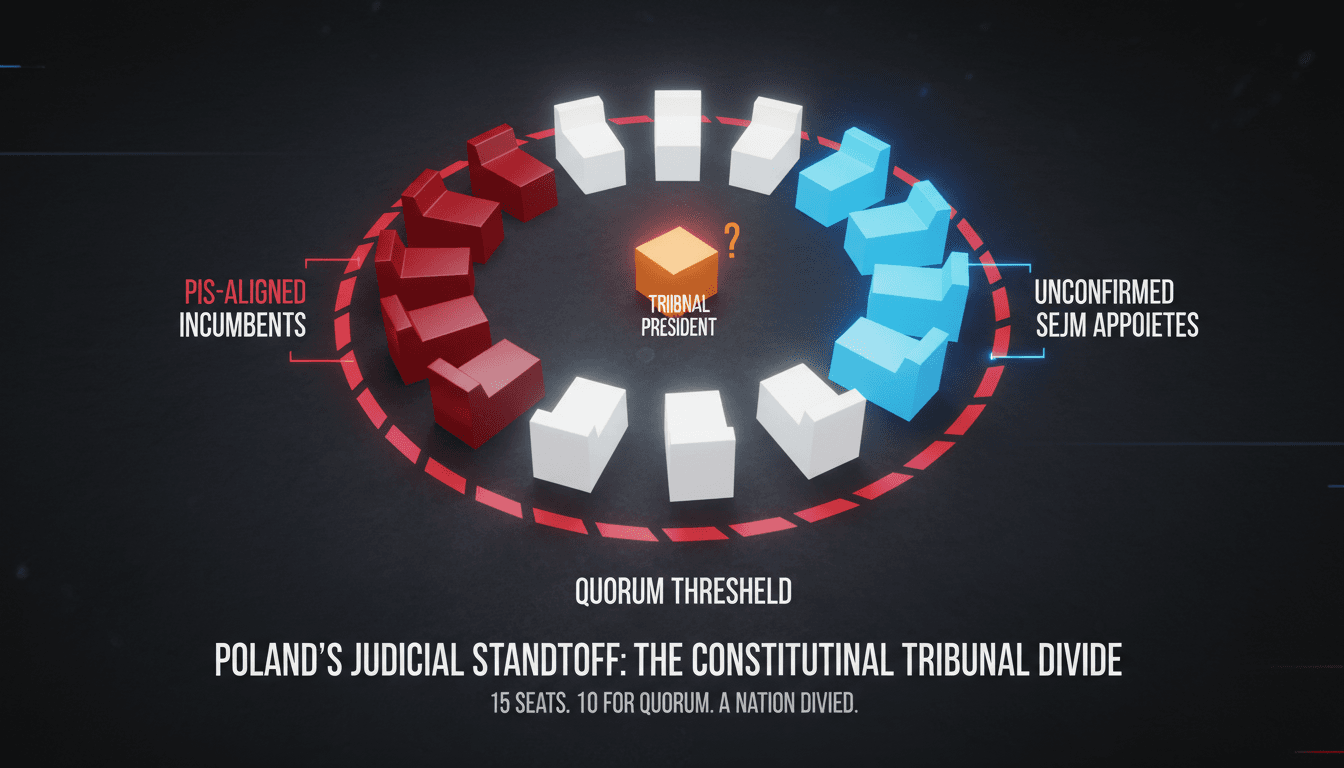
- The operational quorum bottleneck: Poland’s Constitutional Tribunal is composed of exactly 15 judges, and the court requires an operational quorum of at least 10 judges to issue binding constitutional decisions, making unconfirmed seats an effective brake on court output.
What's really happening
The standoff between Donald Tusk and Karol Nawrocki is not merely a political dispute; it is a structural deadlock driven by conflicting incentives inside Poland’s constitutional design. At the core is the mechanism of appointment versus swearing-in. The Sejm holds the constitutional authority to elect judges, but custom and executive procedure require the president to formally confirm and swear them into office. When the executive branch splits—with a pro-European parliamentary majority facing a nationalist-backed presidency—the appointment pipeline halts.
For the Tusk administration, moving aggressively to seat parliamentary appointees is an operational necessity. Returning to power in December 2023 under explicit commitments to restore institutional alignment with European Union norms, the government faced a Constitutional Tribunal staffed primarily under previous PiS rules. That bench held the legal power to invalidate cabinet initiatives and block statutory reforms. By recognizing acting leadership under Anna Korwin-Piotrowska and pushing the Sejm’s selections, the cabinet seeks to bypass what it considers an entrenched institutional blockade.
Conversely, President Nawrocki’s incentive structure favors preservation of the existing bench. Elected with PiS backing in 2025, Nawrocki relies on the tribunal as an essential institutional counterweight to parliamentary legislation. By refusing to confirm parliament-elected judges and challenging the suspension of Bogdan Święczkowski, the presidency preserves its leverage over national jurisprudence. Nawrocki’s public entrance into the Warsaw court and the deployment of state police highlights how quickly administrative resistance can manifest as street-level tension.
The supranational layer compounds these domestic incentives. The European Commission’s November 1 declaration backing parliamentary authority gives Tusk external backing, reinforcing the argument that executive refusal to swear in validly elected judges breaches broader EU rule-of-law standards. However, because the Constitutional Tribunal operates with 15 seats and demands a 10-judge quorum for major rulings, any contested leadership or disputed roster paralyzes the bench. Until the swearing-in impasse resolves, Poland's primary constitutional interpreter remains effectively split, introducing systemic uncertainty into judicial reviews, statutory challenges, and domestic administrative law.
Who feels it first (and how)
- Domestic and cross-border commercial litigators: Legal counsels handling regulatory challenges in Poland face extended delays, as unresolved tribunal leadership paralyzes constitutional questions and appeals.
- Foreign institutional investors in Poland: Capital allocators monitoring European compliance must factor in higher jurisdiction risk premiums while the rule-of-law battle between cabinet and presidency continues.
- Polish state administrative bodies: Civil servants and government ministries encounter operational ambiguity when issuing executive decisions that depend on the legal validity of contested statutes.
- European corporate legal teams: In-house teams operating across EU jurisdictions face shifting precedent regarding whether Polish tribunal judgments hold full authority in EU-linked disputes.
What to watch next
- The November 3 general assembly: The scheduled meeting of Constitutional Tribunal judges to review internal budgets and disciplinary matters will reveal whether acting leadership under Korwin-Piotrowska can command an operational majority.
- President Nawrocki’s response to Tusk’s public demand: Any official presidential registry filing or direct statement regarding swearing-in ceremonies will determine if the executive impasse moves toward compromise or deeper confrontation.
- Formal European Commission procedural steps: Brussels' next formal actions—specifically whether it ties the appointment standoff to broader institutional oversight mechanisms—will define the international pressure on Poland's presidency.
The Sejm elected new tribunal judges; President Nawrocki has refused to confirm them; Bogdan Święczkowski was suspended on October 31, 2026; and the court requires a 10-judge quorum out of 15 seats to rule.
The general assembly of judges will produce competing procedural challenges regarding the legitimacy of decisions taken under acting leadership.
Whether public pressure and European Commission statements will persuade President Nawrocki to administer the oaths of office, or if the court will remain paralyzed leading into Poland's next electoral cycles.
Frequently Asked Questions
- Why it matters?
- The confrontation directly tests the legal mechanics of post-populist judicial reform in the European Union, demonstrating how institutional co-habitation can stall court operations and legal enforcement.
- What happened (in 30 seconds)?
- Prime Minister Tusk issued a direct demand: On November 2, 2026, Polish Prime Minister Donald Tusk publicly called on President Karol Nawrocki to confirm judges elected by the Sejm to the Constitutional Tribunal, citing constitutional requirements. Physical and leadership confrontations erupted at the court: Acting judge Anna Korwin-Piotrowska suspended Tribunal President Bogdan Święczkowski on October 31, 2026, leading to police deployments, street protests, and President Nawrocki cutting short
- What's really happening?
- The standoff between Donald Tusk and Karol Nawrocki is not merely a political dispute; it is a structural deadlock driven by conflicting incentives inside Poland’s constitutional design. At the core is the mechanism of appointment versus swearing-in. The Sejm holds the constitutional authority to elect judges, but custom and executive procedure require the president to formally confirm and swear them into office. When the executive branch splits—with a pro-European parliamentary majority facing
- Who feels it first (and how)?
- Domestic and cross-border commercial litigators: Legal counsels handling regulatory challenges in Poland face extended delays, as unresolved tribunal leadership paralyzes constitutional questions and appeals. Foreign institutional investors in Poland: Capital allocators monitoring European compliance must factor in higher jurisdiction risk premiums while the rule-of-law battle between cabinet and presidency continues. Polish state administrative bodies: Civil servants and government ministries e
- What to watch next?
- The November 3 general assembly: The scheduled meeting of Constitutional Tribunal judges to review internal budgets and disciplinary matters will reveal whether acting leadership under Korwin-Piotrowska can command an operational majority. President Nawrocki’s response to Tusk’s public demand: Any official presidential registry filing or direct statement regarding swearing-in ceremonies will determine if the executive impasse moves toward compromise or deeper confrontation. Formal European Commi
English-language news from Qatar covering domestic and regional affairs.
"Gulf Times reflects Qatari perspectives on regional developments."
— A47 Editor
Polish PM Tusk asks president to confirm judges amid constitutional crisis
Polish Prime Minister Donald Tusk on Monday called on conservative-nationalist President Karol Nawrocki to confirm judges elected by Parliament to the country's highest court, amid a constitutional crisis over the judiciary. The request comes as the ...
International coverage from The Guardian's global desks.
"The Guardian is known for its progressive editorial stance and in-depth analysis."
— A47 Editor
Tusk defends overhaul of Poland’s constitutional court despite protests
Polish Prime Minister Donald Tusk has vowed to push through a contested overhaul of the country's Constitutional Court, stating in a prime-time television address that "in certain matters, there can be no compromise." He said the shake-up is vital to...
English-language reporting on Saudi politics, policy, and society.
"Saudi Gazette reflects mainstream Saudi institutional perspectives."
— A47 Editor
Polish president calls emergency talks after Constitutional Tribunal confrontation
Polish President Karol Nawrocki called emergency consultations with parliamentary parties on Saturday, accusing the government of violating the constitutional order after an overnight confrontation at the Constitutional Tribunal in Warsaw. Nawrocki s...