
Alaska Senate Race Disrupted by Name-Similarity Candidate Litigation and DOJ Certification Suit
Why it matters
The high-stakes legal contest over Alaska’s ballot certification directly threatens legislative timeline predictability in the U.S. Senate while establishing precedent for federal intervention in state-run electoral tabulations.
What happened (in 30 seconds)
- A duplicate-name contender emerged: Independent candidate Daniel J. Sullivan Jr., a retired teacher, qualified for the general election ballot alongside incumbent Republican Sen. Dan S. Sullivan and Democratic challenger Mary Peltola.
- Federal intervention sought a delay: On October 23, 2026, the U.S. Department of Justice filed a lawsuit seeking to block certification if the incumbent lost, citing potential voter confusion and alleged Democratic coordination.
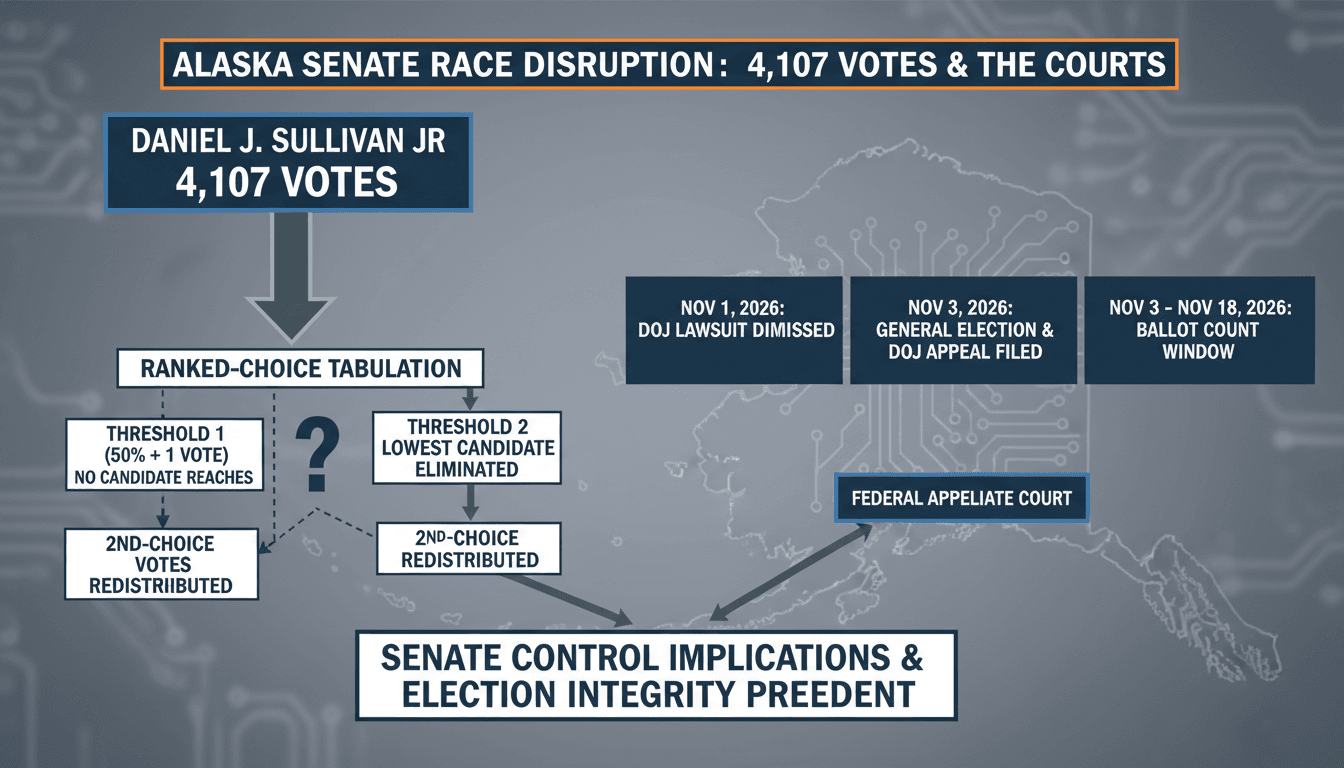
- The suit was dismissed, but legal action continues: A federal judge dismissed the DOJ's complaint on November 1, 2026, though the federal government immediately appealed as the state began ranked-choice vote counting.
The context you actually need
- Primary vote shares revealed tight margins: In the August 2026 open primary, Peltola secured 49.5% of the vote, Sullivan took 41.4%, and Daniel J. Sullivan Jr. captured 2.5%—totaling 4,107 votes.
- Judicial clearance occurred early: The Alaska Supreme Court ruled in June 2026 that Daniel J. Sullivan Jr. must remain on the ballot, overturning an earlier removal attempt by state election officials.
- The tabulation window extends to mid-November: Under Alaska's ranked-choice system, mail-in ballots postmarked by November 3, 2026, remain eligible for counting through November 18, 2026.
What's really happening
The operational core of the Alaska dispute lies in the mechanics of ranked-choice voting combined with thin margins of victory. In high-stakes federal elections, a variance of two to three percentage points determines the legislative balance of the entire U.S. Senate. When an independent candidate shares a nearly identical name with an incumbent on a statewide ballot, the potential for voter error introduces measurable baseline noise into the outcome. In the August 2026 primary, the independent Sullivan’s 4,107 votes (2.5%) demonstrated that even a minor diversion of ballots can decide whether a leading candidate clears the 50% threshold needed to avoid secondary ranked-choice allocation rounds.
The institutional conflict centers on conflicting procedural incentives. For state election administrators, the operational priority is maintaining statutory timelines, voter privacy, and administrative continuity. The Republican-led Alaska Division of Elections explicitly opposed the Department of Justice's legal intervention, asserting that altering verification procedures or reviewing individual ballots for intent after the fact cannot be executed without compromising ballot secrecy laws. For the state, the integrity of the process depends strictly on following codified counting schedules, which permit mail-in ballots to be received and tabulated through November 18.
Conversely, the federal legal strategy introduced by the Department of Justice represents a structural attempt to condition the finality of state election outcomes on administrative investigations. By filing a lawsuit to stall official certification conditional on the incumbent losing, the federal executive branch sought to establish an evidentiary bridge between third-party candidate recruitment tactics and federal voting rights violations. The dismissal of this suit by a federal district judge reinforced traditional constitutional boundaries delegating election mechanics to state jurisdictions, but the DOJ's active appeal keeps systemic uncertainty alive.
Beyond the courtroom, the incentives governing federal resource policy are central to this race. Alaska functions as a focal jurisdiction for federal land access, infrastructure development, and critical energy leasing. Legislative control of the Senate dictates committee leadership, executive branch confirmations, and federal permitting standards. Consequently, external party organizations and national campaigns operate under strong structural incentives to deploy fringe candidacies and aggressive pre-certification litigation to alter margins, even when such maneuvers trigger prolonged federal appellate reviews and extended legislative delays.
Who feels it first (and how)
- Energy and infrastructure operators in North America: Policy uncertainty around federal leasing, environmental permits, and corporate tax rates directly tracks the unresolved balance of power in the U.S. Senate.
- Alaska state election administrators: Officials face immediate operational friction, forced to defend state-level counting protocols and voter privacy mandates against ongoing federal appellate litigation.
- Institutional investors and public market strategists: Asset allocators monitoring legislative timelines must price in delayed congressional committee assignments and extended margins of error on upcoming regulatory votes.
What to watch next
- November 18 postmark deadline: The final receipt and counting of all valid postmarked mail-in ballots will reveal whether any candidate hits the absolute majority required to bypass secondary ranked-choice rounds.
- DOJ appellate court proceedings: The trajectory of the federal appeal determines whether executive agencies can establish legal standing to halt state certifications over candidate-naming disputes.
- Ranked-choice reallocation transfers: The redistribution pattern of the 2.5% primary baseline won by Daniel J. Sullivan Jr. will clarify the actual mathematical impact of ballot confusion on final vote tallies.
A federal judge dismissed the DOJ's certification lawsuit on November 1, 2026; Daniel J. Sullivan Jr. secured 4,107 votes in the primary; mail ballots are countable through November 18, 2026.
The ongoing federal appeal will not conclude before ranked-choice tabulation begins, maintaining legal pressure on the Division of Elections throughout the certification window.
Whether voter confusion surrounding identical candidate names shifted enough primary or general election votes to alter the ultimate winner of the seat.
Frequently Asked Questions
- Why it matters?
- The high-stakes legal contest over Alaska’s ballot certification directly threatens legislative timeline predictability in the U.S. Senate while establishing precedent for federal intervention in state-run electoral tabulations.
- What happened (in 30 seconds)?
- A duplicate-name contender emerged: Independent candidate Daniel J. Sullivan Jr., a retired teacher, qualified for the general election ballot alongside incumbent Republican Sen. Dan S. Sullivan and Democratic challenger Mary Peltola. Federal intervention sought a delay: On October 23, 2026, the U.S. Department of Justice filed a lawsuit seeking to block certification if the incumbent lost, citing potential voter confusion and alleged Democratic coordination. The suit was dismissed, but legal ac
- What's really happening?
- The operational core of the Alaska dispute lies in the mechanics of ranked-choice voting combined with thin margins of victory. In high-stakes federal elections, a variance of two to three percentage points determines the legislative balance of the entire U.S. Senate. When an independent candidate shares a nearly identical name with an incumbent on a statewide ballot, the potential for voter error introduces measurable baseline noise into the outcome. In the August 2026 primary, the independent
- Who feels it first (and how)?
- Energy and infrastructure operators in North America: Policy uncertainty around federal leasing, environmental permits, and corporate tax rates directly tracks the unresolved balance of power in the U.S. Senate. Alaska state election administrators: Officials face immediate operational friction, forced to defend state-level counting protocols and voter privacy mandates against ongoing federal appellate litigation. Institutional investors and public market strategists: Asset allocators monitoring
- What to watch next?
- November 18 postmark deadline: The final receipt and counting of all valid postmarked mail-in ballots will reveal whether any candidate hits the absolute majority required to bypass secondary ranked-choice rounds. DOJ appellate court proceedings: The trajectory of the federal appeal determines whether executive agencies can establish legal standing to halt state certifications over candidate-naming disputes. Ranked-choice reallocation transfers: The redistribution pattern of the 2.5% primary bas
Right-of-center views on political news.
"The Washington Times is a conservative-leaning newspaper known for its political coverage and advocacy of right-of-center viewpoints."
— A47 Editor
Voters to decide Alaska Senate race roiled in final days by litigation, allegations of dirty tricks
A federal judge dismissed a Justice Department lawsuit, pushed by President Donald Trump, that sought to block certification of Alaska's U.S. Senate race if two-term Republican Sen. Dan Sullivan lost, following allegations that Democrat Mary Peltola'...
Capitol Hill news, legislation, and policy insight.
"The Hill specializes in U.S. politics and policy, with a focus on Capitol Hill developments and a reputation for insider reporting."
— A47 Editor
In search of the real Dan Sullivan
The Hill reports on an Alaska Senate race controversy in which allegations surfaced that Democrat Mary Peltola's campaign sought to recruit a namesake candidate, also named Dan Sullivan, to confuse voters in the primary. Legal challenges and investig...
News from the United States including domestic politics, society, and culture.
"The Guardian is known for its progressive editorial stance and in-depth analysis, often advocating for social justice, environmental issues, and liberal values."
— A47 Editor
Alaska Senate race: what to know about Democrats’ alleged ballot-stacking effort
The Guardian reports that Republican officials have called for an investigation into an alleged ballot-stacking scheme by Democrat Mary Peltola's campaign in Alaska's competitive Senate race, which allegedly recruited a second candidate also named Da...
Celebrity news, photo galleries, and Hollywood updates.
"Wonderwall covers celebrity gossip, Hollywood rumors, and pop culture photo galleries."
— A47 Editor
Federal judge shuts down the Trump admin’s efforts to block Alaska from certifying its midterm election results if Republican incumbent Sen. Dan Sullivan loses the state’s closely watched Senate race
A federal judge dismissed the Trump administration's lawsuit seeking to stop Alaska from certifying its midterm Senate election results should Republican incumbent Sen. Dan Sullivan lose, ruling that the Justice Department lacked standing to bring th...
Top international stories selected by The Guardian editors.
"The Guardian is known for its progressive editorial stance and in-depth analysis."
— A47 Editor
Spoiler candidates are nothing new in US politics. It’s clear why Trump is targeting Peltola | Petala Ironcloud
The Justice Department, at President Donald Trump's behest, sued to block certification of Alaska's US Senate race if Republican incumbent Dan Sullivan narrowly loses to Democrat Mary Peltola, an Alaska Native whom polls favor. A federal judge dismis...
News from the United States including domestic politics, society, and culture.
"The Guardian is known for its progressive editorial stance and in-depth analysis, often advocating for social justice, environmental issues, and liberal values."
— A47 Editor
Spoiler candidates are nothing new in US politics. It’s clear why Trump is targeting Peltola | Petala Ironcloud
The US Justice Department, at President Donald Trump's direction, sued to block certification of Alaska's US Senate race if Republican incumbent Dan Sullivan lost to Democrat Mary Peltola, and a federal judge dismissed that suit on Sunday, though the...
Coverage of national news and issues shaping the United States, including politics, economy, and society.
"The Wall Street Journal is one of the most respected financial and news publications in the U.S., known for its rigorous reporting and center-right editorial perspective."
— A47 Editor
Alaska Town Reckons With ‘Decoy Dan’ Election Fallout: ‘Now It Is Serious’
An isolated Alaska village is grappling with the fallout of the "Decoy Dan" scheme, in which a namesake challenger to incumbent Sen. Dan S. Sullivan seemed harmless until the candidate disappeared and federal agents began visiting residents. The Wall...
Comprehensive coverage of Middle Eastern and global issues.
"Al Jazeera is a prominent voice from the Global South, especially the Middle East, with an emphasis on underreported stories."
— A47 Editor
Sullivan vows to honour Alaska race outcome, US judge dismisses DOJ lawsuit
Senator Dan Sullivan has vowed to honour the outcome of Alaska's Senate race, even as a US judge dismissed a Justice Department lawsuit that sought to block certification of the state's election results. The Trump administration had argued that Democ...
Global news coverage with extensive reporting on Middle Eastern conflicts and geopolitics.
"Al Jazeera is a Qatar-based broadcaster known for wide regional coverage and alternative perspectives."
— A47 Editor
Sullivan vows to honour Alaska race outcome, US judge dismisses DOJ lawsuit
Senator Dan Sullivan has vowed to honour the outcome of Alaska's Senate race, even as a US judge dismissed a Justice Department lawsuit that sought to block certification of the state's election results. The Trump administration had argued that Democ...
News from the United States including domestic politics, society, and culture.
"The Guardian is known for its progressive editorial stance and in-depth analysis, often advocating for social justice, environmental issues, and liberal values."
— A47 Editor
Judge dismisses Trump attempt to block Alaska Senate race results if Republican loses
A federal judge on Sunday dismissed a Justice Department lawsuit, backed by Donald Trump, that sought to block certification of Alaska's US Senate race if Republican incumbent Dan Sullivan lost to Democrat Mary Peltola. The suit was filed after Trump...
International coverage from The Guardian's global desks.
"The Guardian is known for its progressive editorial stance and in-depth analysis."
— A47 Editor
Judge dismisses Trump attempt to block Alaska Senate race results if Republican loses
A federal judge on Sunday dismissed a Justice Department lawsuit, backed by Donald Trump, that sought to block certification of Alaska's US Senate race if Republican incumbent Dan Sullivan lost to Democrat Mary Peltola. The suit was filed after Trump...
Capitol Hill news, legislation, and policy insight.
"The Hill specializes in U.S. politics and policy, with a focus on Capitol Hill developments and a reputation for insider reporting."
— A47 Editor
Judge tosses DOJ’s lawsuit over Alaska Senate race
A federal judge on Sunday dismissed a Trump administration Justice Department lawsuit that sought to block certification of Alaska's U.S. Senate race if Republican incumbent Dan Sullivan lost. U.S. District Judge Sharon Gleason ruled the administrati...
News from the United States including domestic politics, society, and culture.
"Sky News is often seen as a center-right outlet in the UK, known for its rolling news coverage and emphasis on breaking stories and political affairs."
— A47 Editor
Trump claims 'voter fraud' in election race where two candidates share same name
Federal authorities are conducting a criminal investigation into Democratic candidate Dan J. Sullivan, who shares his name with Republican Senator Dan S. Sullivan, in Alaska's Senate race ahead of Tuesday's election. President Donald Trump has allege...