
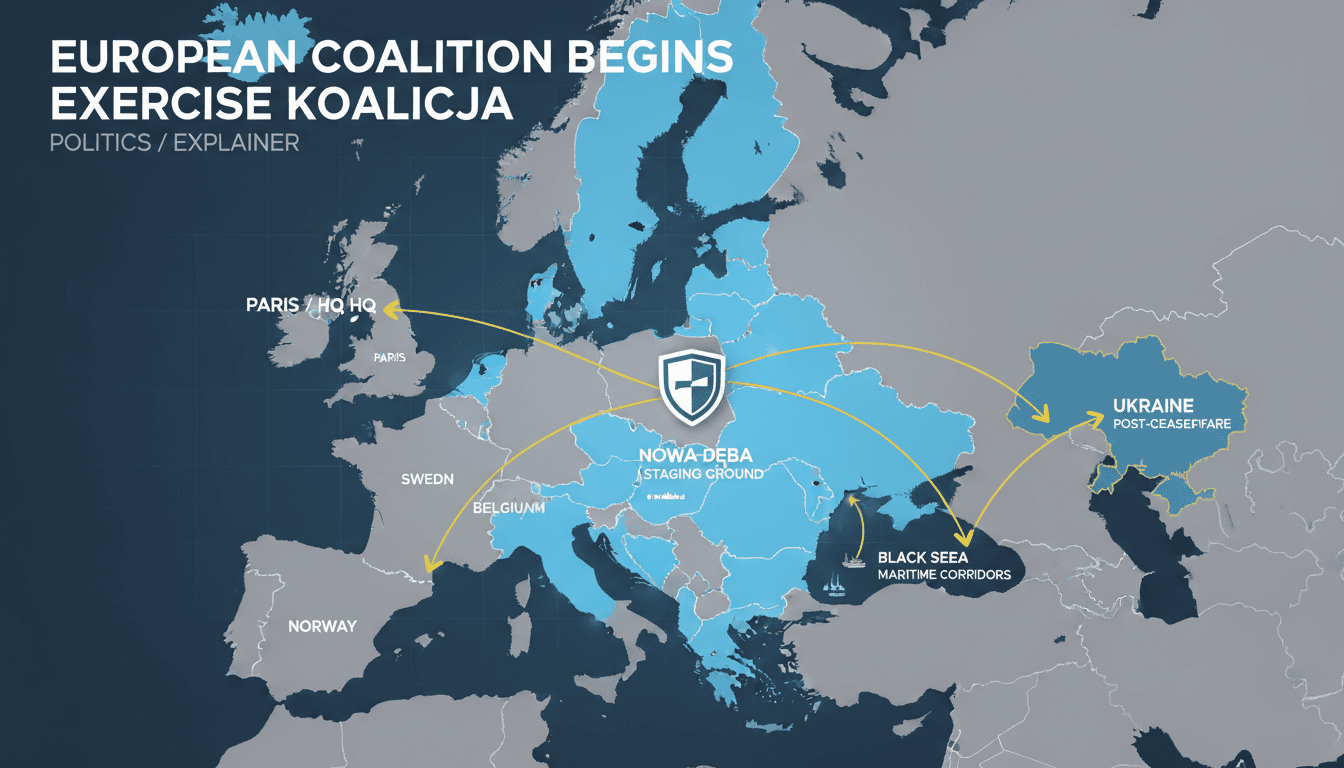
European Coalition Begins Exercise Koalicja to Rehearse Multinational Force Deployment for Post-Ceasefire Ukraine
Why it matters
A sovereign European security coalition operating outside NATO provides the operational blueprint for reopening closed airspace and Black Sea trade lanes once formal fighting ends.
What happened (in 30 seconds)
- A multinational force was mobilised: Between 2,800 and 3,000 military personnel from 12 European nations will assemble in southeastern Poland from 9 to 22 November 2026 for Exercise Koalicja.
- The command structure bypasses NATO: Led by France and the United Kingdom from an operational headquarters in Paris, the Multinational Force-Ukraine (MNF-U) operates independently of NATO command and with minimal US involvement.
- The mission is strictly non-combat: The force is designed solely for post-ceasefire deployment, targeting air defense support, domestic military training, and Black Sea mine clearance led by Turkey.
The context you actually need
- Origins trace to 2025 security commitments: The MNF-U framework emerged in 2025 as European capitals sought formal, long-term stabilization mechanisms to support Ukraine's economic and defensive stability after hostilities cease.
- Rehearsals sit on Ukraine's doorstep: Exercise Koalicja takes place near Nowa Dęba, Poland, approximately 100 kilometers from the Ukrainian border, directly testing cross-border logistics and command integration.
- Sovereign commitments carry deliberate risk: While Western officials maintain the force will not participate in peacekeeping or frontline operations, Russian leadership has officially designated any foreign force deployments within Ukraine as legitimate targets.
What's really happening
The launch of Exercise Koalicja is an operational hedge against geopolitical inertia. European leaders are creating a deployable framework that does not rely on consensus across all 32 NATO allies or political shifts in Washington. By basing the MNF-U headquarters in Paris and coordinating through a 12-nation coalition—including Germany, Poland, Spain, Sweden, the Netherlands, Belgium, Lithuania, and Estonia—the participating nations establish an autonomous structure capable of rapid mobilization the moment diplomatic conditions allow.
The operational architecture targets the economic prerequisites of post-war recovery rather than territorial enforcement. Modern conflict reconstruction requires three foundational security components: clear maritime corridors, secure sovereign airspace, and an intact domestic defense force. The allocation of national assets reflects this division of labor. France provides the largest land contingent with roughly 1,100 troops, while the United Kingdom supplies 300 personnel alongside Royal Air Force Typhoon fighters to rehearse integrated air policing. Turkey spearheads maritime operations focused on clearance of sea mines, a critical requirement for restoring high-volume maritime commerce and commercial shipping insurance coverage in the Black Sea.
The underlying calculation addresses an institutional bottleneck: post-conflict transitions frequently stall because commercial enterprises and logistics providers refuse to re-enter contested zones without verified protection systems. By demonstrating multinational interoperability across land, sea, and air domains prior to a ceasefire, the coalition intends to compress the time lag between an armistice agreement and the resumption of commercial activity.
However, the strategy carries structural friction. Because the force operates outside NATO’s Article 5 mutual defense guarantee, coalition members must manage defensive deterrence unilaterally. Western officials have characterized the deployment as non-offensive reassurance rather than combat peacekeeping. Yet, with Moscow maintaining that external military assets inside Ukraine constitute hostile targets, the deployment's viability remains entirely dependent on whether future ceasefire negotiations explicitly codify or tacitly accept a foreign military presence. The physical drill in Nowa Dęba tests whether 12 distinct defense apparatuses can resolve supply chain coordination, command friction, and air integration before those geopolitical terms are finalized.
Who feels it first (and how)
- Black Sea freight operators and insurers: Maritime transit risks remain elevated until Turkish-led mine clearance frameworks transition from Polish military simulations to actual water access.
- European defense logistics and transport planners: Movement controllers across Poland and France must establish functional cross-border supply hubs capable of moving heavy equipment within 100 kilometers of an active border.
- Post-conflict infrastructure investors: Reconstruction syndicates targeting Ukrainian transit corridors gain an observable timeline for when sovereign airspace monitoring might become operational.
- Regional commercial aviation carriers: Airlines routing around Eastern European airspace must wait for actual post-ceasefire deployments before flight corridors over southwestern Ukraine can safely reopen.
What to watch next
- The Polish field integration readouts (22 November 2026): Command-and-control synchronization between British air components and French ground units will reveal how effectively a non-NATO command staff functions under Paris headquarters oversight.
- Ceasefire negotiation drafts: Whether diplomatic frameworks officially accommodate non-offensive external security forces will determine if the MNF-U can deploy or remains confined to allied territory.
- Maritime clearance timelines: Specific deployment dates for Turkish mine-countermeasure vessels into northern Black Sea shipping routes will indicate the earliest viable window for normalized commercial shipping.
Exercise Koalicja runs from 9 to 22 November 2026 near Nowa Dęba, Poland, involving 2,800 to 3,000 personnel from 12 countries under Anglo-French leadership.
The operational data gathered during this exercise will define the standard operating procedures for any future Western non-combat stabilization missions in Eastern Europe.
Whether future armistice terms will permit the physical entry of MNF-U units into Ukrainian territory without provoking direct defensive engagement from Russian forces.
Frequently Asked Questions
- Why it matters?
- A sovereign European security coalition operating outside NATO provides the operational blueprint for reopening closed airspace and Black Sea trade lanes once formal fighting ends.
- What happened (in 30 seconds)?
- A multinational force was mobilised: Between 2,800 and 3,000 military personnel from 12 European nations will assemble in southeastern Poland from 9 to 22 November 2026 for Exercise Koalicja. The command structure bypasses NATO: Led by France and the United Kingdom from an operational headquarters in Paris, the Multinational Force-Ukraine (MNF-U) operates independently of NATO command and with minimal US involvement. The mission is strictly non-combat: The force is designed solely for post-cease
- What's really happening?
- The launch of Exercise Koalicja is an operational hedge against geopolitical inertia. European leaders are creating a deployable framework that does not rely on consensus across all 32 NATO allies or political shifts in Washington. By basing the MNF-U headquarters in Paris and coordinating through a 12-nation coalition—including Germany, Poland, Spain, Sweden, the Netherlands, Belgium, Lithuania, and Estonia—the participating nations establish an autonomous structure capable of rapid mobilizatio
- Who feels it first (and how)?
- Black Sea freight operators and insurers: Maritime transit risks remain elevated until Turkish-led mine clearance frameworks transition from Polish military simulations to actual water access. European defense logistics and transport planners: Movement controllers across Poland and France must establish functional cross-border supply hubs capable of moving heavy equipment within 100 kilometers of an active border. Post-conflict infrastructure investors: Reconstruction syndicates targeting Ukrain
- What to watch next?
- The Polish field integration readouts (22 November 2026): Command-and-control synchronization between British air components and French ground units will reveal how effectively a non-NATO command staff functions under Paris headquarters oversight. Ceasefire negotiation drafts: Whether diplomatic frameworks officially accommodate non-offensive external security forces will determine if the MNF-U can deploy or remains confined to allied territory. Maritime clearance timelines: Specific deployment
English-language reporting on Saudi politics, policy, and society.
"Saudi Gazette reflects mainstream Saudi institutional perspectives."
— A47 Editor
Thousands of European troops to rehearse post-war Ukraine deployment
Nearly 3,000 troops from 12 European countries will stage the first exercise of the Multinational Force-Ukraine (MNF-U) in Poland from 9 to 22 November, led by France and the UK. The exercise, called Exercise Koalicja, will rehearse how to move, prot...
Pan-Arab political news and analysis.
"Al-Quds Al-Arabi is a London-based Arabic newspaper known for political coverage."
— A47 Editor
قوة متعددة الجنسيات لدعم أوكرانيا تجري أول تدريباتها في بولندا هذا الشهر
A multinational force of 2,800 soldiers from 10 European countries is conducting its first training exercise in Poland this month, according to reports from London and Paris on Tuesday. The Multinational Force Ukraine, led by France and the United Ki...
24/7 international news from a French perspective in multiple languages.
"France 24 is viewed as a globally focused outlet with balanced coverage and a European perspective."
— A47 Editor
European force to hold first Ukraine support exercise in Poland
Around 2,800 troops from 10 European countries will take part in a military exercise in southeastern Poland from November 9 to 22, testing a multinational force designed to support Ukraine after a potential ceasefire. The force, led by France and Bri...
International coverage of politics, culture, and current affairs.
"BBC News is widely regarded as a reputable international news organization, known for its impartial tone and public service mandate."
— A47 Editor
Thousands of European troops to rehearse Ukraine deployment in event of peace
Thousands of European troops are set to rehearse a potential deployment to Ukraine in the event of a peace settlement, the BBC reported, with Western officials stressing that any force sent would not take part in offensive operations.