
Trump Orders DOJ Probe of Democratic Impeachment Threats Following Midterm Congressional Shift
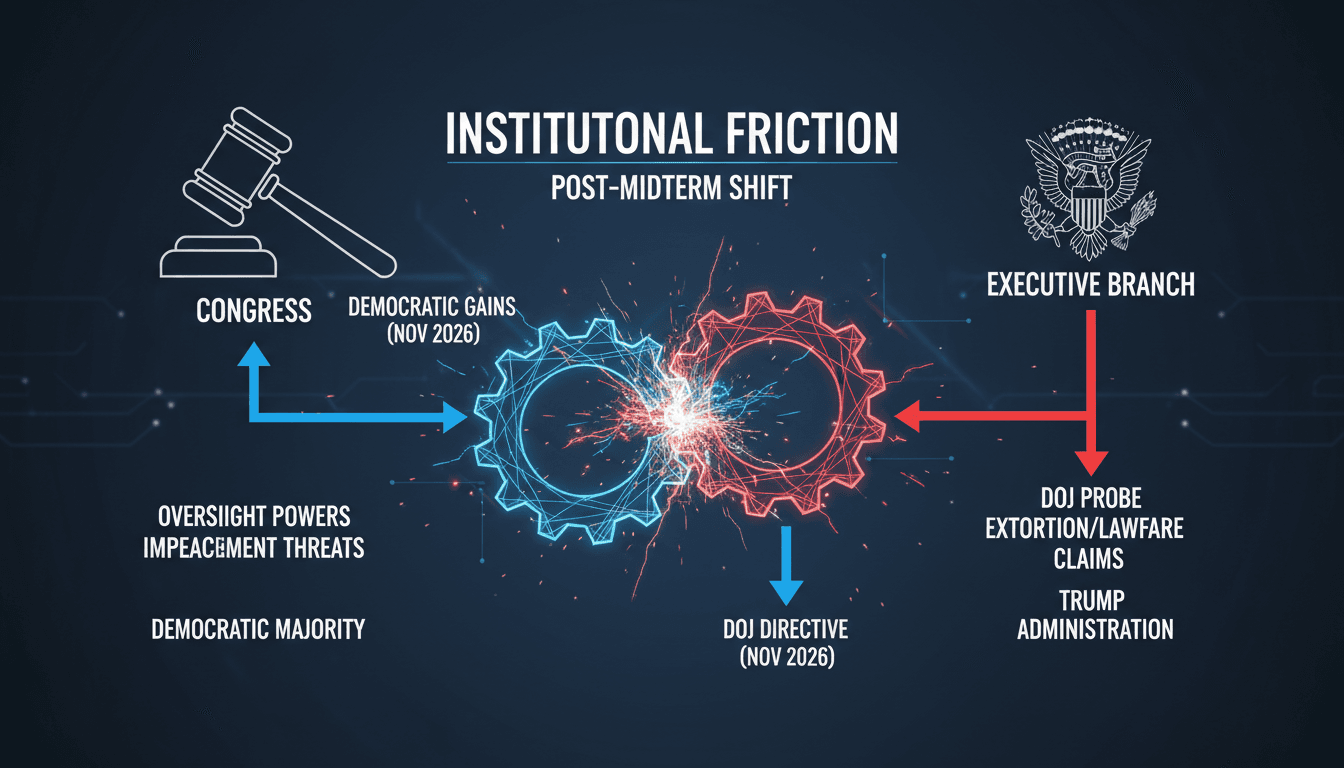
Heightened institutional friction between the executive branch and a newly shifted Congress signals an era of sustained regulatory scrutiny, dual-track investigations, and operational uncertainty across federally exposed sectors.
Why it matters
The direct friction between executive directives and legislative oversight mechanisms alters institutional predictability, setting the stage for prolonged administrative disputes that influence public policy implementation and federal governance.
What happened (in 30 seconds)
- Executive instruction: On November 7, 2026, President Donald Trump publicly directed the Department of Justice to investigate Democratic lawmakers' oversight and impeachment warnings as alleged acts of extortion and unlawful lawfare.
- Midterm transition: The directive followed the November 2026 midterm elections, which resulted in Democratic majorities taking control of both the House of Representatives and the Senate.
- Targeted pushback: The announcement cited specific statements from figures including Sen. Elissa Slotkin, while Attorney General Todd Blanche and administration allies defended executive personnel against proposed legislative inquiries.
The context you actually need
- A reshaped Congress: The 2026 midterm results transferred control of both legislative chambers to Democrats, providing them with subpoena authority and the power to launch formal committee inquiries into federal agencies.
- Preemptive positioning: Prior to taking committee gavels, incoming congressional leadership announced plans to examine executive actions, agency appointments, and potential financial conflicts, prompting immediate administrative resistance.
- Oversight versus interference: While lawmakers frame public warnings as standard constitutional oversight aimed at ensuring statutory compliance, the executive branch categorizes these deterrence strategies as impermissible coercion against public servants and political donors.
What's really happening
The post-midterm escalation between the White House and Capitol Hill reflects a structural realignment of power rather than an isolated political disagreement. When control of both congressional chambers flips during a midterm election, the institutional dynamic shifts overnight from legislative alignment to systemic checks and balances. For global operators tracking administrative continuity, the opening salvos between executive authority and incoming committee chairs determine how federal policy will actually be executed over the subsequent 24 months.
At the core of this tension is an incentive-based contest over administrative leverage. By directing the Department of Justice to evaluate whether oversight statements cross into criminal extortion, the executive branch creates a counter-leverage mechanism. The strategic objective is to raise the operational and legal costs for incoming committee leaders who intend to deploy aggressive investigatory tools. Concurrently, congressional leaders utilize early rhetoric to signal accountability, discourage career professionals from implementing disputed policies, and establish the narrative foundation for incoming committee hearings.
This dual-track posture introduces structural friction into federal administrative machinery. Civil servants, agency heads, and political appointees face competing legal and political pressures: statutory compliance demands from incoming congressional committee chairs on one side, and executive mandates reinforced by Justice Department directives on the other. Rather than standard administrative workflow, agency decision-making frequently slows as personnel navigate subpoena risks, internal legal reviews, and heightened compliance burdens.
Furthermore, this institutional conflict directly impacts public-private interactions. When congressional leadership signals investigations into administration actions—and the White House counters with inquiries into the investigators—contractors, federal grant recipients, and heavily regulated corporate entities find their standard regulatory pathways complicated. The primary consequence is not immediate statutory overhaul, but administrative inertia. Decisions involving public procurement, agency approvals, and regulatory waivers routinely face extended review cycles as federal officials anticipate downstream legislative subpoenas or legal challenges from both branches.
Who feels it first (and how)
- Federal agency leadership and political appointees: Subjected to dual pressures, facing potential congressional oversight hearings alongside executive expectations to maintain operational priorities.
- Regulated enterprise compliance officers: Forced to prepare for parallel information requests and potential subpoena exposure from incoming congressional committees investigating agency decisions.
- Prospective executive branch personnel: Navigating reputational and career considerations as incoming lawmakers explicitly warn of future scrutiny for those executing controversial administration directives.
- Government affairs teams and corporate counsel: Required to adjust legislative and regulatory engagement strategies to account for gridlock and split-power oversight dynamics.
What to watch next
- DOJ formal procedural posture: Monitor whether the Department of Justice opens preliminary inquiries or issues formal responses following the public directive, establishing whether the executive statement translates into official agency action.
- Congressional committee organization: Watch the early agenda setting and committee appointments in both chambers to see which subcommittees prioritize formal subpoenas versus standard policy reviews.
- Judicial interventions on subpoena enforcement: Track whether early conflicts over executive privilege and congressional testimony result in expedited federal court filings, which would define the boundaries of executive authority through 2028.
Democrats secured majorities in both chambers of Congress in the November 2026 elections, prompting planned oversight into executive operations; President Trump issued a public directive to the DOJ on November 7 to investigate those oversight statements.
Incoming congressional leadership will proceed with formal hearings and investigative subpoenas once officially seated, regardless of executive pushback.
Whether the Department of Justice will initiate formal grand jury proceedings or formal criminal charges regarding congressional speech, given constitutional protections surrounding legislative debate.
Frequently Asked Questions
- Why it matters?
- The direct friction between executive directives and legislative oversight mechanisms alters institutional predictability, setting the stage for prolonged administrative disputes that influence public policy implementation and federal governance.
- What happened (in 30 seconds)?
- Executive instruction: On November 7, 2026, President Donald Trump publicly directed the Department of Justice to investigate Democratic lawmakers' oversight and impeachment warnings as alleged acts of extortion and unlawful lawfare. Midterm transition: The directive followed the November 2026 midterm elections, which resulted in Democratic majorities taking control of both the House of Representatives and the Senate. Targeted pushback: The announcement cited specific statements from figures inc
- What's really happening?
- The post-midterm escalation between the White House and Capitol Hill reflects a structural realignment of power rather than an isolated political disagreement. When control of both congressional chambers flips during a midterm election, the institutional dynamic shifts overnight from legislative alignment to systemic checks and balances. For global operators tracking administrative continuity, the opening salvos between executive authority and incoming committee chairs determine how federal poli
- Who feels it first (and how)?
- Federal agency leadership and political appointees: Subjected to dual pressures, facing potential congressional oversight hearings alongside executive expectations to maintain operational priorities. Regulated enterprise compliance officers: Forced to prepare for parallel information requests and potential subpoena exposure from incoming congressional committees investigating agency decisions. Prospective executive branch personnel: Navigating reputational and career considerations as incoming l
- What to watch next?
- DOJ formal procedural posture: Monitor whether the Department of Justice opens preliminary inquiries or issues formal responses following the public directive, establishing whether the executive statement translates into official agency action. Congressional committee organization: Watch the early agenda setting and committee appointments in both chambers to see which subcommittees prioritize formal subpoenas versus standard policy reviews. Judicial interventions on subpoena enforcement: Track w
Celebrity news, photo galleries, and Hollywood updates.
"Wonderwall covers celebrity gossip, Hollywood rumors, and pop culture photo galleries."
— A47 Editor
‘Extortion at the highest level’: President Donald Trump orders the DOJ to investigate Democrats’ threats to impeach Republican leaders, calling it ‘weaponization’ and ‘lawfare’
President Donald Trump has ordered the Department of Justice to investigate Democratic leaders over threats to impeach Republican officials and pursue legal action against administration allies, accusing them of "extortion," "weaponization" and "lawf...
Capitol Hill news, legislation, and policy insight.
"The Hill specializes in U.S. politics and policy, with a focus on Capitol Hill developments and a reputation for insider reporting."
— A47 Editor
Trump asks DOJ to investigate Democrats calling for impeachment of cabinet officials
President Donald Trump raised concerns on Saturday about some Democrats calling for the impeachment of Republican officials, describing the threats as "extortion at the highest level" and asking the Justice Department to "look into this." The remarks...
Global news coverage with extensive reporting on Middle Eastern conflicts and geopolitics.
"Al Jazeera is a Qatar-based broadcaster known for wide regional coverage and alternative perspectives."
— A47 Editor
Trump orders DOJ to investigate Democrats for ‘threatening’ people
Donald Trump lashed out at Democrats on Truth Social days after the party won control of both the Senate and House in the November 3 midterm elections, and ordered the Department of Justice to investigate Democrats over alleged 'threatening' of peopl...
Comprehensive coverage of Middle Eastern and global issues.
"Al Jazeera is a prominent voice from the Global South, especially the Middle East, with an emphasis on underreported stories."
— A47 Editor
Trump orders DOJ to investigate Democrats for ‘threatening’ people
Trump lashed out at Democrats on Truth Social days after the party won control of Congress, and he ordered the Department of Justice to investigate Democrats for allegedly 'threatening' people. The move follows Democratic gains in the November 3 midt...
Right-of-center views on political news.
"The Washington Times is a conservative-leaning newspaper known for its political coverage and advocacy of right-of-center viewpoints."
— A47 Editor
'EXTORTIONISTS': Trump ordering probe of Democrats threatening Republicans
President Donald Trump said on Saturday that he was ordering a Justice Department investigation into Democratic lawmakers accused of trying to intimidate Republicans, which he characterized as extortion. Coverage of the directive from Fox News report...
U.S. political news and right-leaning commentary.
"Fox News is a highly influential conservative news outlet known for right-leaning political commentary and coverage."
— A47 Editor
Trump orders DOJ probe into Democrats over alleged threats against administration officials
President Donald Trump ordered the Justice Department to investigate Democrats over alleged threats against administration officials and Republican donors, which he characterized as criminal conduct and extortion. The directive was reported by Fox Ne...