
Qatar and Turkiye Sign Mutual Defence Pact Amid Regional Instability
Why it matters
The formalization of a mutual defence treaty between a NATO member and a key liquefied natural gas exporter establishes a binding legal counterweight to regional disruptions, insulating energy transit and capital corridors through bilateral deterrence.
What happened (in 30 seconds)
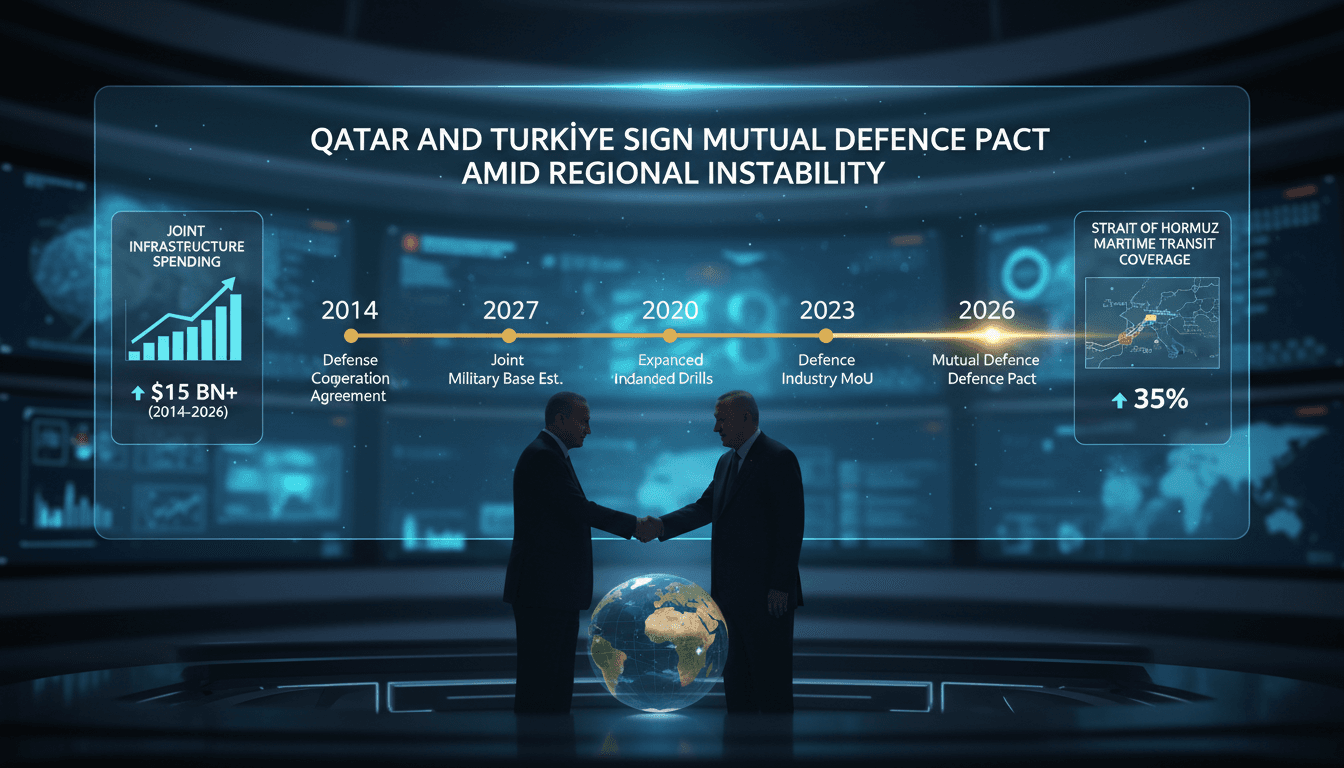
- A formal collective defence treaty was signed in Istanbul. On November 13, 2026, Turkish President Recep Tayyip Erdogan and Qatari Emir Sheikh Tamim bin Hamad Al Thani signed a mutual defence pact committing both states to a unified stance against any external armed attack.
- The agreement took place during the 12th Supreme Strategic Committee. Convening at the Dolmabahce Presidential Office, leadership paired the military pact with four secondary accords spanning education, consumer protection, and peacebuilding initiatives.
- Defence industrial collaboration and joint exercises will expand. The arrangement deepens institutional military ties, joint personnel training, and shared arms production mechanisms without publicly detailing explicit automatic activation triggers.
The context you actually need
- Bilateral military integration has been building since 2014. The alliance originated with the establishment of the Supreme Strategic Committee a decade prior, followed by a 2017 accord that established an active Turkish troop deployment inside Qatar.
- The regional backdrop is marked by maritime and sovereign volatility. The agreement follows mounting cross-border friction, including the US-Iran conflict, broader regional military operations, and recurring transit interruptions across the Strait of Hormuz.
- Commercial links provide an established economic baseline. Beyond military cooperation, bilateral integration is rooted in extensive physical infrastructure, highlighted by $20.8 billion in completed Turkish contracting projects across Qatar covering 206 individual developments.
What's really happening
The formal defence pact between Doha and Ankara addresses structural shifts in how Gulf states hedge against external shocks. Historically reliant on external security umbrellas, regional actors face mounting operational risks along key maritime chokepoints, compounded by open questions surrounding traditional security guarantees. Rather than constructing a short-term tactical alignment, this treaty hardens an existing relationship into a codified mutual defence architecture designed for deterrence.
At the operational core of the agreement is an incentive structure focused on resource security and industrial capability. For Qatar, an economy built on uninterrupted maritime transit via the Strait of Hormuz, formalizing military deterrence with Turkiye creates an added counterweight against external aggression. For Turkiye, the partnership embeds its military presence deeper into the Gulf, securing a key strategic foothold while integrating its growing domestic defence manufacturing sector with high-liquidity Qatari procurement budgets.
The broader shift lies in the push for indigenous defence capabilities. Recent global and regional supply chain friction demonstrated that relying exclusively on foreign arms sales creates operational vulnerabilities during active crises. By focusing explicitly on defence industry collaboration, joint technology initiatives, and combined manufacturing, both states are working to reduce reliance on external suppliers. This transition aims to insulate their military readiness from third-party export limitations.
Crucially, the communique frames this development as a deterrent rather than an expeditionary coalition. Neither capital published specific operational triggers for military intervention, maintaining deliberate ambiguity while formalizing regular security consultations. By tying physical infrastructure—demonstrated by $20.8 billion in completed Turkish projects across 206 developments in Qatar—to sovereign defence obligations, both nations signal to regional markets that bilateral economic assets are backed by shared military commitments.
This model of targeted bilateral pacts allows middle powers to build layered security buffers without relying on complex multinational consensus. In doing so, it introduces a permanent regional counterweight focused on securing energy transit and maintaining state sovereignty amidst wider cross-border conflicts.
Who feels it first (and how)
- Maritime logistics operators and commodity traders: Transit planners routing vessels through the Strait of Hormuz gain secondary deterrence stability, mitigating potential volatility in maritime insurance and route reliability.
- Defence technology and procurement executives: Turkish defence contractors and regional procurement teams gain direct opportunities through codified industrial joint ventures and shared production pipelines.
- Gulf-based cross-border infrastructure firms: Contractors operating large-scale state assets in Qatar operate under a more integrated security framework that protects long-term capital deployment.
- Regional corporate strategists in hubs like Dubai: Corporate planners managing supply chains reliant on Gulf energy transit monitor the pact's stabilizing effect on trade arteries that sustain wider regional commerce.
What to watch next
- Publication of operational activation triggers: Watch for supplementary protocols outlining whether automatic military assistance is mandatory or subject to political review, which clarifies how the pact responds to asymmetric threats.
- Joint defence industrial announcements: Track new manufacturing and procurement agreements announced under the bilateral committee, signaling the pace of shared arms production.
- Deployment modifications at Turkish facilities in Qatar: Monitor changes to troop levels, naval rotations, or advanced hardware stationed at existing Turkish military bases within Qatari territory.
Qatar and Turkiye signed a binding mutual defence pact in Istanbul on November 13, 2026, committing to a unified stance against external armed attacks alongside commitments to expand joint exercises, personnel training, and defence industry collaboration.
The formalization will increase procurement contracts directed toward Turkish defence manufacturing while cementing joint naval and air coordination around Qatari energy installations.
The exact operational triggers that mandate a physical military intervention remain unspecified, as do the formal diplomatic postures of non-signatory regional neighbors toward the new alliance.
Frequently Asked Questions
- Why it matters?
- The formalization of a mutual defence treaty between a NATO member and a key liquefied natural gas exporter establishes a binding legal counterweight to regional disruptions, insulating energy transit and capital corridors through bilateral deterrence.
- What happened (in 30 seconds)?
- A formal collective defence treaty was signed in Istanbul. On November 13, 2026, Turkish President Recep Tayyip Erdogan and Qatari Emir Sheikh Tamim bin Hamad Al Thani signed a mutual defence pact committing both states to a unified stance against any external armed attack. The agreement took place during the 12th Supreme Strategic Committee. Convening at the Dolmabahce Presidential Office, leadership paired the military pact with four secondary accords spanning education, consumer protection, a
- What's really happening?
- The formal defence pact between Doha and Ankara addresses structural shifts in how Gulf states hedge against external shocks. Historically reliant on external security umbrellas, regional actors face mounting operational risks along key maritime chokepoints, compounded by open questions surrounding traditional security guarantees. Rather than constructing a short-term tactical alignment, this treaty hardens an existing relationship into a codified mutual defence architecture designed for deterre
- Who feels it first (and how)?
- Maritime logistics operators and commodity traders: Transit planners routing vessels through the Strait of Hormuz gain secondary deterrence stability, mitigating potential volatility in maritime insurance and route reliability. Defence technology and procurement executives: Turkish defence contractors and regional procurement teams gain direct opportunities through codified industrial joint ventures and shared production pipelines. Gulf-based cross-border infrastructure firms: Contractors operat
- What to watch next?
- Publication of operational activation triggers: Watch for supplementary protocols outlining whether automatic military assistance is mandatory or subject to political review, which clarifies how the pact responds to asymmetric threats. Joint defence industrial announcements: Track new manufacturing and procurement agreements announced under the bilateral committee, signaling the pace of shared arms production. Deployment modifications at Turkish facilities in Qatar: Monitor changes to troop leve
Global news coverage with extensive reporting on Middle Eastern conflicts and geopolitics.
"Al Jazeera is a Qatar-based broadcaster known for wide regional coverage and alternative perspectives."
— A47 Editor
Qatar and Turkiye sign a mutual defence pact: What do we know?
Qatar and Turkiye have signed a mutual defence pact, pledging a unified response to any attack on either state, according to a joint statement issued by their leaders. The agreement was signed in Doha and Ankara and comes amid the wider US-Iran war, ...
Comprehensive coverage of Middle Eastern and global issues.
"Al Jazeera is a prominent voice from the Global South, especially the Middle East, with an emphasis on underreported stories."
— A47 Editor
Qatar and Turkiye sign a mutual defence pact: What do we know?
Qatar and Turkiye have signed a mutual defence pact, pledging a unified response to any attack on either state, according to a joint statement issued by their leaders. The agreement was signed in Doha and Ankara and comes amid the wider US-Iran war, ...
UAE-based English-language newspaper covering regional politics, economics, and global affairs.
"The National reflects Emirati policy perspectives while maintaining international editorial standards."
— A47 Editor
Turkey's approval of Makkah pact takes effect as it signs separate defence agreement with Qatar
Turkey's approval of the Makkah pact has taken effect, and Ankara has signed a separate defence agreement with Qatar, pledging a unified response to any attack on either country, according to a joint statement by the two leaders.
Global news coverage with extensive reporting on Middle Eastern conflicts and geopolitics.
"Al Jazeera is a Qatar-based broadcaster known for wide regional coverage and alternative perspectives."
— A47 Editor
Qatar and Turkiye send message of deterrence with new defence pact
Qatar and Turkiye have signed a mutual defence pact, with the two countries pledging a unified response to any attack on either state, according to a joint statement issued by their leaders. The agreement was signed in Doha and Ankara and is framed a...
Comprehensive coverage of Middle Eastern and global issues.
"Al Jazeera is a prominent voice from the Global South, especially the Middle East, with an emphasis on underreported stories."
— A47 Editor
Qatar and Turkiye send message of deterrence with new defence pact
Qatar and Turkiye have signed a mutual defence pact, with the two countries pledging a unified response to any attack on either state, according to a joint statement issued by their leaders. The agreement was signed in Doha and Ankara and is framed a...
Regional coverage and analysis focused on politics, diplomacy, and business across the Middle East.
"Al-Monitor is known for analytical reporting on Middle East politics and policy developments."
— A47 Editor
Turkey, Qatar sign mutual defence agreement
Turkey and Qatar announced on Friday that they have signed a mutual defence agreement, pledging to adopt a unified position in the face of any external attack. The announcement followed a meeting in Istanbul between Turkish President Recep Tayyip Erd...
24/7 international news from a French perspective in multiple languages.
"France 24 is viewed as a globally focused outlet with balanced coverage and a European perspective."
— A47 Editor
Turkey and Qatar pledge unified stance against attacks in mutual defence pact
Turkey and Qatar signed a mutual defence agreement on Friday, pledging a unified response to any attack on either country, according to a joint statement issued by the two leaders. The pact follows the Mecca Joint Defence Agreement that Turkey, Pakis...
European coverage of Middle East politics and security issues.
"France 24 offers international reporting with a European editorial perspective."
— A47 Editor
Turkey and Qatar pledge unified stance against attacks in mutual defence pact
Turkey and Qatar signed a mutual defence agreement on Friday, pledging a unified response to any attack on either country, according to a joint statement issued by the two leaders. The pact follows the Mecca Joint Defence Agreement signed by Turkey, ...
Regional coverage and analysis focused on politics, diplomacy, and business across the Middle East.
"Al-Monitor is known for analytical reporting on Middle East politics and policy developments."
— A47 Editor
Turkey, Qatar sign mutual defence agreement, pledge unified stance against attack
Turkey and Qatar signed a mutual defence agreement on Friday, November 13, aimed at strengthening collective defence and promoting regional security. The joint statement issued after talks between the two countries' leaders pledged a unified stance a...
Global news coverage with extensive reporting on Middle Eastern conflicts and geopolitics.
"Al Jazeera is a Qatar-based broadcaster known for wide regional coverage and alternative perspectives."
— A47 Editor
Turkiye and Qatar sign mutual defence agreement
Turkiye and Qatar have signed a mutual defence agreement, according to a breaking news report from Al Jazeera, which lists both countries and the outlet as the central entities of the story. The report is categorised under Middle East coverage and pr...