
UK Tribunal Compels Government to Confirm Secret Apple iCloud Encryption Access Order
Why it matters
The forced disclosure of secret capability orders establishes an institutional limit on state surveillance secrecy, shifting the friction between data protection and national security into open legal scrutiny.
What happened (in 30 seconds)
- A specialized court broke government silence: London's Investigatory Powers Tribunal ruled on November 19, 2026, that the UK Home Office must formally confirm it served a secret Technical Capability Notice to Apple concerning encrypted iCloud backups.
- The secrecy defense failed against prior reporting: The three-judge tribunal rejected the state's traditional "neither confirm nor deny" stance, determining that public statements and reporting meant disclosure posed little to no additional national security harm.
- The primary legality dispute advances to 2027: While precise technical mechanics remain classified, the substantive court battle regarding whether the government can lawfully mandate technical modifications to end-to-end encryption will proceed in open hearings in the first half of 2027.
The context you actually need
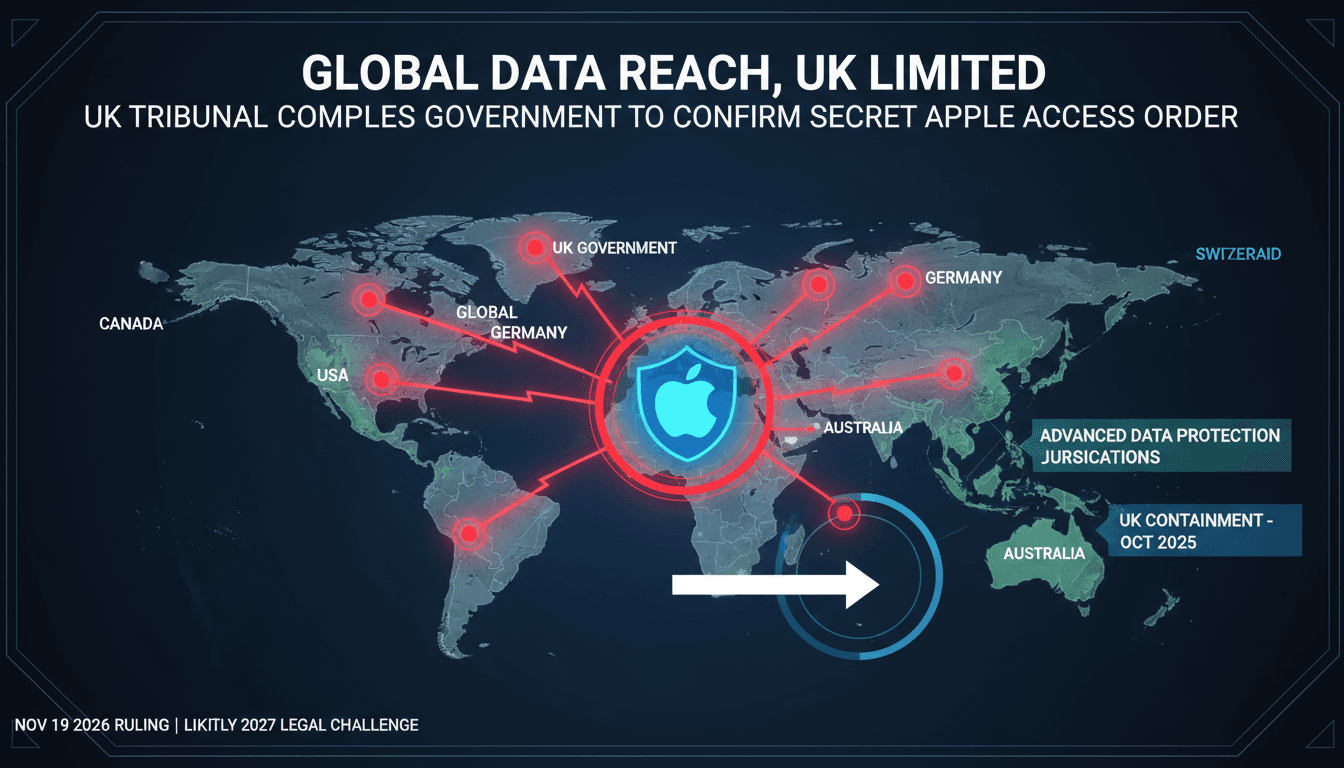
- The mandate originated as a global demand: In January 2025, the UK issued an initial notice under the Investigatory Powers Act 2016 seeking access to iCloud data worldwide, which prompted Apple to withdraw Advanced Data Protection for domestic British accounts by February 2025.
- Cross-border friction narrowed the regulatory scope: Following interventions from United States officials in August 2025, British authorities scaled back the enforcement perimeter by October 2025 to target exclusively UK-based users.
- The legal challenge represents an administrative milestone: This decision marks the first known instance in British legal history where an oversight tribunal compelled the state to confirm the existence of a Technical Capability Notice.
What's really happening
The core mechanism behind this conflict is the tension between jurisdictional enforcement and platform architecture. Under the Investigatory Powers Act 2016, a Technical Capability Notice allows state authorities to require telecommunications operators and service providers to retain the technical ability to assist in lawful interception. Historically, the executive branch applied a strict policy of refusing to confirm or deny the existence of these notices to preserve operational opacity and prevent targets from altering operational patterns.
By compelling confirmation, the tribunal alters the strategic calculations of both tech providers and security agencies. For the state, the incentive has centered on compelling platform compliance discreetly. An opaque notice avoids consumer backlash, protects market stability, and circumvents diplomatic friction with foreign jurisdictions whose citizens might use the same global infrastructure. When the original January 2025 notice attempted to cover global iCloud backups, it created an extraterritorial regulatory conflict that drew active pushback from US officials by August 2025. This diplomatic pressure forced the Home Office to narrow its scope strictly to British user accounts by October 2025.
For hardware and cloud providers, global encryption deployment minimizes compliance overhead and builds consumer brand loyalty. Maintaining uniform client-side encryption architectures reduces attack surfaces and eliminates the expense of localized access systems. However, when faced with statutory obligations, companies must weigh compliance against user transparency. Apple's withdrawal of Advanced Data Protection for British users demonstrated the immediate practical outcome: geographic fragmentation of security profiles.
The tribunal's November 2026 ruling strips away the protective insulation of executive silence. Because widespread authorized statements and news accounts had already outlined the dispute, the court calculated that state secrecy offered zero marginal security utility. By forcing the government to admit the order exists, the judiciary shifts the forthcoming 2027 legal battle out of closed intelligence chambers and into open proceedings. This transition introduces reputational incentives, compelling both the Home Office and corporate actors to defend their trade-offs—public safety capabilities versus systemic data resilience—under public scrutiny.
Who feels it first (and how)
- UK corporate executives and security professionals: Must re-evaluate corporate device fleets and cloud storage configurations knowing that local accounts operate without end-to-end encrypted backup protections.
- Global enterprise risk officers: Face added compliance costs to verify that regional infrastructure isolates jurisdictional compliance orders to local user pools without degrading global encryption architecture.
- Dubai and international market operators: Experience no direct platform changes, as Advanced Data Protection remains operational outside the UK, but must monitor cross-border data transfer protocols for UK-domiciled employees.
- Telecommunications and software infrastructure firms: Gain a visible legal precedent establishing that state-issued technical capability mandates can eventually become public knowledge through legal challenges.
What to watch next
- The H1 2027 substantive tribunal hearing: Will determine whether the Investigatory Powers Act can legally compel a platform to re-engineer an end-to-end encrypted architecture for domestic users.
- Apple's regulatory filings and public statements: Watch whether the hardware provider uses the forced confirmation to publicly address its UK product roadmaps or maintain formal silence ahead of court proceedings.
- Diplomatic negotiations over data jurisdictions: Monitor whether other international governments leverage the UK's narrowed local approach as a framework for their own platform demands.
The UK government issued a Technical Capability Notice to Apple, the scope was restricted to UK users by October 2025, and a substantive tribunal hearing will take place in the first half of 2027.
The 2027 open proceedings will intensify public lobbying from rights groups and tech consortia, forcing formal parliamentary or policy clarifications around statutory limits.
It remains unverified whether Apple will ultimately engineer a localized interception mechanism for the UK or choose to remove select cloud backup features permanently within the British market.
Frequently Asked Questions
- Why it matters?
- The forced disclosure of secret capability orders establishes an institutional limit on state surveillance secrecy, shifting the friction between data protection and national security into open legal scrutiny.
- What happened (in 30 seconds)?
- A specialized court broke government silence: London's Investigatory Powers Tribunal ruled on November 19, 2026, that the UK Home Office must formally confirm it served a secret Technical Capability Notice to Apple concerning encrypted iCloud backups. The secrecy defense failed against prior reporting: The three-judge tribunal rejected the state's traditional "neither confirm nor deny" stance, determining that public statements and reporting meant disclosure posed little to no additional nationa
- What's really happening?
- The core mechanism behind this conflict is the tension between jurisdictional enforcement and platform architecture. Under the Investigatory Powers Act 2016, a Technical Capability Notice allows state authorities to require telecommunications operators and service providers to retain the technical ability to assist in lawful interception. Historically, the executive branch applied a strict policy of refusing to confirm or deny the existence of these notices to preserve operational opacity and pr
- Who feels it first (and how)?
- UK corporate executives and security professionals: Must re-evaluate corporate device fleets and cloud storage configurations knowing that local accounts operate without end-to-end encrypted backup protections. Global enterprise risk officers: Face added compliance costs to verify that regional infrastructure isolates jurisdictional compliance orders to local user pools without degrading global encryption architecture. Dubai and international market operators: Experience no direct platform chang
- What to watch next?
- The H1 2027 substantive tribunal hearing: Will determine whether the Investigatory Powers Act can legally compel a platform to re-engineer an end-to-end encrypted architecture for domestic users. Apple's regulatory filings and public statements: Watch whether the hardware provider uses the forced confirmation to publicly address its UK product roadmaps or maintain formal silence ahead of court proceedings. Diplomatic negotiations over data jurisdictions: Monitor whether other international gover
Tech news and guides occasionally covering AI.
"Independent tech blog with practical tips and news."
— A47 Editor
UK Court Forces Government to Confirm It Ordered Apple to Open iCloud Encryption
The UK's Investigatory Powers Tribunal has confirmed that the UK government served Apple with a secret Technical Capability Notice, requiring the company to bypass encryption protecting iCloud data. The ruling compelled the government to acknowledge ...
Consumer tech news, reviews, and buying guides for gadgets and electronics.
"TechRadar is known for comprehensive buying advice, hardware reviews, and consumer tech news targeted at mainstream audiences."
— A47 Editor
'A victory for privacy:' UK forced to confirm Apple’s encryption backdoor order
The UK government has been forced to confirm the existence of an order requiring Apple to create an encryption backdoor, following a Court ruling that privacy advocates have welcomed as a win for transparency. The base article, published by TechRadar...
RT is a Russian state-funded network covering global events from a Russian perspective.
"RT is widely criticized for promoting pro-Kremlin narratives and is considered by many to be a state propaganda outlet."
— A47 Editor
UK forced to admit it ordered backdoor access to Apple users’ data
A London tribunal has exposed Britain's secret demand for access to encrypted iCloud data belonging to Apple users, after rejecting national security secrecy claims made by the government. The base report, published by RT (Russia Today), frames the d...
Startup news with frequent AI coverage.
"Covers launches, funding, and product updates in AI."
— A47 Editor
UK government forced to disclose secret Apple backdoor order
A U.K. tribunal has mandated the government to disclose a previously secret order issued to Apple, which required the tech giant to bypass its encryption protocols. This ruling counters the government's assertion that such disclosure would jeopardize...
Curated tech headlines including AI stories.
"Influential aggregator surfacing the day’s top tech/AI links."
— A47 Editor
A UK tribunal rules against the UK Home Office, saying it must acknowledge issuing a secret "technical capability notice" to Apple to bypass its encryption (Tim Bradshaw/Financial Times)
A UK tribunal has ruled against the UK Home Office, finding that it must acknowledge having issued a secret "technical capability notice" to Apple requiring the company to bypass its encryption, according to a report by Tim Bradshaw of the Financial ...