
Eight Western Nations Call on Palestinian Authority to Hold Elections in Early 2027
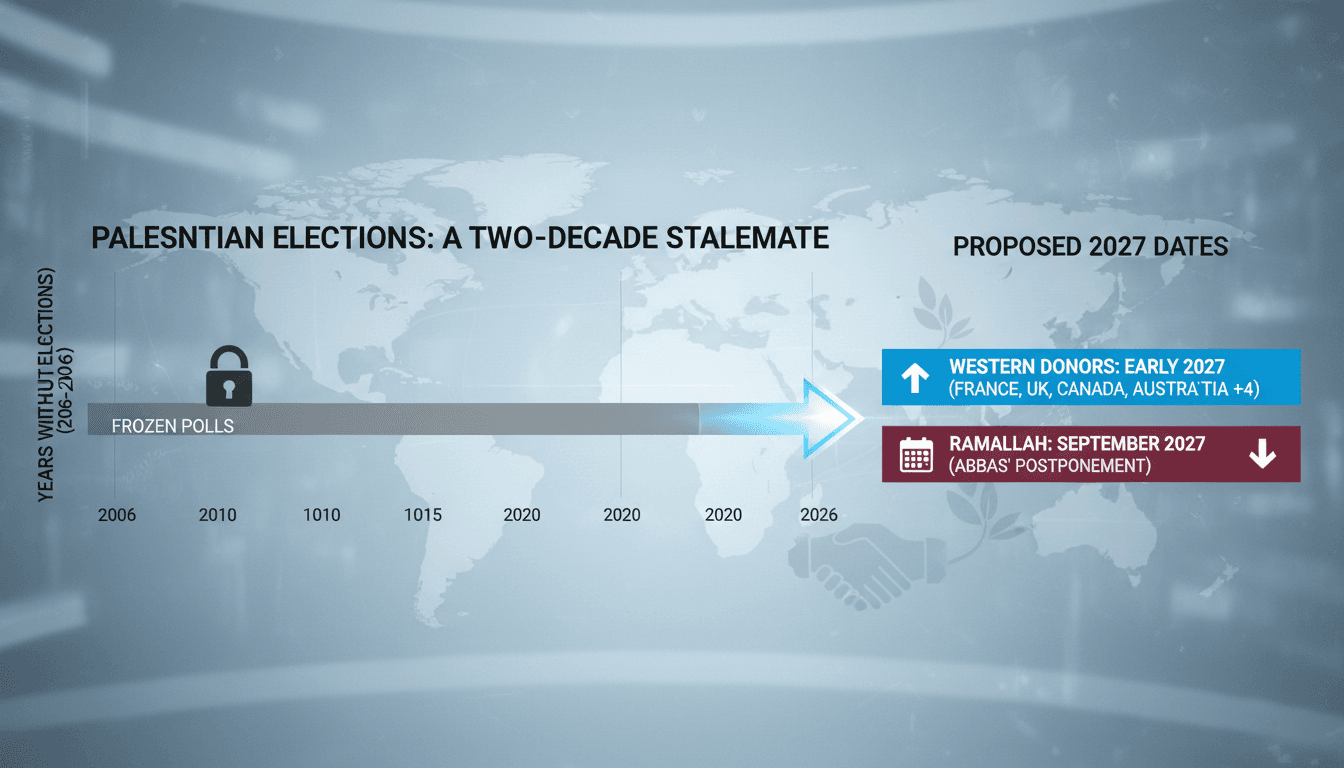
Why it matters
By formally linking bilateral support to an early 2027 electoral timetable, major Western donor nations have introduced concrete fiscal and governance benchmarks into Palestinian diplomacy.
What happened (in 30 seconds)
- A coordinated diplomatic call: On November 28, 2026, foreign ministers from eight countries—Australia, Belgium, Canada, France, Luxembourg, Norway, Poland, and the United Kingdom—issued a joint statement urging the Palestinian Authority to conduct national legislative and presidential elections during the first quarter of 2027.
- The missed deadline: The diplomatic statement was intentionally published via the French Ministry for Europe and Foreign Affairs on November 28, 2026, the exact date when postponed Palestinian legislative polls were originally scheduled to occur.
- Aid tied to democratic renewal: The coalition expressed regret over Palestinian President Mahmoud Abbas’s October 2026 decision to delay legislative and presidential voting until September 2027, explicitly warning that sustained international backing depends on verifiable institutional renewal.
The context you actually need
- A 20-year governance gap: The Palestinian Authority has not conducted national legislative or presidential elections since 2005 and 2006, leaving its executive and legislative bodies without fresh electoral mandates for two decades.
- The deferred calendar: In October 2026, President Abbas pushed the planned November 28 legislative vote back to September 11, 2027, synchronizing it with the presidential ballot and citing security conditions in Gaza alongside administrative measures implemented by Israel.
- Prior diplomatic commitments: The electoral mandate was previously affirmed when Abbas provided written assurances to French President Emmanuel Macron and Saudi Crown Prince Mohammed bin Salman, aligning election plans with France's official recognition of a Palestinian state in September 2025.
What's really happening
The joint communiqué delivered by the eight Western nations represents a calibrated pivot from open-ended diplomatic support to strict, timeline-driven conditionality. By issuing their call on the very day Palestinians were slated to vote, the foreign ministries of France, the United Kingdom, Canada, Australia, Belgium, Luxembourg, Norway, and Poland established a defined line: the political status quo will no longer guarantee uninterrupted institutional assistance.
At the core of this tension lies the institutional architecture of the Palestinian Authority itself. Having governed without a national popular vote since the 2005 presidential and 2006 legislative elections, the administration faces a dual-front legitimacy crisis. For Western capitals, the absence of fresh mandates weakens the structural case for an eventual two-state solution. In their operational assessment, an administration lacking refreshed representative credentials cannot credibly execute governance reforms, manage cross-border fiscal flows, or administer civil institutions throughout the occupied Palestinian territory.
However, the incentives governing Ramallah point in a different direction. President Mahmoud Abbas’s decision in October 2026 to push both legislative and presidential ballots to September 11, 2027, was framed around severe operational and logistical hurdles. The administration pointed directly to active security conditions in Gaza and movement restrictions across the West Bank and East Jerusalem. Israel, meanwhile, disputed any institutional responsibility for the delays.
This creates an immediate diplomatic impasse. While the Palestinian leadership seeks to minimize the political and security volatility associated with running nationwide polls under unstable conditions, Western backers view further delays as an unacceptable erosion of governance standards. The coalition’s joint statement urges all stakeholders, explicitly noting Israel, to facilitate voting across all occupied territories.
More crucially, the ministers have introduced economic leverage. By explicitly connecting continued international support to transparent electoral mechanics, the eight nations have signaled to institutional donors and non-governmental entities that future aid disbursements may become conditional on democratic progress. For global operators tracking diplomatic stability and sovereign funding flows in the Levant, this creates a measurable compliance window spanning the next 15 months: either the Palestinian Authority commits to ballot verification by March 2027, or its core international funding pipelines face systemic reassessment.
Who feels it first (and how)
- Palestinian Authority administrative planners: Civil servants and election officials face immediate diplomatic pressure to present operational frameworks for balloting by March 2027 despite security impediments.
- Development finance and multilateral aid directors: Program managers monitoring West Bank and Gaza stabilization funds must reassess timeline-based risk metrics as key donor states tether disbursements to democratic milestones.
- Diplomatic delegations in Paris, London, and Ottawa: Foreign policy teams must coordinate multilateral pressure and prepare contingent policy responses should the September 2027 postponement remain unchanged.
- Regional security and cross-border logistics operators: Field teams working across the Palestinian territories face prolonged procedural uncertainty regarding border access, administrative permissions, and municipal coordination.
What to watch next
- The Palestinian Authority's formal reply: Watch for whether President Abbas or the foreign ministry issues an official diplomatic response to the eight-nation statement, signaling willingness to reconsider the September 2027 delay.
- Donor coordination meetings in early 2027: Track upcoming multilateral funding rounds to see if France, the UK, or Norway operationalize the joint statement by adding formal conditionality clauses to aid packages.
- Israeli operational facilitations: Monitor administrative movements regarding voter registration access and polling infrastructure within East Jerusalem and across West Bank checkpoints.
Eight Western nations formally asked the Palestinian Authority on November 28, 2026, to hold elections in Q1 2027, expressing regret over Abbas’s postponement of votes to September 11, 2027.
Western donor nations will use scheduled diplomatic summits throughout 2027 to pressure regional stakeholders to clear logistical hurdles for voting.
Whether the Palestinian Authority will adjust its published September 2027 timetable, or how donor nations will alter financial transfers if the March 2027 timeline is missed.
Frequently Asked Questions
- Why it matters?
- By formally linking bilateral support to an early 2027 electoral timetable, major Western donor nations have introduced concrete fiscal and governance benchmarks into Palestinian diplomacy.
- What happened (in 30 seconds)?
- A coordinated diplomatic call: On November 28, 2026, foreign ministers from eight countries—Australia, Belgium, Canada, France, Luxembourg, Norway, Poland, and the United Kingdom—issued a joint statement urging the Palestinian Authority to conduct national legislative and presidential elections during the first quarter of 2027. The missed deadline: The diplomatic statement was intentionally published via the French Ministry for Europe and Foreign Affairs on November 28, 2026, the exact date when
- What's really happening?
- The joint communiqué delivered by the eight Western nations represents a calibrated pivot from open-ended diplomatic support to strict, timeline-driven conditionality. By issuing their call on the very day Palestinians were slated to vote, the foreign ministries of France, the United Kingdom, Canada, Australia, Belgium, Luxembourg, Norway, and Poland established a defined line: the political status quo will no longer guarantee uninterrupted institutional assistance. At the core of this tension
- Who feels it first (and how)?
- Palestinian Authority administrative planners: Civil servants and election officials face immediate diplomatic pressure to present operational frameworks for balloting by March 2027 despite security impediments. Development finance and multilateral aid directors: Program managers monitoring West Bank and Gaza stabilization funds must reassess timeline-based risk metrics as key donor states tether disbursements to democratic milestones. Diplomatic delegations in Paris, London, and Ottawa: Foreign
- What to watch next?
- The Palestinian Authority's formal reply: Watch for whether President Abbas or the foreign ministry issues an official diplomatic response to the eight-nation statement, signaling willingness to reconsider the September 2027 delay. Donor coordination meetings in early 2027: Track upcoming multilateral funding rounds to see if France, the UK, or Norway operationalize the joint statement by adding formal conditionality clauses to aid packages. Israeli operational facilitations: Monitor administrat
24/7 international news from a French perspective in multiple languages.
"France 24 is viewed as a globally focused outlet with balanced coverage and a European perspective."
— A47 Editor
France and seven other countries call for Palestinian elections in early 2027
France, the United Kingdom, Canada and five other countries on Saturday urged the Palestinian Authority to hold its delayed parliamentary and presidential elections by the end of March 2027. The call came in response to a decision by PA President Mah...
Regional coverage and analysis focused on politics, diplomacy, and business across the Middle East.
"Al-Monitor is known for analytical reporting on Middle East politics and policy developments."
— A47 Editor
Eight countries urge Palestinian Authority to hold elections by early 2027
Foreign ministers of Australia, Belgium, Canada, France, Luxembourg, Norway, Poland and the United Kingdom have called on the Palestinian Authority to hold legislative and presidential elections in the first quarter of 2027, according to a joint stat...
Arabic-language coverage of political affairs and current events.
"Okaz political coverage typically follows mainstream Saudi framing on national and regional affairs."
— A47 Editor
8 دول تضغط لإجراء انتخابات فلسطينية.. وعباس يحدد سبتمبر 2027 موعداً
Eight Western countries, namely Australia, Belgium, Canada, France, Luxembourg, Norway, Poland and the United Kingdom, issued a joint statement calling on the Palestinian Authority to hold presidential and legislative elections in the first quarter o...