
ACLU Sues Trump Administration Over Grand Jury Subpoenas Targeting Anonymous ICE Critics
Why it matters
The clash over digital anonymity and law enforcement demands creates an operational precedent for how tech platforms manage user disclosures under federal pressure.
What happened (in 30 seconds)
* A class-action challenge: On November 28, 2026, the American Civil Liberties Union unsealed a federal lawsuit in the District of Columbia challenging grand jury subpoenas issued under a federal program known as "Investigation 18." * Targeting anonymous speech: The litigation represents four anonymous users following at least 35 federal subpoenas issued to digital platforms, including Bluesky, X, and Meta, seeking to identify users who posted hostile statements about immigration authorities. * The named leadership: The lawsuit formally names Attorney General Todd Blanche, DHS Secretary Markwayne Mullin, and U.S. Attorney Jeanine Pirro as defendants before U.S. District Judge James Boasberg.
The context you actually need
* A recorded surge in workplace violence: Federal reports recorded 647 physical assaults against Immigration and Customs Enforcement (ICE) personnel between January 20, 2025, and September 20, 2026, representing a 1,600% increase over the 37 assaults documented in the prior equivalent period. * A pivot in legal instruments: Enforcement authorities initially deployed hundreds of administrative subpoenas in late 2025 to compel tech firms to disclose account owners, but shifted toward grand jury subpoenas following initial platform and legal pushback. * Secrecy versus constitutional protections: Grand jury proceedings operate under strict secrecy requirements, creating an institutional dispute between federal security prerogatives and First and Fourth Amendment shields for protected political rhetoric.
What's really happening
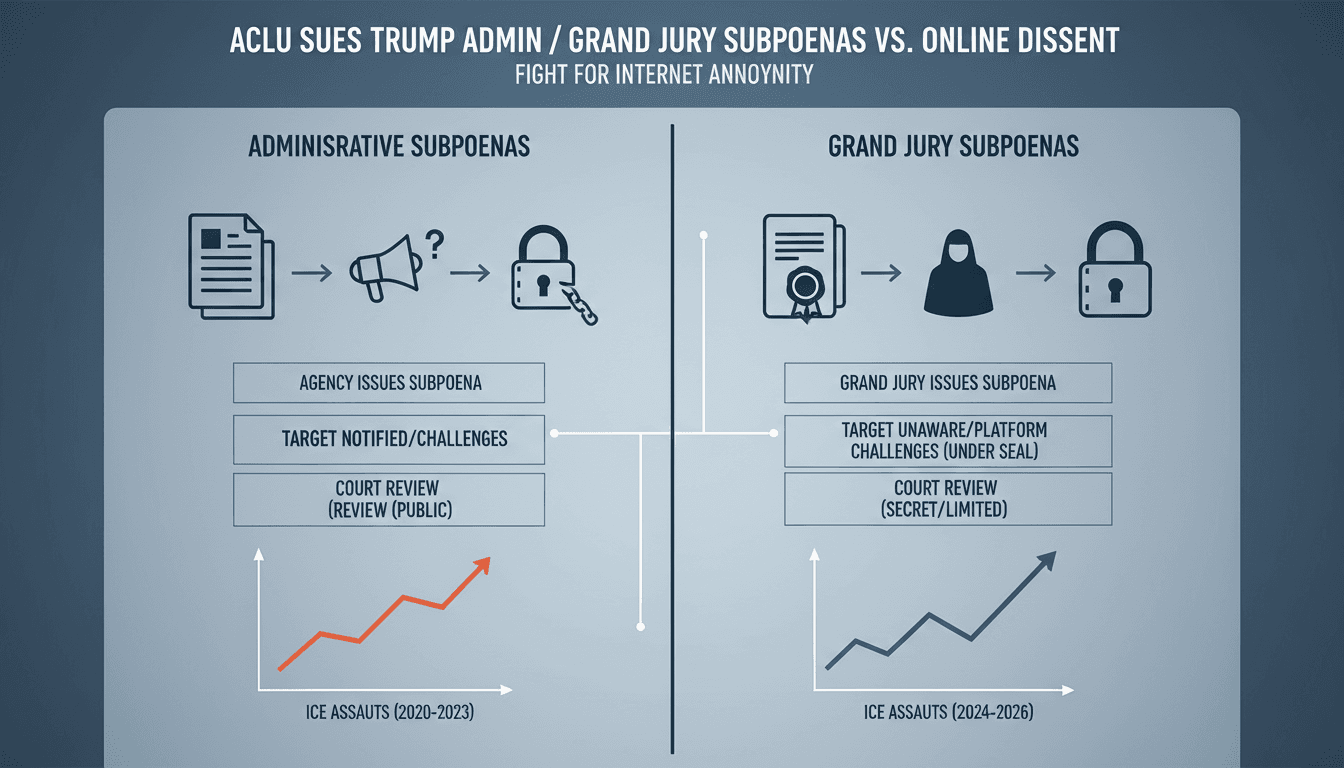
The core tension in this litigation lies in the mechanism federal investigators choose to uncover online identities. When regulatory or law enforcement agencies track potential operational threats, their legal toolkit dictates how much oversight private firms can exercise. Administrative subpoenas allow recipients to push back openly in civil court; grand jury subpoenas, by contrast, carry strict legal secrecy mandates and severe compliance burdens.
The institutional rationale on the enforcement side centers on risk mitigation. Following a documented 1,600% increase in assaults on field agents—rising from 37 incidents to 647 across parallel 20-month periods—the Department of Homeland Security identified hostile digital speech as a threat vector tied to real-world operational hazards. When public communications cross into violent phrasing, such as declarations to burn facilities or harm personnel, investigators view unmasking account owners as an investigative necessity rather than routine intelligence gathering.
For digital platforms, the structural friction is operational and jurisdictional. Social media operators like Meta, X, and Bluesky depend on predictable legal standards to balance user trust against statutory compliance. When an administration transitions from standard administrative requests to criminal grand jury instruments, platforms face a tighter legal corridor. Resisting a grand jury subpoena demands significant litigation resources, while compliance risks eroding user privacy guarantees. Several platforms have already complied with past requests, establishing uneven precedents across the digital ecosystem.
The plaintiffs, through the ACLU, are pursuing an injunctive mechanism designed to quash existing subpoenas and compel the purge of previously obtained records. By presenting the case to Judge James Boasberg, the legal strategy attempts to establish that sweeping grand jury inquiries cannot be deployed systematically across groups of anonymous speakers without showing individualized criminal intent. This litigation effectively tests where the boundary lies between non-actionable hyperbole and prosecutable threats in high-enforcement environments.
Who feels it first (and how)
* Platform Trust & Safety and Legal Counsel: Facing immediate compliance costs and difficult technical determinations when served with sealed federal data demands. * Anonymous Digital Commentators: Encountering reduced confidence in pseudonymity protections across public-facing social networks. * Federal Law Enforcement Agencies: Risking the curtailment of an investigative workflow aimed at mitigating field security threats if the court limits subpoena powers.
What to watch next
* The preliminary injunction proceedings: Scheduled for January 6, 2027, this hearing before Judge James Boasberg will signal the court's view on the legality of Investigation 18. * Department of Justice filings: Formal legal responses from Todd Blanche and Jeanine Pirro will reveal the evidentiary threshold used to classify specific posts as criminal threats. * Platform terms of service adjustments: Revisions by tech firms regarding how, when, and whether they notify end users about government requests for identity records.
The ACLU filed a class-action suit on November 16, 2026, unsealed on November 28, targeting at least 35 grand jury subpoenas issued under Investigation 18 to platforms like Bluesky, X, and Meta.
The Department of Justice will argue that heightened field assaults (647 incidents over 20 months) provide sufficient legal justification to investigate threatening online statements.
Whether Judge Boasberg will grant the preliminary injunction ordering the purging of previously surrendered user data from federal databases.
Frequently Asked Questions
- Why it matters?
- The clash over digital anonymity and law enforcement demands creates an operational precedent for how tech platforms manage user disclosures under federal pressure.
- What happened (in 30 seconds)?
- A class-action challenge: On November 28, 2026, the American Civil Liberties Union unsealed a federal lawsuit in the District of Columbia challenging grand jury subpoenas issued under a federal program known as "Investigation 18." Targeting anonymous speech: The litigation represents four anonymous users following at least 35 federal subpoenas issued to digital platforms, including Bluesky, X, and Meta, seeking to identify users who posted hostile statements about immigration authorities. The na
- What's really happening?
- The core tension in this litigation lies in the mechanism federal investigators choose to uncover online identities. When regulatory or law enforcement agencies track potential operational threats, their legal toolkit dictates how much oversight private firms can exercise. Administrative subpoenas allow recipients to push back openly in civil court; grand jury subpoenas, by contrast, carry strict legal secrecy mandates and severe compliance burdens. The institutional rationale on the enforcemen
- Who feels it first (and how)?
- Platform Trust & Safety and Legal Counsel: Facing immediate compliance costs and difficult technical determinations when served with sealed federal data demands. Anonymous Digital Commentators: Encountering reduced confidence in pseudonymity protections across public-facing social networks. Federal Law Enforcement Agencies: Risking the curtailment of an investigative workflow aimed at mitigating field security threats if the court limits subpoena powers.
- What to watch next?
- The preliminary injunction proceedings: Scheduled for January 6, 2027, this hearing before Judge James Boasberg will signal the court's view on the legality of Investigation 18. Department of Justice filings: Formal legal responses from Todd Blanche and Jeanine Pirro will reveal the evidentiary threshold used to classify specific posts as criminal threats. Platform terms of service adjustments: Revisions by tech firms regarding how, when, and whether they notify end users about government reques
Conservative-leaning coverage of current events.
"Fox News is a highly influential conservative news outlet known for right-leaning political commentary and coverage."
— A47 Editor
Trump admin sued over bid to unmask ICE critics, including one who wrote 'I want to kill ICE'
The American Civil Liberties Union has sued the Trump administration, alleging that grand jury subpoenas issued under "Investigation 18" seek to unmask anonymous critics of Immigration and Customs Enforcement (ICE), including one account that posted ...
Global news coverage with extensive reporting on Middle Eastern conflicts and geopolitics.
"Al Jazeera is a Qatar-based broadcaster known for wide regional coverage and alternative perspectives."
— A47 Editor
US civil rights group challenges ICE subpoenas as attack on speech
The American Civil Liberties Union has filed a lawsuit challenging subpoenas issued by U.S. Immigration and Customs Enforcement (ICE), arguing that the requests violate First Amendment protections by targeting anonymous individuals who have criticize...
Comprehensive coverage of Middle Eastern and global issues.
"Al Jazeera is a prominent voice from the Global South, especially the Middle East, with an emphasis on underreported stories."
— A47 Editor
US civil rights group challenges ICE subpoenas as attack on speech
The American Civil Liberties Union has filed a lawsuit challenging subpoenas issued by U.S. Immigration and Customs Enforcement (ICE), arguing that the requests violate First Amendment protections by targeting anonymous individuals who have criticize...
Capitol Hill news, legislation, and policy insight.
"The Hill specializes in U.S. politics and policy, with a focus on Capitol Hill developments and a reputation for insider reporting."
— A47 Editor
ACLU sues Trump administration over investigations into online ICE critics
The American Civil Liberties Union filed a class action lawsuit in federal court on behalf of four unnamed social media users, seeking to stop the Trump administration from investigating anonymous online accounts that have criticized Immigration and ...