
Swiss Voters Approve Easing of Arms Export Restrictions in Referendum
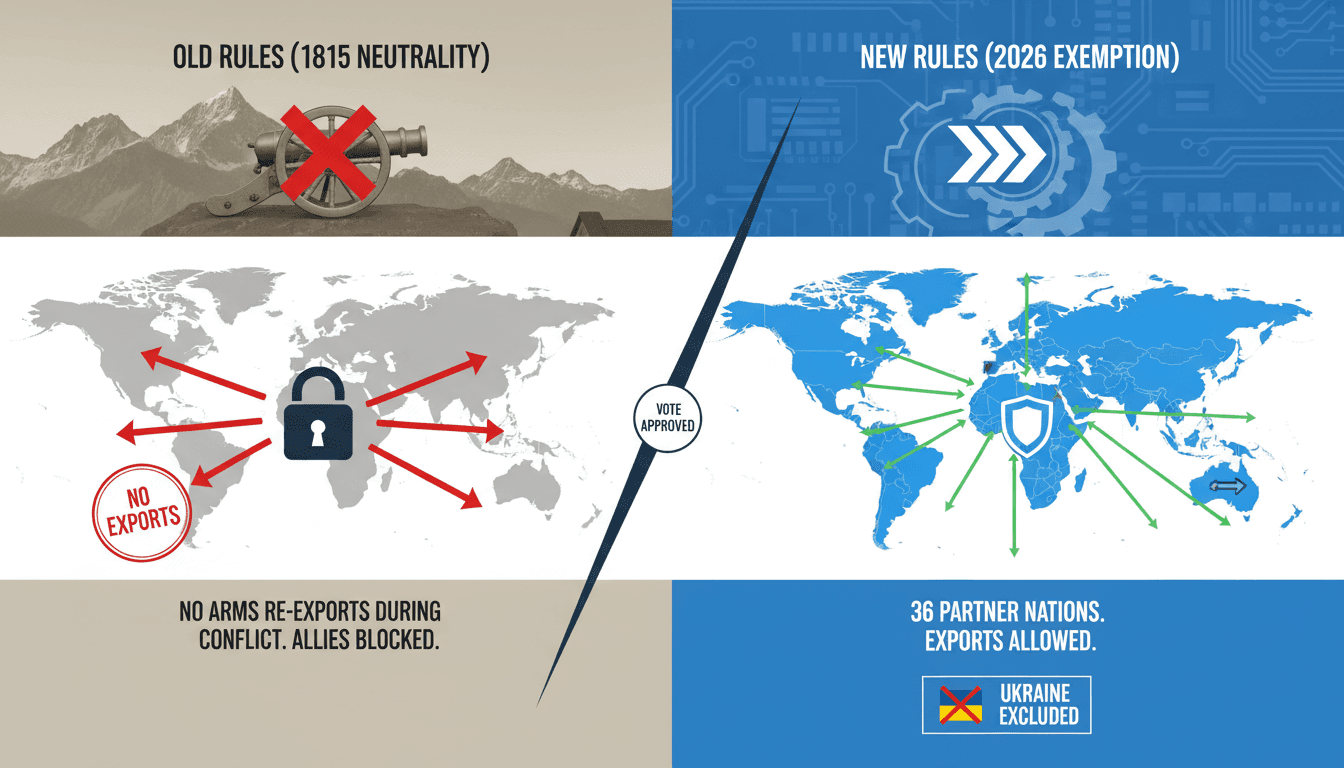
Why it matters
The 54.3 percent referendum outcome removes mandatory re-export approvals for key Western purchasers, stabilizing Switzerland's domestic industrial base against cross-border production flight while recalibrating two centuries of neutral defense doctrine.
What happened (in 30 seconds)
- Voters approved legal revisions: On November 29, 2026, 54.3 percent of Swiss voters backed statutory amendments to the War Materiel Act, loosening long-standing constraints on defense exports.
- Rules eased for 36 partner nations: Swiss manufacturers can now export defense equipment to 36 designated states—including EU and EFTA members, the United States, the United Kingdom, Canada, Australia, Japan, New Zealand, and Argentina—even during active conflicts, provided exports align with international obligations.
- Ukraine remains explicitly carved out: Under pressure from parliamentary factions including the Swiss People’s Party, Ukraine remains barred from receiving these direct arms flows under the updated legal structure.
The context you actually need
- Neutrality dates back to 1815: Switzerland's standard of permanent armed neutrality, formally recognized at the Congress of Vienna, historically prohibited arms deliveries to combatant nations and mandated strict buyer consent for any subsequent re-export.
- The 2022 supply chain rupture: Following the 2022 invasion of Ukraine, Bern blocked European partners from transferring Swiss-origin military materiel (such as Leopard 1 tanks), causing direct friction with European purchasers who subsequently bypassed Swiss contractors.
- Industrial relocation threats mounted: Faced with contractual exclusions across Europe, Swiss defense manufacturers increasingly planned relocations outside the country, prompting Parliament to pass reform legislation in December 2025 that opponents challenged at the ballot box.
What's really happening
The core driver behind the November 2026 vote is industrial economics, not geopolitical posturing. For an advanced manufacturing nation, defense output cannot survive purely on domestic procurement. Switzerland’s armed forces do not possess the capital expenditure volume necessary to sustain high-tech domestic arms manufacturers, optical component builders, or munitions producers on their own. To keep unit costs viable, Swiss manufacturers require access to foreign export markets.
Under the pre-existing framework of the War Materiel Act, Swiss manufacturers operated under a distinct commercial disadvantage. Every defense contract came bundled with a blanket restriction: should the client state enter an armed conflict, Swiss supply chains would freeze, and any secondary transfer of Swiss-made components to a third party required Bern’s explicit authorization. When European nations sought to re-export existing stockpiles of Swiss equipment to Ukraine after 2022, Bern enforced its legal neutrality mandate.
The market response was immediate. European defense ministries began inserting clauses into procurement tenders that explicitly excluded components subject to Swiss export vetos. For Swiss defense firms, remaining under those restrictions meant losing integration into multinational consortia. Several manufacturers initiated capital relocation, moving production lines to jurisdictions like Germany, France, and the United States to preserve their access to NATO-adjacent procurement programs.
The December 2025 parliamentary compromise, ratified by 54.3 percent of the electorate, re-engineers this commercial incentive structure. By pre-authorizing exports and waiving routine re-export consent for 36 designated partner economies—predominantly EU/EFTA allies and Western Pacific partners like Japan and Australia—Switzerland restores supply chain reliability for its industrial base. European defense integrators can once again source Swiss components without risking legal bottlenecks during allied defense mobilizations.
Yet the compromise imposes structural limits. The carve-out maintaining the ban on direct transfers to Ukraine highlights the domestic political friction between pure legal neutrality and commercial integration. Swiss policymakers navigated this balance by providing regulatory certainty to sovereign treaty partners while preserving a baseline legal distinction: Switzerland will service the defense needs of its established trading network, but it will not engage in targeted wartime re-supply to active non-treaty combatants outside this framework.
Who feels it first (and how)
- Swiss defense manufacturers and precision engineering firms: Engineering teams and executive boards gain contract stability, reducing capital expenditure requirements for setting up duplicate production facilities abroad.
- European defense ministries: Procurement officers in Germany, the UK, and neighboring EU states regain access to Swiss supply chains without the friction of conditional re-export vetoes.
- International trade compliance officers: Legal teams managing cross-border military and dual-use equipment will manage streamlined compliance protocols when routing components through the 36 designated partner territories.
- Non-designated third-party states: Nations outside the approved 36-country framework face unchanged, strict non-export protocols, ensuring Swiss neutrality remains intact for non-aligned markets.
What to watch next
- Federal Council administrative timelines: Watch for the Swiss Federal Council’s official schedule for codifying the War Materiel Act revisions into actionable administrative ordinances.
- European defense procurement tenders: Monitor whether tier-one European defense contractors resume bidding with Swiss subcontractors in major allied equipment programs.
- Parliamentary monitoring of the 36-nation roster: Track whether shifting international alignments prompt parliamentary efforts to expand, amend, or restrict the roster of designated partner countries.
Swiss voters approved the War Materiel Act reforms with 54.3 percent of the vote on November 29, 2026, creating an exemption for 36 partner nations while maintaining a strict exclusion for Ukraine.
The regulatory certainty will stem the outflow of Swiss defense manufacturing capital and personnel into neighboring EU jurisdictions.
How Swiss export regulators will resolve edge cases where Swiss-made subsystems embedded within foreign systems are transferred to conflict zones outside the approved 36-nation list.
Frequently Asked Questions
- Why it matters?
- The 54.3 percent referendum outcome removes mandatory re-export approvals for key Western purchasers, stabilizing Switzerland's domestic industrial base against cross-border production flight while recalibrating two centuries of neutral defense doctrine.
- What happened (in 30 seconds)?
- Voters approved legal revisions: On November 29, 2026, 54.3 percent of Swiss voters backed statutory amendments to the War Materiel Act, loosening long-standing constraints on defense exports. Rules eased for 36 partner nations: Swiss manufacturers can now export defense equipment to 36 designated states—including EU and EFTA members, the United States, the United Kingdom, Canada, Australia, Japan, New Zealand, and Argentina—even during active conflicts, provided exports align with international
- What's really happening?
- The core driver behind the November 2026 vote is industrial economics, not geopolitical posturing. For an advanced manufacturing nation, defense output cannot survive purely on domestic procurement. Switzerland’s armed forces do not possess the capital expenditure volume necessary to sustain high-tech domestic arms manufacturers, optical component builders, or munitions producers on their own. To keep unit costs viable, Swiss manufacturers require access to foreign export markets. Under the pre
- Who feels it first (and how)?
- Swiss defense manufacturers and precision engineering firms: Engineering teams and executive boards gain contract stability, reducing capital expenditure requirements for setting up duplicate production facilities abroad. European defense ministries: Procurement officers in Germany, the UK, and neighboring EU states regain access to Swiss supply chains without the friction of conditional re-export vetoes. International trade compliance officers: Legal teams managing cross-border military and dua
- What to watch next?
- Federal Council administrative timelines: Watch for the Swiss Federal Council’s official schedule for codifying the War Materiel Act revisions into actionable administrative ordinances. European defense procurement tenders: Monitor whether tier-one European defense contractors resume bidding with Swiss subcontractors in major allied equipment programs. Parliamentary monitoring of the 36-nation roster: Track whether shifting international alignments prompt parliamentary efforts to expand, amend,
Editor-curated FT homepage stories spanning markets, business, world, and opinion.
"The Financial Times is a globally respected business publication with a centrist/center-left tone and strong markets focus."
— A47 Editor
Switzerland votes to ease strict arms export laws
Switzerland has voted to ease its strict arms export laws, with more than 54% of voters backing relaxed rules on where weapons can be sold and how buyers may use them.
International coverage of politics, culture, and current affairs.
"BBC News is widely regarded as a reputable international news organization, known for its impartial tone and public service mandate."
— A47 Editor
Switzerland votes to ease strict arms export rules
Switzerland has voted to ease its strict rules on arms exports, a move that will allow arms sales to 36 Western countries even if they are engaged in armed conflict, according to reporting by BBC News. The change has drawn opposition from critics who...
Arabic-language coverage of international news and geopolitics.
"RT Arabic is a Russian state-funded outlet often criticized for promoting Kremlin-aligned narratives."
— A47 Editor
تقارير أولية: الناخبون السويسريون يؤيدون تخفيف قواعد تصدير الأسلحة
Preliminary estimates indicate that Swiss voters approved easing restrictions on arms exports in a referendum held on Sunday, a sensitive issue touching on the country's traditional neutrality and the future of its defense industry.