
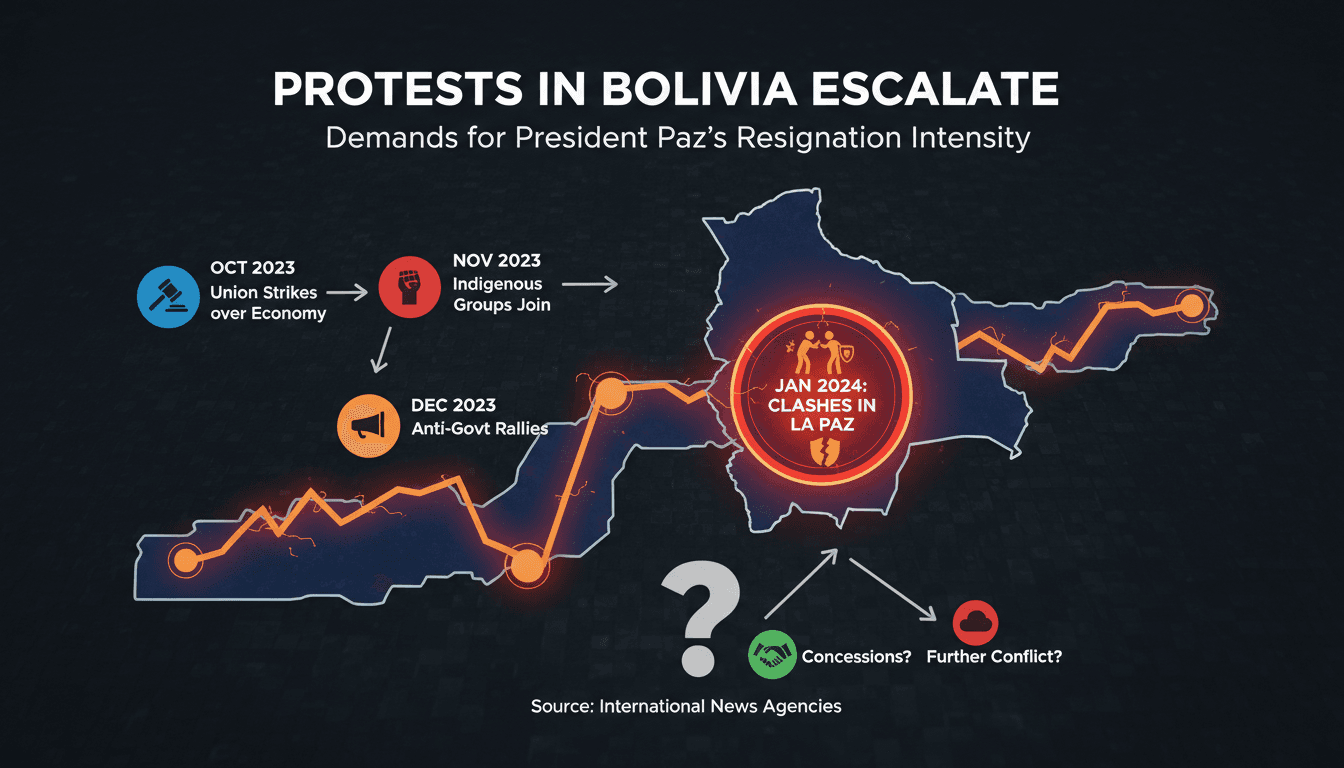
Protests in Bolivia escalate as demands for President Paz's resignation intensify
Here's what it means for you.
The escalating protests in Bolivia signal a critical moment for the country's political landscape. As unions and Indigenous groups rally against President Rodrigo Paz, the government's response will be pivotal in shaping public sentiment and stability. The potential for further unrest could impact economic conditions and governance in the region, making it essential for stakeholders to monitor developments closely. The situation underscores the growing discontent among various societal groups, which could lead to broader implications for policy and governance. As opposition movements gain traction, the Bolivian government may face increasing pressure to address the underlying grievances.
What happened
Protests erupted in La Paz as demonstrators clashed with police, demanding the resignation of President Rodrigo Paz. This unrest marks the second confrontation between protesters and law enforcement within a week, highlighting the rising tensions in the capital. Demonstrators gathered near the presidential palace, signaling a direct challenge to the government’s authority.
Riot police were deployed to manage the situation, reflecting the government's attempt to maintain order amid escalating protests. The clashes illustrate the deep-seated discontent among the populace, particularly among unions and Indigenous groups.
The Context
The protests are primarily led by unions and Indigenous groups, who have voiced their dissatisfaction with President Paz's administration. This unrest is not an isolated incident; it represents a broader movement against the government, fueled by longstanding grievances. The timing of these protests is critical, as they coincide with a period of heightened political sensitivity in Bolivia.
The recent clashes indicate a significant shift in public sentiment, with demonstrators feeling emboldened to confront the government directly. The situation is further complicated by the historical context of social and political tensions in Bolivia, making it a focal point for potential conflict.
Takeaway
As the protests continue, the Bolivian government faces substantial pressure to respond to the demonstrators' demands. The outcome of this unrest could lead to either concessions from the government or further escalation of violence. Observers should monitor the government's actions closely, as they will be crucial in determining the future stability of the region.
The potential for further protests in other areas of Bolivia remains high, suggesting that the opposition groups are mobilizing effectively. The situation warrants attention as it unfolds, given its implications for governance and social cohesion in the country.
Global news coverage with extensive reporting on Middle Eastern conflicts and geopolitics.
"Al Jazeera is a Qatar-based broadcaster known for wide regional coverage and alternative perspectives."
— A47 Editor
Tensions rise in Bolivia as protesters march toward presidential palace
Tensions escalated in Bolivia as thousands of protesters marched toward the presidential palace in La Paz, demanding the resignation of President Rodrigo Paz amid a severe economic crisis. Police maintained blockades to control the situation, reflect...
Comprehensive coverage of Middle Eastern and global issues.
"Al Jazeera is a prominent voice from the Global South, especially the Middle East, with an emphasis on underreported stories."
— A47 Editor
Tensions rise in Bolivia as protesters march toward presidential palace
Tensions escalated in Bolivia as thousands of protesters marched toward the presidential palace in La Paz, demanding the resignation of President Rodrigo Paz amid a severe economic crisis. Police maintained blockades to control the situation, reflect...
News across North, Central, and South America including politics and economics.
"France 24 is viewed as a globally focused outlet with balanced coverage and a European perspective."
— A47 Editor
Police, protesters clash in new marches against Bolivian leader
Bolivian riot police clashed with anti-government protesters in La Paz on Friday, marking the second confrontation in a week as unions and Indigenous groups intensified their demands for President Rodrigo Paz to resign amid ongoing unrest. The protes...
Pan-Arab news coverage spanning politics, business, sports, and regional affairs.
"Asharq Al-Awsat reflects a broad Arab editorial perspective with strong attention to regional geopolitics."
— A47 Editor
اشتباكات بين الشرطة ومتظاهرين ضد الرئيس البوليفي في لاباز
In La Paz, Bolivia, clashes erupted between riot police and anti-government protesters on Friday, marking the second such incident within a week. The confrontations highlight ongoing tensions in the country as citizens express their dissatisfaction w...