
Death of Iran's Supreme Leader Ali Khamenei Triggers National Mourning and Regional Tensions
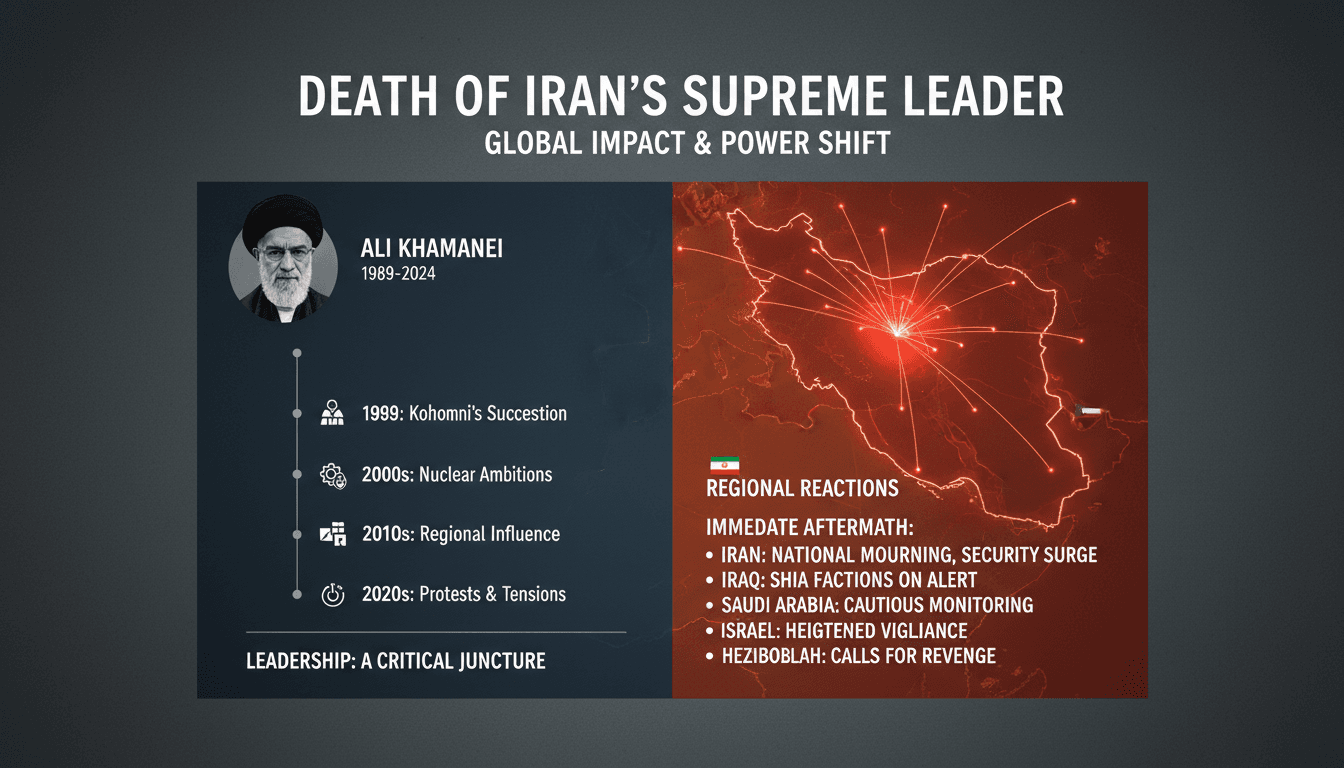
Here's what it means for you.
The death of Supreme Leader Ali Khamenei marks a pivotal moment in Iran's political landscape, with potential ramifications for both domestic stability and regional dynamics. As the Iranian government navigates this leadership transition, the calls for revenge from officials may escalate tensions within the country and beyond. Stakeholders should closely monitor how these developments influence Iran's foreign policy and its relationships with neighboring nations.
What happened
The funeral of Iran's Supreme Leader Ali Khamenei has drawn large crowds in cities like Qom, reflecting widespread public mourning. As his body arrives in Iraq for the funeral proceedings, the event is being utilized by the Iranian government to project its regional influence. Heightened security measures have been implemented to manage the narrative surrounding this significant event, indicating the government's desire to control public sentiment during this transitional period.
Calls for revenge have emerged from senior Iranian officials, underscoring the political tensions that accompany Khamenei's death. This combination of mourning and calls for retribution highlights the complexities of Iran's internal and external challenges as the nation grapples with the implications of losing its Supreme Leader.
The Context
Khamenei's death represents a significant moment in Iranian politics, as he held a position of immense power and influence in the region. The Iranian government is keenly aware of the need to maintain stability during this leadership transition, which is why security measures have been heightened. Public displays of mourning are intertwined with political rhetoric, reflecting the underlying tensions that may shape Iran's future.
The timing of Khamenei's funeral is critical, as it coincides with a period of uncertainty regarding Iran's domestic policies and its role in regional affairs. The government's efforts to control the narrative surrounding the funeral are indicative of the high stakes involved, as they seek to manage both public sentiment and international perceptions.
Takeaway
The aftermath of Khamenei's death will likely shape Iran's domestic and foreign policies in the coming months. Observers should watch for potential shifts in leadership dynamics within Iran, as various factions vie for influence during this transitional period. Additionally, responses from regional powers will be crucial in determining how Iran's evolving political landscape impacts its relationships with neighboring countries.
As the situation unfolds, the implications for both domestic stability and regional relations will be closely monitored, particularly in light of the calls for revenge and the government's narrative management efforts. The coming weeks will be critical in understanding the future trajectory of Iran under new leadership.
UAE-based English-language newspaper covering regional politics, economics, and global affairs.
"The National reflects Emirati policy perspectives while maintaining international editorial standards."
— A47 Editor
Khamenei’s body arrives in Iraq, turning shrines into venues for Tehran’s regional message
The body of Iran's late Supreme Leader, Ali Khamenei, has arrived in Iraq, where funeral ceremonies are set to take place in the revered cities of Najaf and Karbala. This follows a week of state mourning that began on July 3, 2026, after Khamenei was...
Regional and international reporting focused on Middle Eastern politics, diplomacy, and economics.
"Asharq Al-Awsat is a Saudi-owned international newspaper reflecting mainstream Gulf political perspectives."
— A47 Editor
Crowds Bid Farewell to Khamenei in Iranian City of Qom
Tens of thousands of mourners gathered in the holy city of Qom to bid farewell to Iran's late Supreme Leader, Ali Khamenei, whose coffin arrived following a week of state funeral ceremonies that began in Tehran on July 3, 2026. The ceremonies were in...
Regional and international reporting focused on Middle Eastern politics, diplomacy, and economics.
"Asharq Al-Awsat is a Saudi-owned international newspaper reflecting mainstream Gulf political perspectives."
— A47 Editor
Iran Issues Security Directives to Control Narrative Around Khamenei Funeral
Iran has issued security directives to manage the narrative surrounding the funeral of Supreme Leader Ali Khamenei, who was assassinated in a U.S.-Israeli airstrike on February 28, 2026. The week-long state funeral commenced on July 3, 2026, in Tehra...
Regional and international reporting focused on Middle Eastern politics, diplomacy, and economics.
"Asharq Al-Awsat is a Saudi-owned international newspaper reflecting mainstream Gulf political perspectives."
— A47 Editor
Calls for Revenge as Senior Iranian Officials Appear in Public for Supreme Leader’s Funeral
A week-long state funeral for Iran's late Supreme Leader, Ayatollah Ali Khamenei, commenced on July 3, 2026, following his assassination in a U.S.-Israeli airstrike. Senior Iranian officials have made public appearances during the ceremonies, which a...