
Discovery of 59,000-Year-Old Neanderthal Tooth Reveals Early Dental Practices
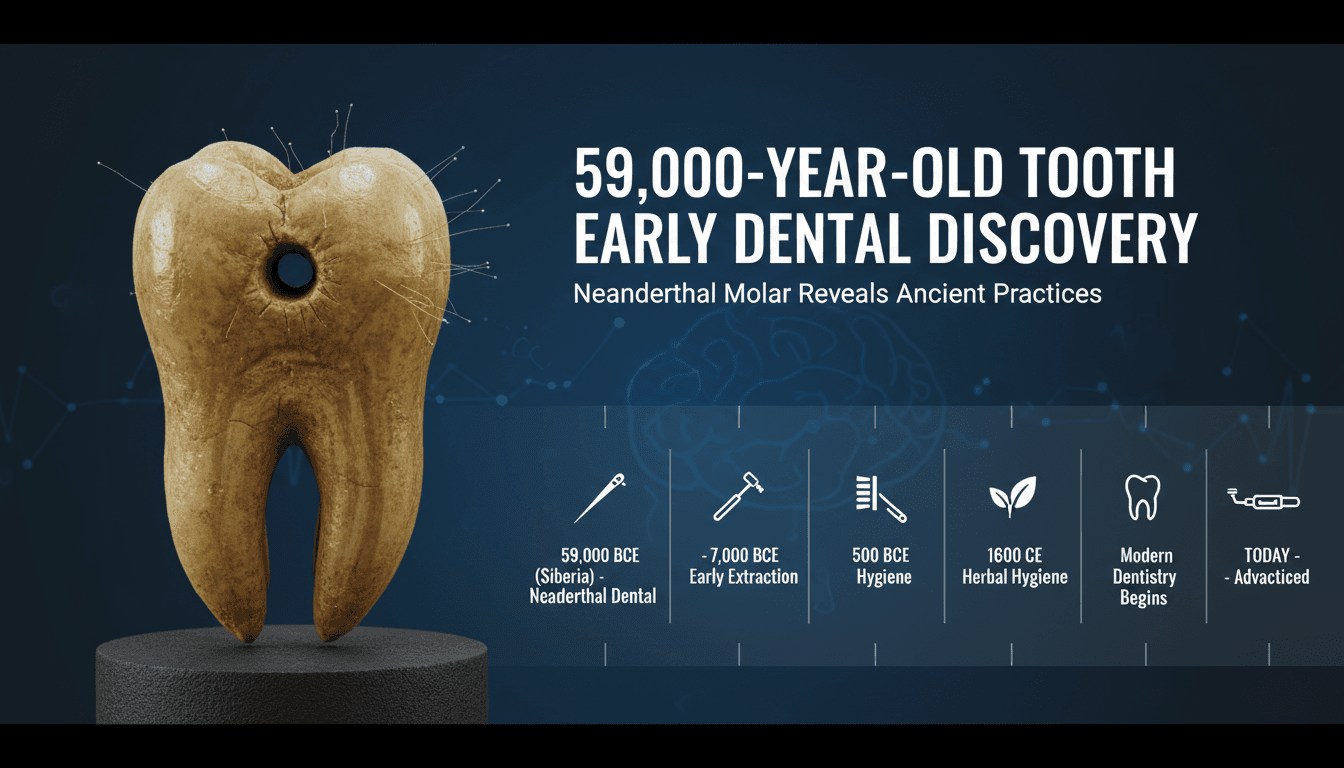
Here's what it means for you.
This groundbreaking discovery challenges our understanding of Neanderthal intelligence and health care practices.
What happened
Researchers found a Neanderthal tooth with signs of drilling, indicating early dental intervention.
The Context
- The tooth was found in a cave in southern Siberia.
- Experts are divided on the interpretation of the findings, with some expressing skepticism.
- This discovery pushes back the timeline of known dental practices among early humans.
Takeaway
This finding may reshape our understanding of Neanderthal capabilities and their approach to health care.
Discoveries, research, environment, and health innovations.
"New Scientist is a well-respected publication offering accessible science news, commentary, and expert analysis."
— A47 Editor
Neanderthals treated a dental cavity by drilling into the tooth
A recent discovery has revealed that Neanderthals practiced early dentistry by drilling into a tooth to treat bacterial decay, dating back at least 59,000 years. This finding, highlighted in a Neanderthal molar from Siberia, indicates that these anci...
Reports on science policy, discoveries, and public debate in the scientific realm.
"The Guardian’s science section is known for thoughtful and critical reporting on global research, ethics, and public understanding of science."
— A47 Editor
Neanderthals used stone drills to treat cavities 59,000 years ago, tooth suggests
Neanderthals are believed to have used stone drills to treat dental cavities nearly 60,000 years ago, as evidenced by a molar discovered in a cave in southern Siberia. The tooth features a deep hole likely created with a sharp, thin stone tool during...
Top international stories selected by The Guardian editors.
"The Guardian is known for its progressive editorial stance and in-depth analysis."
— A47 Editor
Neanderthals used stone drills to treat cavities 59,000 years ago, tooth suggests
Neanderthals are believed to have used stone drills to treat dental cavities nearly 60,000 years ago, as evidenced by a molar discovered in a cave in southern Siberia. The tooth features a deep hole likely created with a sharp, thin stone tool during...
Scientific discoveries, health, technology, and natural phenomena.
"Live Science reports on scientific discoveries, health, technology, and natural phenomena with a popular science tone."
— A47 Editor
'Exceptional' drilled tooth reveals Neanderthals practiced dentistry in Siberia 60,000 years ago
A recent discovery in Siberia has revealed a 60,000-year-old Neanderthal tooth featuring a hole likely made by a stone drill, marking the oldest evidence of intentional dentistry known to date. This finding suggests that Neanderthals engaged in advan...
Science and technology stories including AI.
"Longstanding science magazine with thoughtful AI coverage."
— A47 Editor
59,000-year-old Neanderthal tooth may be oldest evidence of dentistry
Archaeologists have analyzed a 59,000-year-old Neanderthal molar that appears to have been intentionally drilled, suggesting early forms of dental practices among prehistoric humans. This finding raises questions about the sophistication of Neanderth...
Scientific research, technology, environment, and society.
"Scientific American is one of the oldest and most authoritative science magazines, known for deep dives into science, technology, and society."
— A47 Editor
59,000-year-old Neanderthal tooth may be oldest evidence of dentistry
Archaeologists have analyzed a 59,000-year-old Neanderthal molar that appears to have been intentionally drilled, suggesting early forms of dental practices among prehistoric humans. This finding raises questions about the sophistication of Neanderth...