
U.S. and Iran Exchange Military Strikes Amid Rising Tensions
Here's what it means for you.
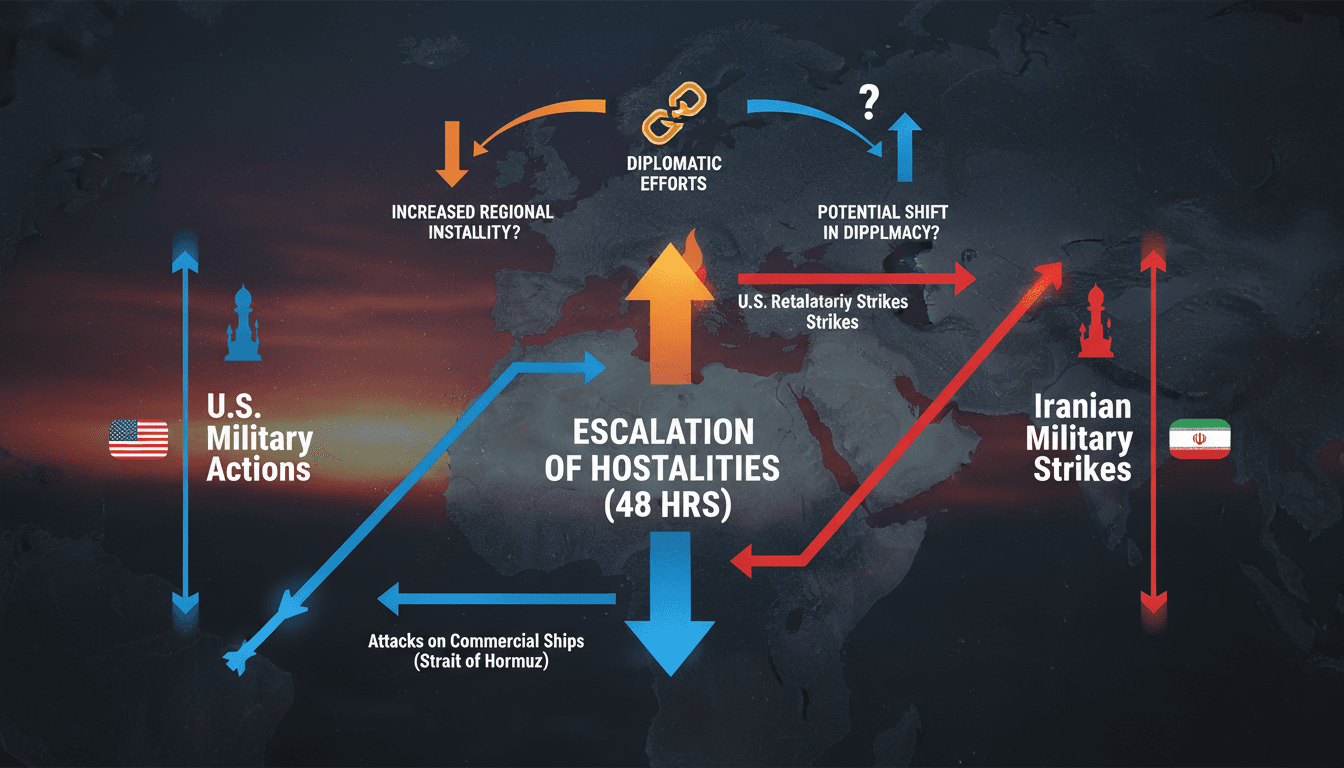
The recent military exchanges between the U.S. and Iran signal a significant escalation in hostilities that could impact global markets, particularly in oil. Investors should remain vigilant as the situation may lead to increased volatility in energy prices. Additionally, policymakers will need to navigate the delicate balance between military action and diplomatic efforts to prevent further escalation. The potential for broader regional instability raises concerns for international relations and trade routes, especially in the strategically vital Strait of Hormuz. Stakeholders across various sectors should prepare for possible shifts in U.S. foreign policy and military strategy in the coming days.
What happened
In the past 48 hours, the U.S. and Iran have engaged in military strikes, marking a significant escalation in their ongoing conflict. President Trump has warned of further U.S. military actions in response to these hostilities. The exchanges of strikes are a direct reaction to recent attacks on commercial ships in the Strait of Hormuz, a critical maritime route for global oil shipments.
Despite the rising tensions, Trump has expressed skepticism about the likelihood of a full-scale war erupting. He believes that Iran may be eager to deescalate tensions and return to negotiations, although the situation remains precarious. The number of military strikes exchanged between the two nations stands at two, highlighting the urgency of the conflict.
The Context
The conflict between the U.S. and Iran has deep historical roots, but recent events have intensified the situation significantly. The attacks on commercial vessels in the Strait of Hormuz have raised alarms about the safety of international shipping and the potential for broader military engagement. The U.S. military's retaliatory strikes are part of a strategy to deter further Iranian aggression.
President Trump's administration is navigating a complex landscape where military action and diplomatic negotiations must coexist. The timing of these strikes coincides with ongoing discussions about Iran's nuclear program and its influence in the region. As both nations engage in tit-for-tat actions, the potential for miscalculation increases, raising the stakes for all involved.
Takeaway
As tensions continue to rise, the potential for further military engagement remains high. Observers should monitor any new military actions from the U.S. in response to Iranian provocations, as well as any diplomatic efforts aimed at deescalating the situation. The outlook remains uncertain, but the possibility of a broader conflict in the Middle East looms large.
The situation is fluid, and stakeholders should stay informed about developments that could impact regional stability and global markets. The interplay between military actions and diplomatic negotiations will be crucial in determining the future trajectory of U.S.-Iran relations.
Conservative-leaning political and national coverage.
"The Washington Times is a conservative-leaning newspaper known for its political coverage and advocacy of right-of-center viewpoints."
— A47 Editor
Trump says he does not know if U.S. is returning to full-scale war with Iran
President Trump has expressed uncertainty regarding the potential return of the U.S. to full-scale war with Iran, amidst escalating tensions marked by a series of military strikes exchanged between the two nations. This situation follows Iranian atta...
Global business headlines with AI angles.
"General business outlet that frequently covers AI."
— A47 Editor
The U.S. And Iran Are Clashing Again. Trump Says Tehran 'Badly' Wants To Deescalate
President Donald Trump stated that Iran is eager to return to negotiations aimed at deescalating tensions in the Strait of Hormuz, following a series of military exchanges that have heightened hostilities in the region. This assertion comes amid ongo...
United Kingdom-focused news including local politics, business, and social issues.
"BBC News is widely regarded as a reputable international news organization, known for its impartial tone and public service mandate."
— A47 Editor
The Papers: 'Iran war back on' and 'Count Binface exclusive'
The ongoing tensions between the United States and Iran have escalated, with President Donald Trump vowing to take decisive military action against the Iranian regime. This comes in the wake of recent airstrikes by the U.S. on Iranian targets, which ...
Regional coverage and analysis focused on politics, diplomacy, and business across the Middle East.
"Al-Monitor is known for analytical reporting on Middle East politics and policy developments."
— A47 Editor
Trump says he doesn't think Iran conflict will start again
U.S. President Donald Trump stated that he does not anticipate a renewed conflict with Iran following recent military exchanges, asserting that any escalation would be brief and ultimately enhance safety, particularly regarding oil security. This com...
Global business headlines with AI angles.
"General business outlet that frequently covers AI."
— A47 Editor
Tensions Are Rising Again In The Strait Of Hormuz. Trump Is Vowing To Escalate Further
President Donald Trump announced that the U.S. will conduct military strikes against Iran, stating that the country will be hit 'hard again tonight' following recent tensions in the Strait of Hormuz. This escalation follows a series of military excha...
National headlines across the United States including breaking stories and societal issues.
"NBC News is a mainstream media outlet known for comprehensive national and international news coverage with a centrist to slightly left-leaning editorial tone."
— A47 Editor
Trump says the U.S. will carry out strikes on Iran again
President Donald Trump has warned that the U.S. military will conduct further strikes against Iran, following a recent escalation in hostilities after Iran attacked commercial vessels in the Strait of Hormuz. This warning comes just a day after the U...