
U.S. Judge Issues Temporary Block on Trump's Anti-Weaponization Fund
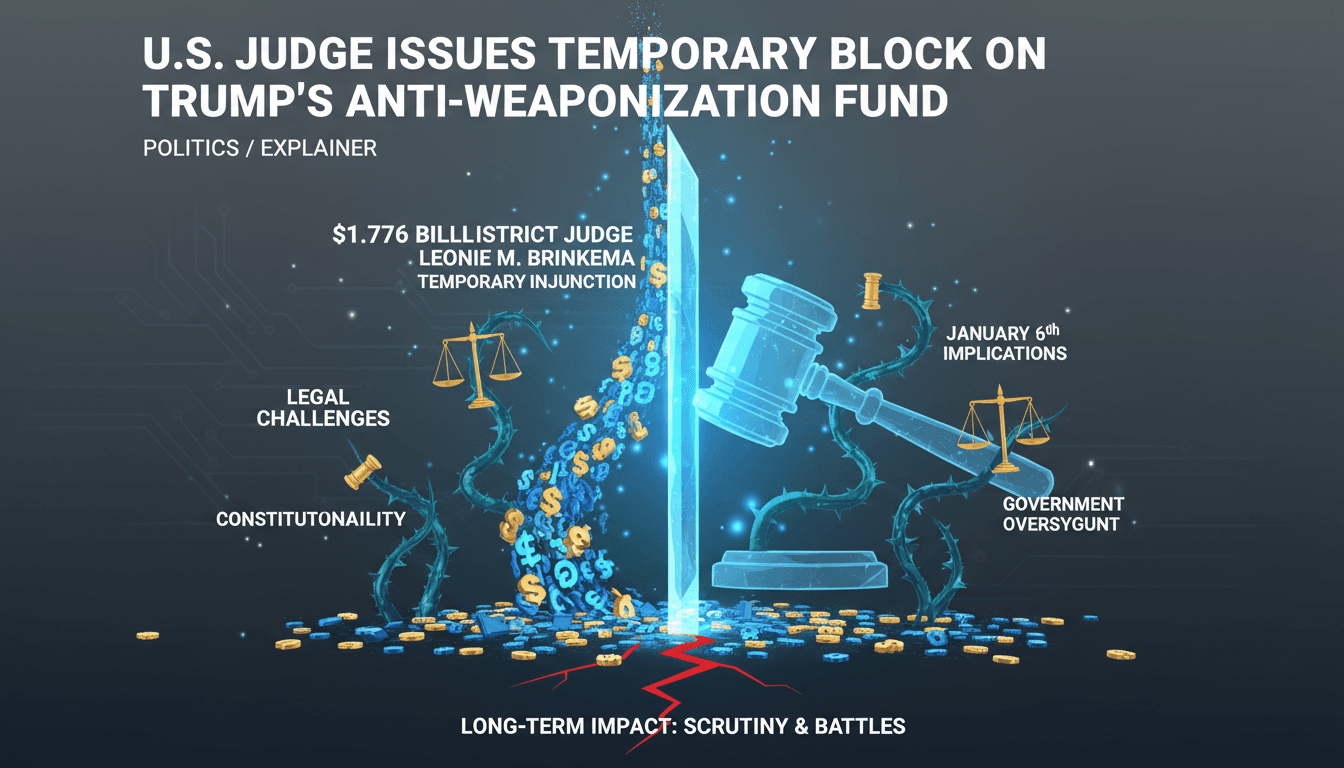
Here's what it means for you.
If you’re an investor or stakeholder in U.S. markets, this legal ruling could signal shifts in political stability that may affect your financial strategies.
Why it matters
This ruling raises questions about the legitimacy of government funds and their implications for accountability in U.S. governance.
What happened (in 30 seconds)
- On May 29, 2026, U.S. District Judge Leonie M. Brinkema issued a temporary injunction against the Trump administration's $1.776 billion anti-weaponization fund.
- The fund, created to compensate individuals allegedly wrongfully targeted by government actions, has faced criticism over its legal foundation and potential beneficiaries.
- A hearing is scheduled for June 12, 2026, to discuss the future of the injunction and the fund's viability.
The context you actually need
- The anti-weaponization fund was established as part of a settlement related to a lawsuit over the unauthorized disclosure of Trump's tax records.
- Critics argue that the fund could potentially benefit individuals involved in the January 6 Capitol riots, raising constitutional concerns.
- Bipartisan backlash has emerged, with many labeling the fund a "slush fund" and questioning its implications for accountability.
What's really happening
The temporary injunction issued by Judge Brinkema halts any actions related to the anti-weaponization fund, including the transfer of funds and disbursement of payments. This ruling stems from a lawsuit led by Andrew Floyd, a former federal prosecutor, who argues that the fund lacks a solid legal foundation and raises serious constitutional issues. The fund was created following a settlement from a lawsuit filed by Donald Trump against the IRS concerning the unauthorized disclosure of his tax records.
The fund's purpose is to compensate individuals who claim they were wrongfully targeted by government actions, but its creation has sparked significant controversy. Critics, including some Republicans, have raised alarms about the potential for the fund to benefit individuals involved in the January 6 insurrection, which has further complicated its legitimacy.
The ruling has prompted varied responses, with some government officials and legal experts supporting the injunction due to concerns over the fund's constitutionality. The Department of Justice has yet to publicly comment on the ruling, leaving many questions unanswered about the fund's future.
As the June 12 hearing approaches, the implications of this legal ruling may extend beyond the courtroom. Investor confidence in U.S. political stability could be affected, which may indirectly influence market perceptions in Dubai and the broader UAE region. The ongoing legal battles surrounding the fund highlight the complexities of governance and accountability in the U.S., raising critical questions about the role of government in compensating individuals and the potential for misuse of public funds.
Who feels it first (and how)
- Investors in U.S. markets may experience shifts in confidence and market stability.
- Legal professionals monitoring the case will be impacted by the evolving legal landscape surrounding government funds.
- Political analysts will need to reassess the implications of this ruling on future governance and accountability measures.
What to watch next
- The June 12 hearing will be crucial in determining the future of the injunction and the fund's viability, impacting public trust in government actions.
- Responses from the Department of Justice could indicate the administration's stance on the fund and its legal implications, influencing investor sentiment.
- Public opinion on the fund and its legitimacy may shift, affecting political dynamics and future governance strategies.
The injunction is currently in place, halting any actions related to the fund.
The June 12 hearing will provide further clarity on the fund's future and its legal standing.
The long-term implications for investor confidence and market stability remain uncertain.
Frequently Asked Questions
- Why it matters?
- This ruling raises questions about the legitimacy of government funds and their implications for accountability in U.S. governance.
- What happened (in 30 seconds)?
- On May 29, 2026, U.S. District Judge Leonie M. Brinkema issued a temporary injunction against the Trump administration's $1.776 billion anti-weaponization fund. The fund, created to compensate individuals allegedly wrongfully targeted by government actions, has faced criticism over its legal foundation and potential beneficiaries. A hearing is scheduled for June 12, 2026, to discuss the future of the injunction and the fund's viability.
- What's really happening?
- The temporary injunction issued by Judge Brinkema halts any actions related to the anti-weaponization fund, including the transfer of funds and disbursement of payments. This ruling stems from a lawsuit led by Andrew Floyd, a former federal prosecutor, who argues that the fund lacks a solid legal foundation and raises serious constitutional issues. The fund was created following a settlement from a lawsuit filed by Donald Trump against the IRS concerning the unauthorized disclosure of his tax re
- Who feels it first (and how)?
- Investors in U.S. markets may experience shifts in confidence and market stability. Legal professionals monitoring the case will be impacted by the evolving legal landscape surrounding government funds. Political analysts will need to reassess the implications of this ruling on future governance and accountability measures.
- What to watch next?
- The June 12 hearing will be crucial in determining the future of the injunction and the fund's viability, impacting public trust in government actions. Responses from the Department of Justice could indicate the administration's stance on the fund and its legal implications, influencing investor sentiment. Public opinion on the fund and its legitimacy may shift, affecting political dynamics and future governance strategies.
Global news coverage with extensive reporting on Middle Eastern conflicts and geopolitics.
"Al Jazeera is a Qatar-based broadcaster known for wide regional coverage and alternative perspectives."
— A47 Editor
US federal judge temporarily blocks Trump’s ‘anti-weaponisation fund’
A US federal judge has temporarily blocked the implementation of Donald Trump's nearly $1.8 billion 'anti-weaponization fund', which was established following a settlement with the IRS regarding Trump's tax records. This fund was intended to provide ...
Comprehensive coverage of Middle Eastern and global issues.
"Al Jazeera is a prominent voice from the Global South, especially the Middle East, with an emphasis on underreported stories."
— A47 Editor
US federal judge temporarily blocks Trump’s ‘anti-weaponisation fund’
A US federal judge has temporarily blocked the implementation of Donald Trump's nearly $1.8 billion 'anti-weaponization fund', which was established following a settlement with the IRS regarding Trump's tax records. This fund was intended to provide ...
Editor-curated FT homepage stories spanning markets, business, world, and opinion.
"The Financial Times is a globally respected business publication with a centrist/center-left tone and strong markets focus."
— A47 Editor
Trump’s $1.8bn ‘anti-weaponisation’ fund blocked by judge
A judge has blocked former President Donald Trump's proposed $1.8 billion 'anti-weaponization' fund, which was challenged in court by plaintiffs alleging that it rewards unlawful behavior. This decision reflects ongoing legal scrutiny surrounding Tru...
Macro commentary, policy analysis, growth/inflation themes, and global outlooks.
"Contextual macro coverage that complements day-to-day market headlines."
— A47 Editor
US judge temporarily blocks Trump’s $1.8 billion ’weaponization’ fund
A US judge has temporarily blocked former President Donald Trump's proposed $1.8 billion 'anti-weaponization' fund, which faced legal challenges alleging it rewards unlawful behavior. This ruling comes amid significant political pushback from within ...
Global business headlines with AI angles.
"General business outlet that frequently covers AI."
— A47 Editor
Federal Judge Blocks Trump Admin From Creating 'Anti-Weaponization' Fund
A federal judge has temporarily blocked the Trump administration from utilizing its proposed $1.776 billion 'anti-weaponization fund,' which was intended to combat perceived threats from various groups. This ruling halts any payments from the fund un...
News from the United States including domestic politics, society, and culture.
"The Guardian is known for its progressive editorial stance and in-depth analysis, often advocating for social justice, environmental issues, and liberal values."
— A47 Editor
US judge temporarily blocks Trump’s $1.8bn ‘anti-weaponization’ fund
A federal judge in Virginia has temporarily blocked the Trump administration from transferring funds into a $1.8 billion 'anti-weaponization' fund, pending further legal arguments regarding its establishment. This ruling by US District Judge Leonie B...
Conservative-leaning political and national coverage.
"The Washington Times is a conservative-leaning newspaper known for its political coverage and advocacy of right-of-center viewpoints."
— A47 Editor
Judge temporarily halts payout from Trump administration's Anti-Weaponization Fund
A federal judge in Virginia has temporarily halted the Trump administration's $1.8 billion Anti-Weaponization Fund, which was intended to compensate individuals claiming improper targeting by the government. This decision puts any planned payouts on ...
Business, investment, entrepreneurship, leadership, and innovation.
"Forbes is known for its coverage of business leaders, market trends, and entrepreneurial ventures with a pro-business editorial stance."
— A47 Editor
Trump’s $1.8 Billion ‘Anti-Weaponization’ Fund Blocked In Court—At Least For Now
A court has temporarily blocked the Trump administration from transferring funds to its proposed $1.8 billion 'Anti-Weaponization' fund, halting any disbursement to applicants. This legal setback comes amid ongoing scrutiny of the administration's fi...