
Supreme Court Limits Corporate Liability for Human Rights Abuses in Cisco Case
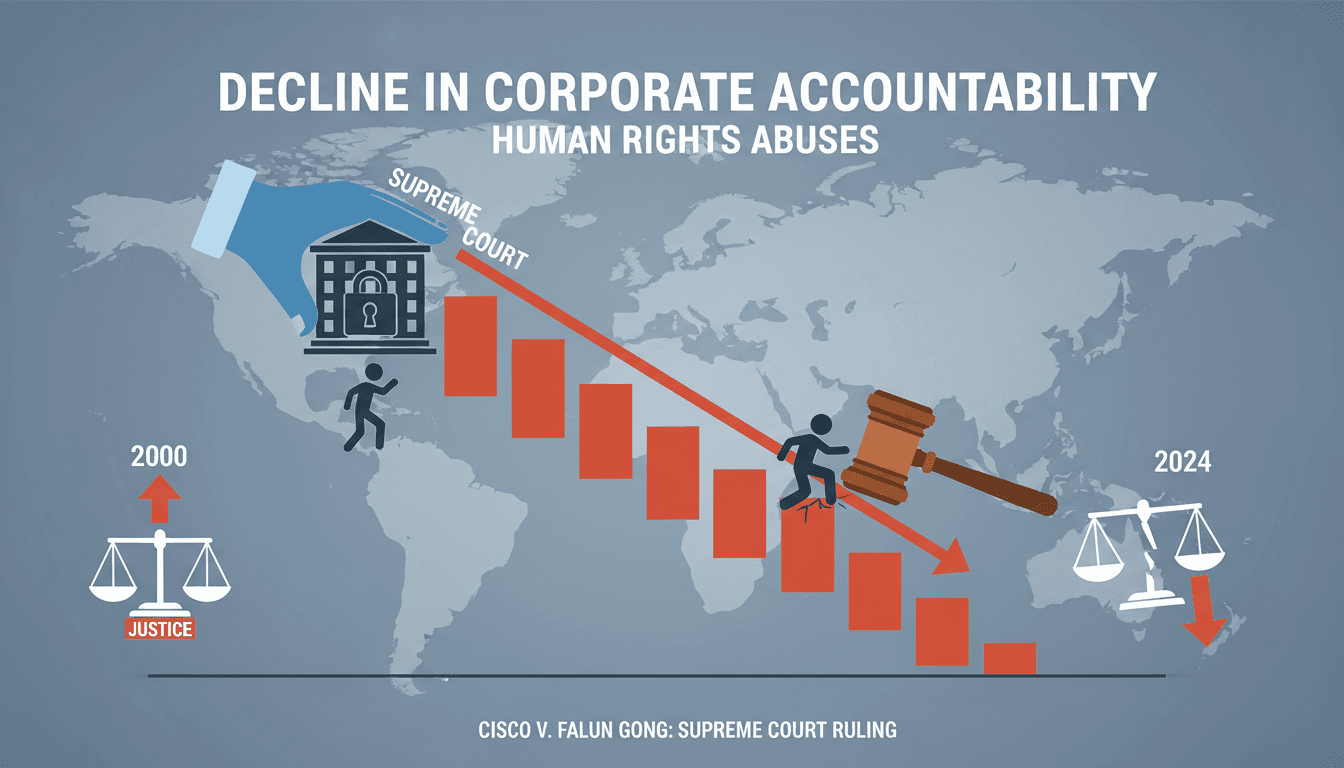
Here's what it means for you.
The U.S. Supreme Court's ruling against Cisco Systems signifies a pivotal moment in corporate accountability for human rights violations. This decision may deter future lawsuits against corporations accused of complicity in abuses abroad, raising significant concerns about the legal recourse available to victims. As the court narrows the application of the Alien Tort Statute, the implications for international human rights litigation could be profound. The ruling reflects a broader trend in the judiciary that may embolden corporations operating in regions with poor human rights records. Stakeholders in human rights advocacy and corporate governance will need to reassess their strategies in light of this evolving legal landscape.
What happened
The U.S. Supreme Court ruled against a lawsuit alleging that Cisco Systems facilitated the persecution of Falun Gong members in China. This decision effectively limits corporate liability for human rights violations, marking a significant shift in the legal landscape. The lawsuit, originally filed in 2011 under the Alien Tort Statute, accused Cisco of developing technology that enabled the Chinese government to surveil and persecute practitioners of Falun Gong.
The Supreme Court's ruling, issued on June 23, 2026, reversed a lower court's decision that had allowed the lawsuit to proceed. This outcome underscores the challenges faced by individuals seeking justice for human rights abuses committed by corporations operating internationally.
The Context
The lawsuit against Cisco Systems was initiated in 2011, highlighting the lengthy duration of this legal battle. The plaintiffs claimed that Cisco knowingly aided in the surveillance and persecution of Falun Gong members, raising critical questions about corporate complicity in human rights violations. The Supreme Court's decision reflects a broader trend of limiting the reach of U.S. laws in international human rights cases, which could have lasting implications for accountability.
As the court continues to restrict the application of the Alien Tort Statute, concerns are mounting regarding the ability of victims to seek redress against corporations. This ruling not only affects the plaintiffs in this case but also sets a precedent that could impact future human rights litigation against companies operating in countries with poor human rights records.
Takeaway
The Supreme Court's ruling may deter future lawsuits against corporations for alleged complicity in human rights abuses abroad. As the legal landscape shifts, stakeholders must consider the implications for other human rights lawsuits against corporations. Future Supreme Court decisions regarding corporate liability in international contexts will be crucial to watch, as they could further define the boundaries of corporate accountability.
The ongoing trend of limiting corporate liability raises significant concerns about the accountability of companies operating in regions with poor human rights practices. As this legal environment evolves, it will be essential for advocates and policymakers to navigate the challenges posed by these judicial decisions.
Curated tech headlines including AI stories.
"Influential aggregator surfacing the day’s top tech/AI links."
— A47 Editor
SCOTUS ends a suit alleging Cisco aided China's Falun Gong persecution, further limiting a law used to hold corporations liable for overseas human rights abuses (Jan Wolfe/Reuters)
The U.S. Supreme Court has dismissed a lawsuit against Cisco Systems Inc., which alleged that the company assisted the Chinese government in persecuting Falun Gong practitioners. This ruling further narrows the scope of a federal law that previously ...
News from the United States including domestic politics, society, and culture.
"The Guardian is known for its progressive editorial stance and in-depth analysis, often advocating for social justice, environmental issues, and liberal values."
— A47 Editor
US supreme court ends lawsuit alleging Cisco helped China pursue Falun Gong
The U.S. Supreme Court ruled 6-3 to end a lawsuit against Cisco Systems, which accused the company of aiding the Chinese government in surveilling and persecuting members of the Falun Gong spiritual movement. This decision reversed a lower court's ru...
International coverage from The Guardian's global desks.
"The Guardian is known for its progressive editorial stance and in-depth analysis."
— A47 Editor
US supreme court ends lawsuit alleging Cisco helped China pursue Falun Gong
The U.S. Supreme Court ruled 6-3 to end a lawsuit against Cisco Systems, which accused the company of aiding the Chinese government in surveilling and persecuting members of the Falun Gong spiritual movement. This decision reversed a lower court's ru...
Technology business and AI-related headlines.
"Data-driven tech newsroom with global scope."
— A47 Editor
Supreme Court Puts Curbs on Human-Rights Suits in Cisco Win
The US Supreme Court has imposed new limitations on lawsuits against corporations for human rights violations abroad, specifically rejecting a case against Cisco Systems Inc. that accused the company of aiding in the torture of Falun Gong practitione...
Technology business news, market impacts, and innovation trends.
"Bloomberg is a premier financial and tech news provider, respected for its in-depth reporting and analytical rigor."
— A47 Editor
Supreme Court Puts Curbs on Human-Rights Suits in Cisco Win
The US Supreme Court has imposed new limitations on lawsuits against corporations for human rights violations abroad, specifically rejecting a case against Cisco Systems Inc. that accused the company of aiding in the torture of Falun Gong practitione...