
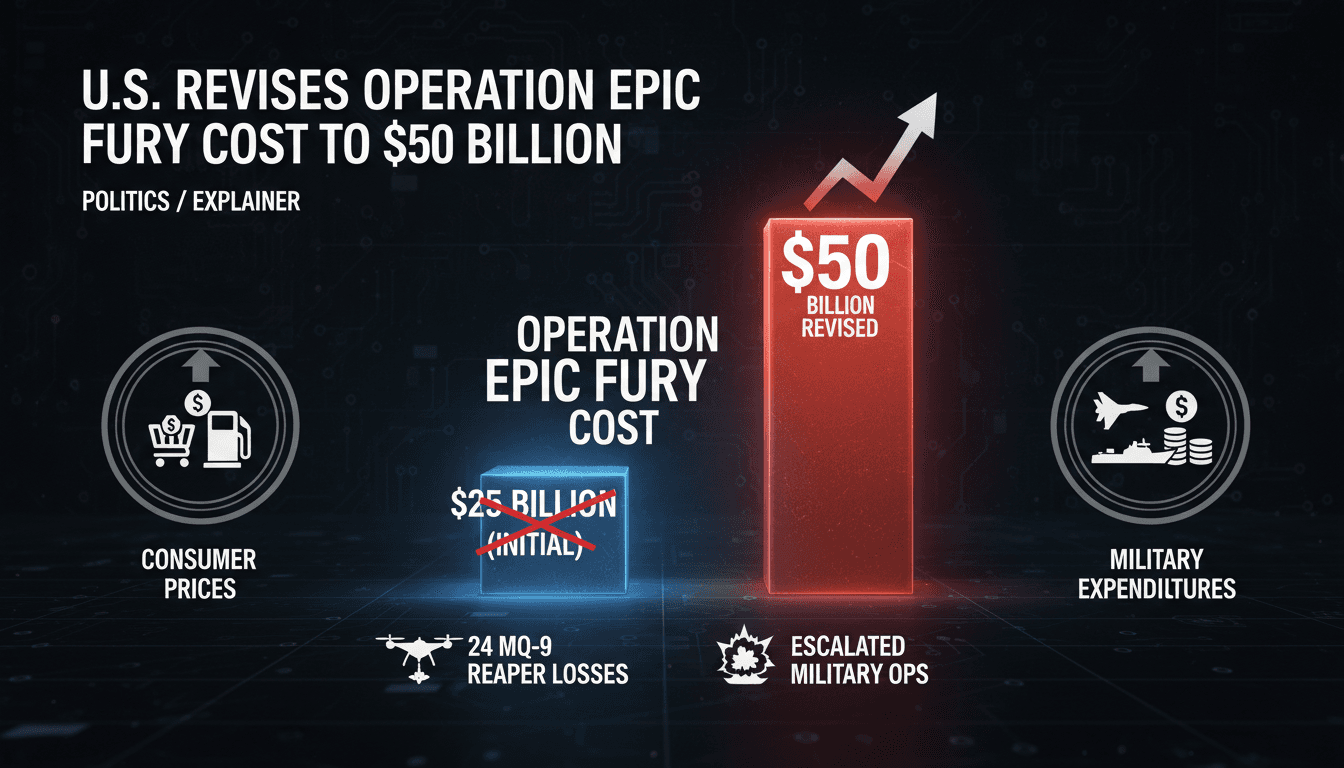
U.S. Revises Operation Epic Fury Cost to $50 Billion Amid Ongoing Conflict with Iran
Here's what it means for you.
Rising military expenditures could lead to increased costs for consumers globally, impacting everything from fuel prices to food.
Why it matters
The escalating financial burden of military operations can ripple through economies, affecting consumer prices and market stability.
What happened (in 30 seconds)
- U.S. officials revised the estimated cost of Operation Epic Fury against Iran to nearly $50 billion, nearly double the previously stated figure.
- Congressional hearings revealed discrepancies in cost assessments, prompting skepticism from lawmakers about the Pentagon's transparency.
- Iran's counterclaims suggest U.S. costs could exceed $100 billion, further complicating the financial narrative surrounding the conflict.
The context you actually need
- Operation Epic Fury was initiated on February 28, 2026, following failed negotiations regarding Iran's nuclear program and regional activities.
- The Pentagon's initial estimate of $25 billion did not account for significant losses, including 24 MQ-9 Reaper drones and damage to U.S. bases.
- Market reactions have been volatile, with oil prices fluctuating significantly due to the conflict, impacting global supply chains and consumer costs.
What's really happening
The revision of Operation Epic Fury's cost to nearly $50 billion underscores a critical gap in military budgeting and transparency. Initially, the Pentagon's figure of $25 billion was presented during a Senate Armed Services Committee hearing, where Secretary of Defense Pete Hegseth and Chairman of the Joint Chiefs of Staff Dan Caine faced scrutiny from lawmakers. The discrepancy arose from the exclusion of substantial operational costs, including munitions replenishment and equipment losses, which were not fully disclosed at the time.
The conflict, which began as a preemptive strike against Iran's nuclear capabilities, has escalated into a complex military engagement involving sustained air and naval operations. The U.S. has deployed significant resources, including aircraft carriers and drones, to counter Iranian military actions. However, the operational costs have ballooned due to the loss of equipment and the need for ongoing military support, leading to a revised estimate that reflects the true financial burden of the operation.
This situation is exacerbated by the geopolitical landscape, where tensions in the Strait of Hormuz have led to increased oil prices, directly impacting global markets. As crude oil prices exceed $100 per barrel, consumers worldwide are likely to feel the pinch through higher fuel and food costs. The American Enterprise Institute estimates that households could see an additional $150 monthly expense due to rising prices for fuel and fertilizers, which are closely tied to military operations and oil market fluctuations.
Moreover, the U.S. military's reliance on advanced technology, such as the MQ-9 Reaper drones, adds another layer of complexity. Each drone lost in combat represents not just a financial loss but also a strategic setback, necessitating further investment in replacements and repairs. The replenishment of munitions and equipment is projected to take years, indicating that the financial implications of Operation Epic Fury will extend well beyond the immediate conflict.
As the U.S. continues its military campaign, the financial strain on the government may lead to budget reallocations that could affect domestic programs and services. This could create a feedback loop where increased military spending results in higher taxes or reduced public services, ultimately impacting everyday citizens.
Who feels it first (and how)
- Consumers: Higher fuel and food prices due to increased operational costs and oil price volatility.
- Aviation sector: Increased operational costs leading to higher airfares and potential flight cancellations.
- Military contractors: Increased demand for munitions and equipment replacements, potentially leading to higher profits but also higher costs for the government.
- Local economies: Areas reliant on military contracts may see fluctuations in employment and economic stability.
What to watch next
- Oil prices: Monitor fluctuations in crude oil prices, as they directly impact consumer costs and economic stability.
- Military budget discussions: Watch for congressional debates on military spending and potential reallocations that could affect domestic programs.
- Iran's response: Keep an eye on Iran's military and diplomatic actions, as they could influence U.S. operational costs and regional stability.
The estimated cost of Operation Epic Fury is now nearly $50 billion.
Continued volatility in oil prices and consumer costs as the conflict persists.
The long-term implications of military spending on domestic programs and services.
Frequently Asked Questions
- Why it matters?
- The escalating financial burden of military operations can ripple through economies, affecting consumer prices and market stability.
- What happened (in 30 seconds)?
- U.S. officials revised the estimated cost of Operation Epic Fury against Iran to nearly $50 billion, nearly double the previously stated figure. Congressional hearings revealed discrepancies in cost assessments, prompting skepticism from lawmakers about the Pentagon's transparency. Iran's counterclaims suggest U.S. costs could exceed $100 billion, further complicating the financial narrative surrounding the conflict.
- What's really happening?
- The revision of Operation Epic Fury's cost to nearly $50 billion underscores a critical gap in military budgeting and transparency. Initially, the Pentagon's figure of $25 billion was presented during a Senate Armed Services Committee hearing, where Secretary of Defense Pete Hegseth and Chairman of the Joint Chiefs of Staff Dan Caine faced scrutiny from lawmakers. The discrepancy arose from the exclusion of substantial operational costs, including munitions replenishment and equipment losses, wh
- Who feels it first (and how)?
- Consumers: Higher fuel and food prices due to increased operational costs and oil price volatility. Aviation sector: Increased operational costs leading to higher airfares and potential flight cancellations. Military contractors: Increased demand for munitions and equipment replacements, potentially leading to higher profits but also higher costs for the government. Local economies: Areas reliant on military contracts may see fluctuations in employment and economic stability.
- What to watch next?
- Oil prices: Monitor fluctuations in crude oil prices, as they directly impact consumer costs and economic stability. Military budget discussions: Watch for congressional debates on military spending and potential reallocations that could affect domestic programs. Iran's response: Keep an eye on Iran's military and diplomatic actions, as they could influence U.S. operational costs and regional stability.
Arabic-language coverage of political affairs and current events.
"Okaz political coverage typically follows mainstream Saudi framing on national and regional affairs."
— A47 Editor
بزيادة 100% عن تقديرات «البنتاغون».. مسؤولون أمريكيون: 50 مليار دولار تكلفة حرب إيران
U.S. officials have estimated the cost of the ongoing war in Iran to be around $50 billion, significantly higher than the Pentagon's public estimate of $25 billion, as reported by CBS News. This figure reflects not only the operational pace but also ...
Global news coverage with extensive reporting on Middle Eastern conflicts and geopolitics.
"Al Jazeera is a Qatar-based broadcaster known for wide regional coverage and alternative perspectives."
— A47 Editor
$25bn or $1 trillion: How much has Iran war really cost the US?
A recent heated exchange on Capitol Hill has highlighted growing concerns among U.S. lawmakers regarding the lack of transparency surrounding the financial costs of the ongoing military conflict with Iran, which has reportedly reached approximately $...
Comprehensive coverage of Middle Eastern and global issues.
"Al Jazeera is a prominent voice from the Global South, especially the Middle East, with an emphasis on underreported stories."
— A47 Editor
$25bn or $1 trillion: How much has Iran war really cost the US?
A recent heated exchange on Capitol Hill has highlighted growing concerns among U.S. lawmakers regarding the lack of transparency surrounding the financial costs of the ongoing military conflict with Iran, which has reportedly reached approximately $...
English-language reporting on Saudi politics, policy, and society.
"Saudi Gazette reflects mainstream Saudi institutional perspectives."
— A47 Editor
Iran war has cost the US $25 billion so far, Pentagon says
The Pentagon has reported that the ongoing war in Iran has cost the United States approximately $25 billion, marking the first official estimate of Operation Epic Fury. This figure was presented to Congress by Jules Hurst, the acting comptroller, dur...
English-language news from Qatar covering domestic and regional affairs.
"Gulf Times reflects Qatari perspectives on regional developments."
— A47 Editor
Iran war has cost US $25bn so far
The ongoing war against Iran has incurred costs of approximately $25 billion for the United States since its initiation in late February, as reported by a senior Pentagon official. This figure represents the first official estimate of Operation Epic ...
Public radio coverage of American news and issues.
"NPR is an American public media organization known for thoughtful reporting and a slightly left-leaning editorial tone."
— A47 Editor
DOD officials say Iran war has cost $25 billion so far during Congressional grilling
During a recent congressional hearing, Pentagon officials disclosed that the ongoing military operations in Iran have incurred costs of approximately $25 billion to date. This figure was presented by Defense Secretary Pete Hegseth, highlighting the f...
Global business headlines with AI angles.
"General business outlet that frequently covers AI."
— A47 Editor
Pentagon Says Iran War Has Cost $25 Billion So Far, Most In Munitions
The Pentagon has reported that the ongoing conflict with Iran has incurred costs of approximately $25 billion, primarily attributed to munitions expenditures. This figure reflects the financial implications of military operations that have escalated ...
Editor-curated FT homepage stories spanning markets, business, world, and opinion.
"The Financial Times is a globally respected business publication with a centrist/center-left tone and strong markets focus."
— A47 Editor
Trump’s Iran war has cost $25bn, Pentagon official says
The Pentagon has reported that the United States has incurred approximately $25 billion in costs related to military operations in Iran, raising concerns about the financial implications of ongoing conflicts. This expenditure reflects a significant c...
Arabic-language coverage of political affairs and current events.
"Okaz political coverage typically follows mainstream Saudi framing on national and regional affairs."
— A47 Editor
«البنتاغون»: أنفقنا 25 مليار دولار على الحرب.. قاليباف: أمريكا سعت لتحويل إيران إلى فنزويلا
The Pentagon announced that the United States has spent $25 billion on the war against Iran, marking the first official estimate of the war's costs. Acting financial monitor Jules Hurst stated that most of this expenditure has been on munitions, whil...
Insights and news on social issues, policy, and political movements across the United States.
"The Wall Street Journal is known for its deep political coverage, especially at the intersection of policy, regulation, and social dynamics."
— A47 Editor
U.S. military operations in Iran have so far cost taxpayers roughly $25 billion, a top Pentagon official told lawmakers
In a recent testimony, Defense Secretary Pete Hegseth revealed that U.S. military operations in Iran have cost taxpayers approximately $25 billion to date. This marks Hegseth's first public appearance since the onset of the conflict, where he emphasi...
Arabic-language coverage of international news and geopolitics.
"RT Arabic is a Russian state-funded outlet often criticized for promoting Kremlin-aligned narratives."
— A47 Editor
مسؤول في البنتاغون: الحرب على إيران كلفت 25 مليار دولار حتى الآن
Jules Horst III, the acting comptroller of the U.S. Department of Defense, announced that the total expenditure on U.S. military operations against Iran has reached approximately $25 billion to date. This figure highlights the significant financial b...
Pan-Arab news coverage spanning politics, business, sports, and regional affairs.
"Asharq Al-Awsat reflects a broad Arab editorial perspective with strong attention to regional geopolitics."
— A47 Editor
«البنتاغون»: تكاليف حرب إيران 25 مليار دولار حتى الآن
The U.S. Deputy Under Secretary of Defense for Financial Management, Jules Hurst, announced that the estimated cost of the war with Iran has reached $25 billion. This figure highlights the significant financial burden associated with ongoing military...
Business and tech news excluding paywalled content.
"High-volume business/tech outlet with frequent AI coverage."
— A47 Editor
The Pentagon just revealed how much the US has spent on 2 months of war with Iran
The Pentagon has disclosed that the United States has spent approximately $25 billion over two months in its ongoing conflict with Iran, primarily on munitions. This substantial expenditure highlights the financial burden of military operations in th...
Regional coverage and analysis focused on politics, diplomacy, and business across the Middle East.
"Al-Monitor is known for analytical reporting on Middle East politics and policy developments."
— A47 Editor
U.S. war in Iran has cost $25 billion so far, says Pentagon official
The Pentagon has reported that the ongoing U.S. war in Iran has incurred costs amounting to $25 billion, marking the first official estimate of the military expenditure in this conflict. This revelation comes as the U.S. approaches mid-term elections...
Capitol Hill news, legislation, and policy insight.
"The Hill specializes in U.S. politics and policy, with a focus on Capitol Hill developments and a reputation for insider reporting."
— A47 Editor
Pentagon CFO: Iran war has cost $25 billion so far
The Pentagon's acting chief financial officer, Jules Hurst III, informed the House Armed Services Committee that the ongoing war against Iran has incurred costs of approximately $25 billion to date, primarily attributed to ammunition expenses. This f...
Focused political reporting and governmental affairs.
"NBC News is a mainstream media outlet known for comprehensive national and international news coverage with a centrist to slightly left-leaning editorial tone."
— A47 Editor
Iran war has cost the U.S. $25 billion after eight weeks, official says
During a recent House Armed Services Committee hearing, Acting Comptroller Jules Hurst III disclosed that the cost of Operation Epic Fury in Iran has escalated to $25 billion after just eight weeks of military engagement. This figure highlights the s...
Macro commentary, policy analysis, growth/inflation themes, and global outlooks.
"Contextual macro coverage that complements day-to-day market headlines."
— A47 Editor
US spent $25 billion on Iran war so far, Pentagon says
The Pentagon has reported that the United States has spent approximately $25 billion on military operations in Iran to date, reflecting the ongoing financial commitment to the conflict. This expenditure highlights the significant resources allocated ...