
Bolivia declares state of emergency amid escalating anti-government protests
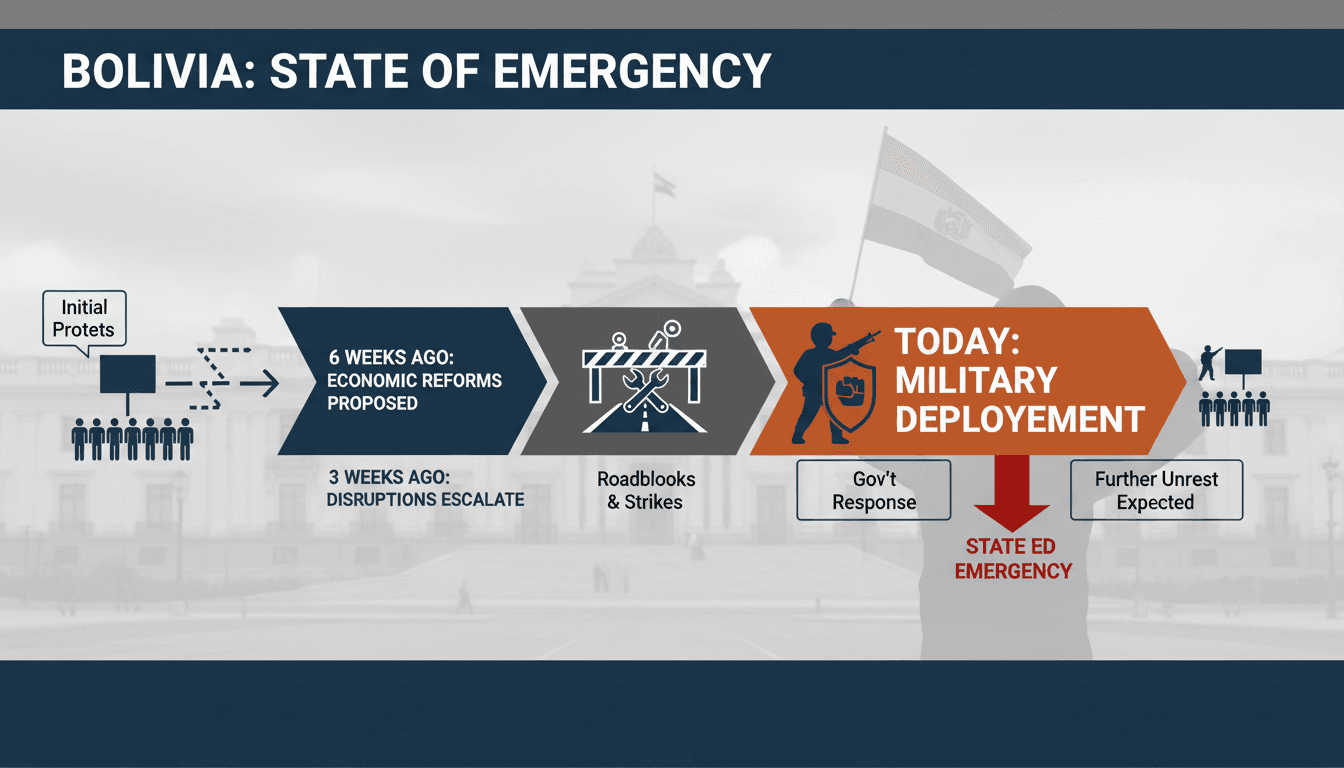
Here's what it means for you.
The declaration of a state of emergency in Bolivia signals a significant escalation in the government's response to civil unrest. This situation may impact economic stability and investor confidence as protests continue to disrupt daily life and commerce. Stakeholders should closely monitor the evolving dynamics between the government and protest leaders, as further unrest could lead to more stringent measures. The ongoing protests, fueled by opposition to economic reforms, highlight deep-seated tensions within Bolivian society. As various groups, including unions and Indigenous communities, rally against perceived authoritarianism, the potential for prolonged instability remains high.
What happened
Bolivia's president declared a state of emergency on June 21, 2026, in response to extensive anti-government protests that have persisted for over six weeks. The government has deployed military forces and bulldozers to dismantle roadblocks established by various protesting groups, including unions, Indigenous groups, and coca farmers. This heavy-handed approach aims to restore order but risks escalating tensions further.
The protests have been primarily driven by opposition to economic reforms proposed by the government, which many view as detrimental to their livelihoods. The state of emergency grants the military authority to intervene, significantly curtailing the right to protest and raising concerns about civil liberties.
The Context
The protests in Bolivia have been ongoing for more than six weeks, reflecting widespread dissatisfaction with the government's economic policies. Key stakeholders include unions, Indigenous groups, and coca farmers, all of whom feel marginalized by the proposed reforms. The timing of the protests coincides with a broader global trend of civil unrest, where citizens are increasingly vocal about their grievances.
The government's decision to deploy military forces indicates a serious escalation in its approach to managing dissent. This move may be perceived as an authoritarian response, further alienating the affected populations and potentially leading to more significant unrest. The situation is critical, as the balance between maintaining order and respecting civil rights hangs in the balance.
Takeaway
The situation in Bolivia remains tense as the government seeks to restore order amid widespread dissent. Observers should monitor the response of protest leaders to the military's actions, as their next steps could significantly influence the trajectory of the protests. Additionally, potential escalations in both protests and government measures are likely as the situation develops.
As the government grapples with the unrest, the implications for economic stability and public trust are profound. The heavy-handed approach may provoke further demonstrations, complicating efforts to achieve a peaceful resolution. Stakeholders must remain vigilant as the situation unfolds.
Global news coverage with extensive reporting on Middle Eastern conflicts and geopolitics.
"Al Jazeera is a Qatar-based broadcaster known for wide regional coverage and alternative perspectives."
— A47 Editor
Bolivian authorities say no active blockades after state of emergency decree
Bolivian authorities have declared that there are no active blockades following a state of emergency decree aimed at addressing five weeks of anti-government protests. The decree allows for the deployment of military forces to assist police in mainta...
Comprehensive coverage of Middle Eastern and global issues.
"Al Jazeera is a prominent voice from the Global South, especially the Middle East, with an emphasis on underreported stories."
— A47 Editor
Bolivian authorities say no active blockades after state of emergency decree
Bolivian authorities have declared that there are no active blockades following a state of emergency decree aimed at addressing five weeks of anti-government protests. The decree allows for the deployment of military forces to assist police in mainta...
News across North, Central, and South America including politics and economics.
"France 24 is viewed as a globally focused outlet with balanced coverage and a European perspective."
— A47 Editor
Bolivia deploys army to halt protests after declaration of state of emergency
Bolivia's government has deployed military forces and bulldozers to dismantle anti-government roadblocks following President Rodrigo Paz's declaration of a state of emergency. This measure, which restricts the right to protest, comes in response to o...
Regional and international reporting focused on Middle Eastern politics, diplomacy, and economics.
"Asharq Al-Awsat is a Saudi-owned international newspaper reflecting mainstream Gulf political perspectives."
— A47 Editor
Bolivia Declares State of Emergency, Deploys Military to Quell Protests
Bolivia has declared a state of emergency and deployed military forces to manage escalating protests against President Rodrigo Paz, which have been driven by a severe economic crisis and demands for his resignation. The unrest has led to significant ...
Reporting on North, Central, and South America, plus the Caribbean.
"The Guardian is known for its progressive editorial stance and in-depth analysis."
— A47 Editor
Bolivian president declares state of emergency and deploys military to quell anti-government protests
Bolivia's President Rodrigo Paz declared a state of emergency and deployed military forces to dismantle roadblocks established by protesters, primarily farmers and Indigenous groups, who have been demonstrating against his conservative government for...