
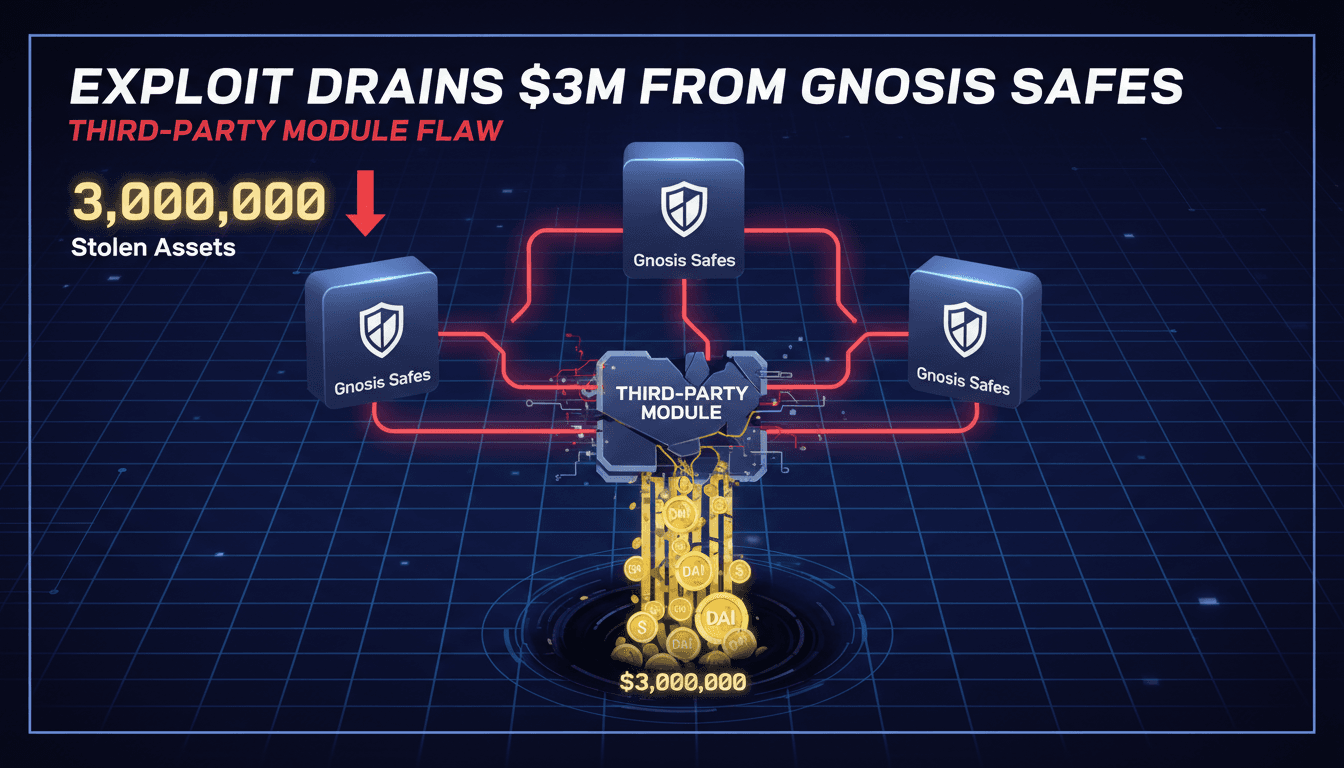
Third-party module exploit drains $3 million from Gnosis Safes
Here's what it means for you.
The recent exploit involving the SquidRouterModule highlights significant vulnerabilities in third-party integrations within the cryptocurrency ecosystem. As the industry matures, this incident may prompt increased regulatory scrutiny and a reevaluation of security protocols among crypto platforms. Stakeholders must prioritize robust security measures to protect user assets and maintain trust in decentralized finance.
What happened
On May 25, 2026, a significant exploit involving the SquidRouterModule resulted in the theft of approximately $3 million from 86 Gnosis Safes. The attack exploited vulnerabilities in third-party modules, leading to a substantial financial loss for the affected wallets. The stolen tokens were swiftly converted into DAI on Ethereum and Base, indicating a well-coordinated operation behind the theft.
Squid, the provider of the module, has publicly clarified that its core systems were not compromised during this incident. This statement aims to distance the company from the exploit while addressing concerns about the security of third-party integrations in the cryptocurrency space.
The Context
The exploit targeted wallets across both Ethereum and Base networks, raising alarms about the security of third-party modules in the cryptocurrency ecosystem. As decentralized finance continues to grow, the reliance on third-party services increases, making it crucial for developers to ensure the integrity of their systems. The incident serves as a reminder of the potential risks associated with these integrations.
The timing of this exploit is particularly concerning, as it comes amid a broader conversation about regulatory measures in the cryptocurrency space. Stakeholders are now faced with the challenge of balancing innovation with security, as incidents like this could lead to stricter oversight from regulators.
Takeaway
The incident underscores the urgent need for enhanced security measures for third-party modules in cryptocurrency platforms. As the landscape evolves, developers will likely focus on strengthening their protocols to prevent similar exploits in the future. Additionally, the potential for regulatory responses to such vulnerabilities may shape the future of third-party integrations in the industry.
In the coming months, it will be essential to monitor how Gnosis and Squid respond to this incident and what new security measures they implement. The ongoing dialogue about security in decentralized finance will likely intensify as stakeholders seek to protect user assets and maintain confidence in the ecosystem.
Covers blockchain, cryptocurrency news, project analysis, and market insights.
"Cointelegraph is a leading crypto-focused media outlet known for timely news, analysis, and educational content related to blockchain and digital assets."
— A47 Editor
Squid and Safe Labs say third-party module behind $3.2M exploit
A third-party module has been identified as the cause of a $3.2 million exploit affecting Safe wallets, with Squid stating that its core systems remain unaffected by the incident. The exploit has raised concerns about the security of third-party inte...
Real-time updates, analysis, and reports on the blockchain and cryptocurrency sectors.
"Crypto News delivers real-time updates, analysis, and reports on the blockchain and cryptocurrency sectors."
— A47 Editor
Squid rushes to separate brand from $3 million Gnosis Safe module exploit
Squid has swiftly clarified that a recent exploit resulting in the theft of approximately $3 million targeted a third-party Gnosis Safe module, known as SquidRouterModule, rather than its primary cross-chain routing contracts. This incident involved ...
Real-time updates, analysis, and reports on the blockchain and cryptocurrency sectors.
"Crypto News delivers real-time updates, analysis, and reports on the blockchain and cryptocurrency sectors."
— A47 Editor
Blockaid flags $3M SquidRouterModule exploit across 86 Safes
Blockaid has reported a significant exploit involving the SquidRouterModule, which has drained approximately $3 million from 86 Gnosis Safes. The stolen tokens were subsequently swapped into DAI on the Ethereum and Base networks. This incident highli...