
2026 FIFA World Cup to be the largest tournament in history with 48 teams across three nations
Here's what it means for you.
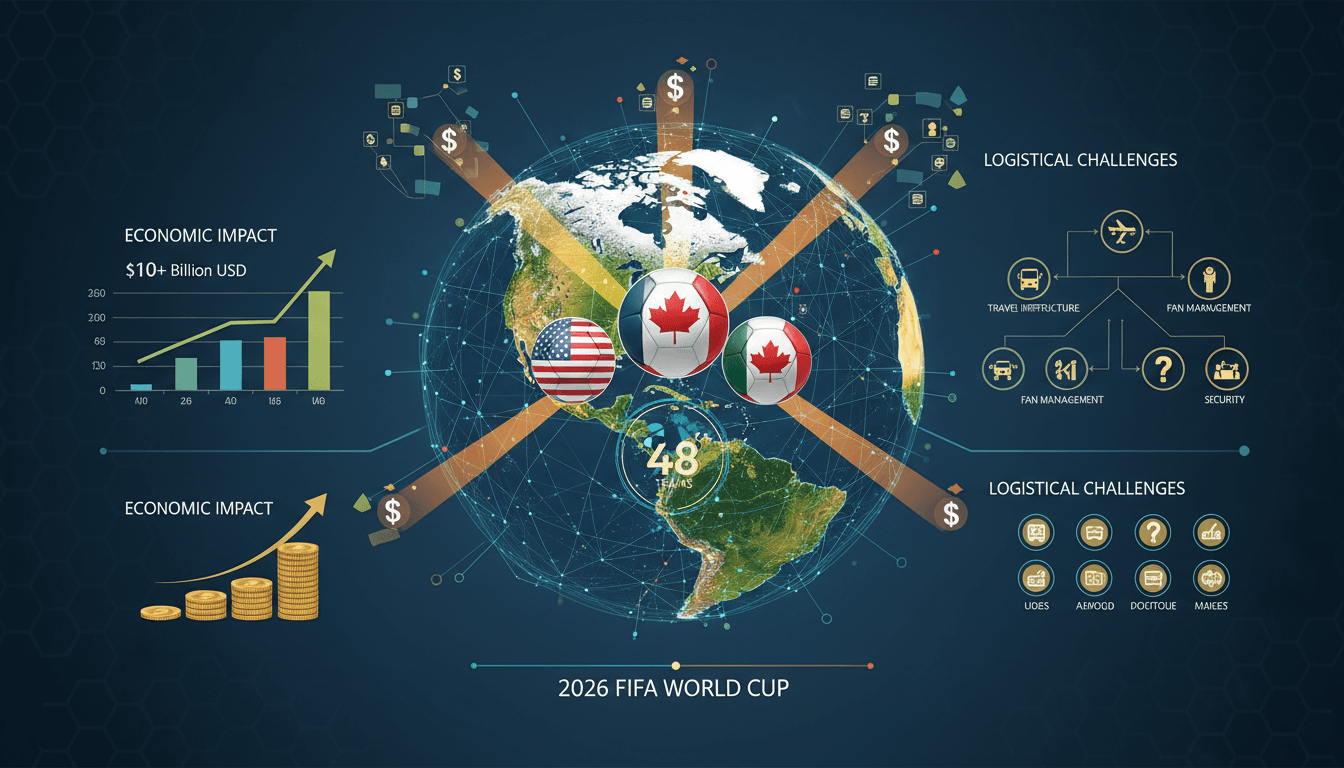
The 2026 FIFA World Cup represents a significant shift in international sports, expanding participation and viewership on an unprecedented scale. With 48 teams competing, the tournament is set to enhance global engagement, offering new opportunities for sponsors and broadcasters alike. The economic implications are substantial, with host nations poised to reap billions in revenue, potentially reshaping future sporting events. As the tournament approaches, stakeholders must navigate complex logistical and security challenges, ensuring a seamless experience for fans and participants. The successful execution of this event could redefine standards for international competitions.
What happened
The 2026 FIFA World Cup will be co-hosted by the United States, Canada, and Mexico, marking the first time the tournament features 48 teams. This historic event will take place across 16 cities, showcasing a total of 104 matches. The expansion aims to enhance global participation and viewership, setting a new precedent for future tournaments.
FIFA has allocated a record $871 million in prize money, reflecting a 50% increase from the previous World Cup. The anticipated economic impact is significant, with expected revenues reaching $30 billion for the host countries and $41 billion globally.
The Context
This World Cup is notable not only for its size but also for being the first hosted by three nations. The collaboration among the U.S., Canada, and Mexico highlights a unique opportunity for cross-border cooperation in sports. The tournament's scale introduces complexities in organization, requiring robust infrastructure and security measures.
The financial stakes are high, with host cities expected to incur costs of approximately $14 billion for security, transportation, and venue upgrades. As the tournament date approaches, the focus will shift to how effectively these nations can manage the logistical challenges presented by such a large-scale event.
Takeaway
Looking ahead, the successful execution of the 2026 World Cup could set a new standard for international sporting events. Stakeholders should monitor preparations in host cities, particularly regarding infrastructure and security measures. Additionally, updates on sponsorship deals and broadcasting rights will be crucial as the tournament draws near.
The interplay of economic, political, and logistical factors will be critical in determining the event's success. As the tournament unfolds, it will serve as a benchmark for future competitions and their organization.
Sports reporting with a focus on Saudi and regional competitions.
"Okaz sports coverage is broad and audience-friendly, with strong attention to Saudi teams and leagues."
— A47 Editor
مليارات تتدفق في نسخة كأس العالم الأضخم عالميًا
As the 2026 FIFA World Cup approaches, significant economic projections have emerged, indicating that the tournament could generate up to $30 billion for the host countries—United States, Mexico, and Canada—alongside an additional $41 billion for the...
Sports news with an emphasis on business, economics, and strategy behind major events and leagues.
"WSJ’s sports coverage is distinguished by its focus on financial and strategic aspects of the sports world."
— A47 Editor
North America’s World Cup Feels Like Three Different Tournaments
The 2026 FIFA World Cup, co-hosted by the U.S., Mexico, and Canada, is characterized by distinct mascots, marketing strategies, and fan policies, reflecting the unique cultural identities of each nation amid politically charged relations.
Global political, business, and cultural coverage from WSJ international desks.
"The Wall Street Journal offers extensive international reporting with a reputation for financial insight and a center-right editorial stance."
— A47 Editor
North America’s World Cup Feels Like Three Different Tournaments
The 2026 FIFA World Cup has commenced, co-hosted by the U.S., Mexico, and Canada, with Mexico winning the opening match against South Africa 2-0 at the Azteca Stadium. This tournament is marked by distinct mascots, marketing strategies, and fan polic...
Stock market news, investing ideas, and trading analysis.
"TheStreet provides market news and retail-investor-focused analysis."
— A47 Editor
Why brands are spending billions on 2026 FIFA World Cup
The 2026 FIFA World Cup, co-hosted by the U.S., Canada, and Mexico, is projected to be the largest tournament in history, featuring 48 teams across 16 cities. Brands are investing billions in anticipation of the event, which is expected to generate n...
Pan-Arab news coverage spanning politics, business, sports, and regional affairs.
"Asharq Al-Awsat reflects a broad Arab editorial perspective with strong attention to regional geopolitics."
— A47 Editor
كأس العالم 2026... عندما تتحوّل كرة القدم إلى اختبار للأمن والسياسة والمناخ
The 2026 FIFA World Cup is set to be the largest in history, taking place across the United States, Canada, and Mexico, and presenting complex challenges related to security, politics, climate, and technology. As the tournament approaches, it is not ...