
Vice President Vance Acknowledges Diverging U.S. and Israeli Interests
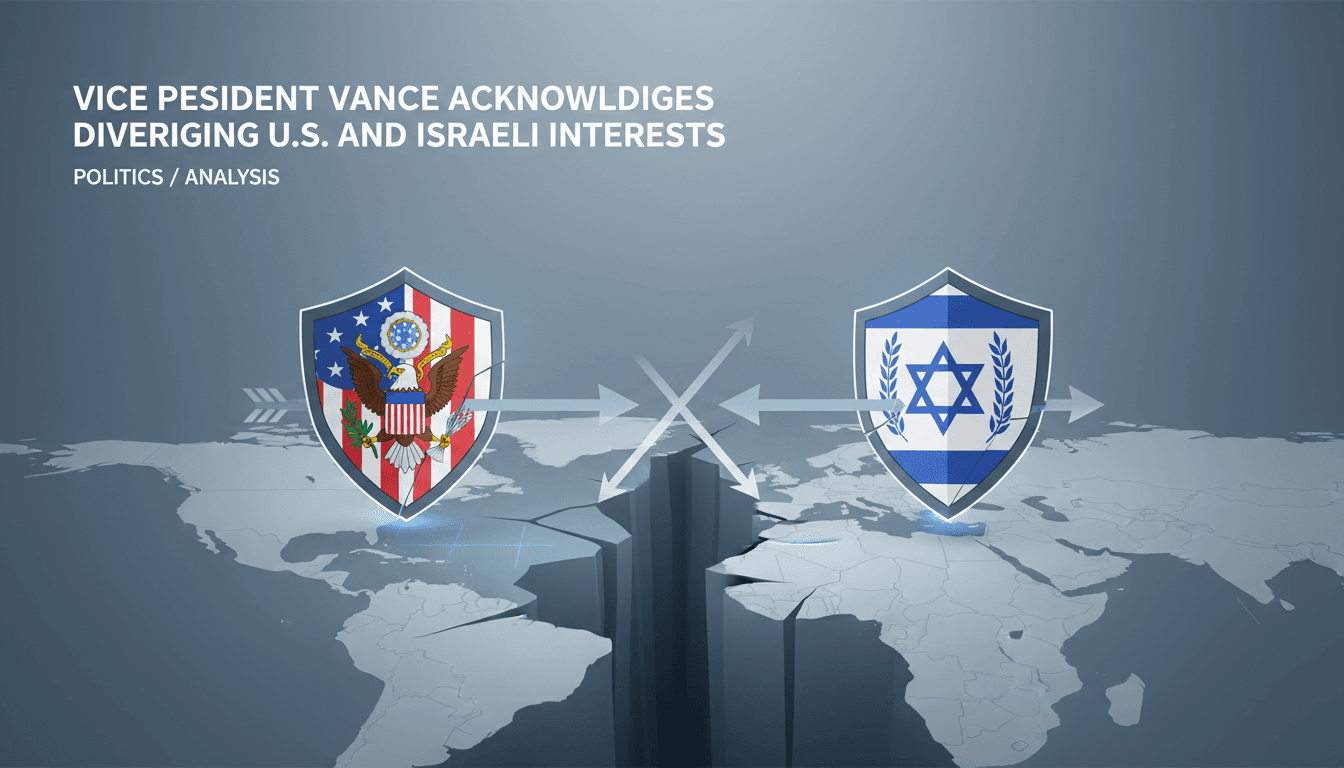
Here's what it means for you.
Vice President J.D. Vance's recent remarks signal a potential shift in U.S. foreign policy, particularly regarding its relationship with Israel. By acknowledging that U.S. and Israeli interests are not always aligned, Vance emphasizes the importance of evaluating foreign influence in American politics. This perspective may lead to a more independent approach to foreign alliances, particularly in the Middle East. As the U.S. reassesses its geopolitical strategies, stakeholders in both domestic and international arenas will need to adapt to these evolving dynamics. The implications of Vance's statements could reshape how the U.S. engages with its allies, prompting a reevaluation of long-standing partnerships.
What happened
Vice President J.D. Vance stated that U.S. and Israeli interests are not always aligned, highlighting the complexities in their relationship. He noted that Israel, like other nations, seeks to influence U.S. policy, which reflects a more nuanced understanding of international relations. These comments were made during a recent talk show appearance, where Vance discussed the broader implications of foreign influence on American politics.
His acknowledgment of diverging interests underscores a critical moment in U.S.-Israel relations, suggesting that the traditional alignment may be under scrutiny. This recognition of differing priorities could lead to significant changes in how the U.S. formulates its foreign policy.
The Context
Vance's remarks come amid ongoing discussions about U.S. foreign policy in the Middle East, a region where alliances have historically been complex and multifaceted. The Vice President highlighted the need for U.S. leaders to be cautious about foreign influence, a sentiment that resonates with growing concerns among the American public regarding external pressures on domestic policy.
This acknowledgment of Israel's attempts to influence U.S. policy reflects a broader trend of reevaluating international relationships. As the geopolitical landscape shifts, understanding the nuances of these alliances becomes increasingly important for policymakers and citizens alike.
Takeaway
The implications of Vance's statements may lead to increased scrutiny of foreign influence in U.S. politics and a reevaluation of alliances, particularly in the context of Middle Eastern geopolitics. Observers should watch for potential shifts in U.S. foreign policy towards Israel and the broader region as these discussions unfold.
Responses from Israeli officials regarding Vance's comments will also be critical in shaping the future of U.S.-Israel relations. As the U.S. navigates its foreign policy, the focus on independent interests may redefine how it engages with allies moving forward.
Pan-Arab political news and analysis.
"Al-Quds Al-Arabi is a London-based Arabic newspaper known for political coverage."
— A47 Editor
فانس: إسرائيل تسعى للتأثير على السياسة الأمريكية
J.D. Vance has stated that Israel is actively seeking to influence American politics, highlighting the ongoing interplay between foreign interests and domestic policy in the United States. This assertion reflects concerns about the extent to which ex...
Arabic-language political and world news coverage for UAE readers.
"Emarat Al Youm world coverage usually presents international developments through a UAE and Arab audience lens."
— A47 Editor
فانس: مصالحنا لا تتطابق دائماً مع إسرائيل وتهمة "معاداة السامية" تُستغل سياسياً فانس: مصالحنا لا تتطابق دائماً مع إسرائيل وتهمة "معاداة السامية" تُستغل سياسياً
U.S. Vice President Vance stated that American interests do not always align with those of Israel, highlighting a realistic approach to U.S. foreign policy. He also noted that the accusation of anti-Semitism is often politically exploited.
Arabic-language coverage of international news and geopolitics.
"RT Arabic is a Russian state-funded outlet often criticized for promoting Kremlin-aligned narratives."
— A47 Editor
فانس: المصالح الأمريكية والإسرائيلية ليست متطابقة دائما.. نحن دولتان مختلفتان وهناك تصور خاطئ سائد
U.S. Vice President D.J. Vance made significant remarks regarding the nature of the relationship between the United States and Israel, emphasizing that their interests are not always aligned and that there is a prevailing misconception about their re...