
Trump Announces Immediate Reopening of Strait of Hormuz After Iran Peace Agreement
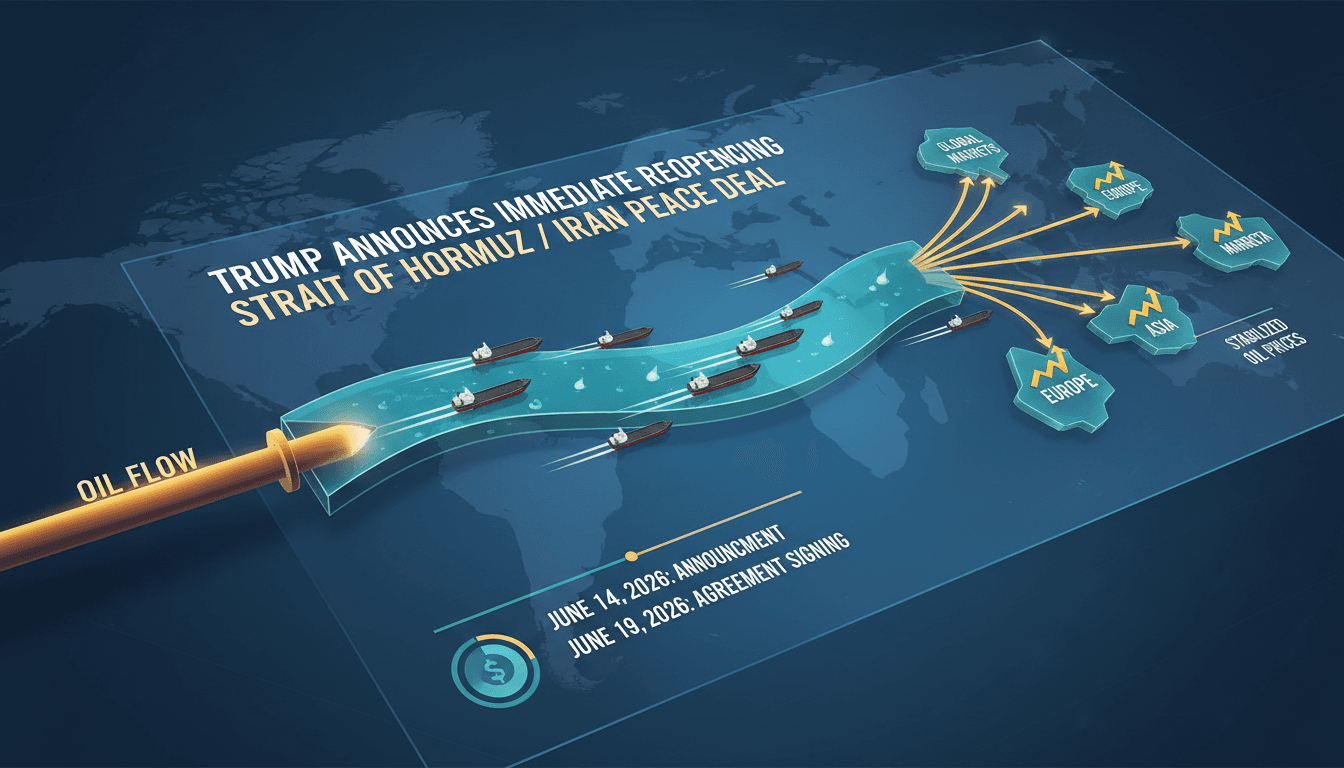
Here's what it means for you.
If you’re involved in global trade or energy markets, this development could significantly impact shipping costs and supply chains.
Why it matters
The reopening of the Strait of Hormuz is crucial for stabilizing global oil prices and ensuring the smooth flow of energy resources.
What happened (in 30 seconds)
- On June 14, 2026, President Trump announced the immediate reopening of the Strait of Hormuz following a peace agreement with Iran set for June 19, 2026.
- This strait is a vital maritime chokepoint, with approximately 20% of the world's oil and liquefied natural gas transported through it.
- Market reactions have included fluctuations in oil prices as investors respond to the potential stabilization of the region.
The context you actually need
- The Strait of Hormuz is a critical passage for global energy supplies, making its stability essential for international markets.
- Tensions between the U.S. and Iran have historically led to disruptions in shipping, causing significant fluctuations in oil prices and impacting global economies.
- The peace agreement aims to restore normalcy in maritime trade, contrasting with previous agreements that involved financial transactions, which may influence investor confidence.
What's really happening
On June 14, 2026, President Trump took to Truth Social to announce a significant diplomatic breakthrough: the Strait of Hormuz would reopen immediately following a peace agreement with Iran, scheduled for June 19, 2026. This announcement comes amid escalating tensions that have disrupted maritime trade and caused volatility in global oil prices. The Strait of Hormuz is not just a geographical feature; it is a critical artery for the global economy, with about 20% of the world's oil and liquefied natural gas passing through it.
The peace agreement, as outlined by Trump, is designed to alleviate the ongoing conflicts that have plagued U.S.-Iran relations. Unlike the previous Joint Comprehensive Plan of Action (JCPOA) established under the Obama administration, this new agreement emphasizes that no financial transactions will occur, which Trump believes will foster a more stable environment for trade. However, Iranian officials have expressed caution regarding the details and timeline of the deal, indicating that while the U.S. is optimistic, the situation remains fluid.
The announcement has already generated significant attention from global markets, particularly in the energy sector. Investors are closely monitoring the situation, as the reopening of the Strait of Hormuz is expected to restore normalcy in maritime trade, which has been severely impacted by previous conflicts. The potential stabilization of the region could lead to lower oil prices, benefiting consumers and businesses reliant on energy resources.
However, the implications extend beyond just oil prices. The reopening of the strait is anticipated to enhance Dubai's logistics and trade sectors, reinforcing its role as a key hub in regional and global markets. As shipping routes normalize, businesses in Dubai and surrounding areas may experience increased trade volumes, leading to economic growth and job creation.
In summary, while the announcement is a positive step towards peace and stability in the region, the cautious response from Iranian officials highlights the complexities of international diplomacy. The coming days leading up to the signing of the agreement will be critical in determining the actual impact on global markets and regional stability.
Who feels it first (and how)
- Energy companies: Fluctuations in oil prices will directly affect profitability and operational costs.
- Shipping and logistics firms: A stable Strait of Hormuz will reduce shipping delays and costs, impacting supply chains.
- Consumers: Potential decreases in oil prices could lead to lower fuel costs and energy prices.
- Dubai's trade sector: Increased trade activity may boost economic growth and job opportunities in the emirate.
What to watch next
- Market reactions: Monitor oil price fluctuations as the signing date approaches, which will indicate investor sentiment regarding the agreement's viability.
- Iranian government responses: Pay attention to any statements or actions from Iranian officials that could signal their commitment to the agreement.
- Global shipping trends: Watch for changes in shipping routes and logistics operations as the Strait of Hormuz reopens, impacting trade dynamics.
The Strait of Hormuz is a critical passage for global oil and gas supplies.
The reopening will stabilize oil prices and enhance trade in the region.
The long-term sustainability of the peace agreement and its impact on U.S.-Iran relations.
Frequently Asked Questions
- Why it matters?
- The reopening of the Strait of Hormuz is crucial for stabilizing global oil prices and ensuring the smooth flow of energy resources.
- What happened (in 30 seconds)?
- On June 14, 2026, President Trump announced the immediate reopening of the Strait of Hormuz following a peace agreement with Iran set for June 19, 2026. This strait is a vital maritime chokepoint, with approximately 20% of the world's oil and liquefied natural gas transported through it. Market reactions have included fluctuations in oil prices as investors respond to the potential stabilization of the region.
- What's really happening?
- On June 14, 2026, President Trump took to Truth Social to announce a significant diplomatic breakthrough: the Strait of Hormuz would reopen immediately following a peace agreement with Iran, scheduled for June 19, 2026. This announcement comes amid escalating tensions that have disrupted maritime trade and caused volatility in global oil prices. The Strait of Hormuz is not just a geographical feature; it is a critical artery for the global economy, with about 20% of the world's oil and liquefied
- Who feels it first (and how)?
- Energy companies: Fluctuations in oil prices will directly affect profitability and operational costs. Shipping and logistics firms: A stable Strait of Hormuz will reduce shipping delays and costs, impacting supply chains. Consumers: Potential decreases in oil prices could lead to lower fuel costs and energy prices. Dubai's trade sector: Increased trade activity may boost economic growth and job opportunities in the emirate.
- What to watch next?
- Market reactions: Monitor oil price fluctuations as the signing date approaches, which will indicate investor sentiment regarding the agreement's viability. Iranian government responses: Pay attention to any statements or actions from Iranian officials that could signal their commitment to the agreement. Global shipping trends: Watch for changes in shipping routes and logistics operations as the Strait of Hormuz reopens, impacting trade dynamics.
Arabic-language political and world news coverage for UAE readers.
"Emarat Al Youm world coverage usually presents international developments through a UAE and Arab audience lens."
— A47 Editor
ترامب يعلن أن مضيق هرمز سيُفتَح مجدداً بعد توقيع الاتفاق مع إيران الجمعة ترامب يعلن أن مضيق هرمز سيُفتَح مجدداً بعد توقيع الاتفاق مع إيران الجمعة
U.S. President Donald Trump announced that the Strait of Hormuz will be reopened following the signing of a peace agreement with Iran on Friday. This declaration marks a significant shift in U.S.-Iran relations and suggests a potential easing of tens...
Algerian news with politics, society, and sports coverage.
"Ennahar Online is a high-volume Algerian outlet."
— A47 Editor
ترامب يعلن إتمام الاتفاق مع إيران ويدعو لتدفق النفط وحرية الملاحة
President Donald Trump announced the successful completion of a formal agreement with the Islamic Republic of Iran, marking a significant diplomatic achievement aimed at reducing tensions between the two nations. He stated that he has ordered the lif...
Jordanian news and regional updates.
"Roya News is a Jordanian outlet focused on breaking news and local affairs."
— A47 Editor
ترمب: اتفاق السلام مع إيران ينهي فشل الرؤساء السابقين ويعيد تدفق النفط عبر مضيق هرمز
U.S. President Donald Trump announced a significant peace agreement with Iran, claiming it resolves the failures of previous administrations and facilitates the flow of oil through the Strait of Hormuz. This development marks a pivotal moment in U.S....
Jordanian news and regional updates.
"Roya News is a Jordanian outlet focused on breaking news and local affairs."
— A47 Editor
ترمب يعلن إتمام الاتفاق مع إيران ورفع الحصار البحري وفتح مضيق هرمز
President Donald Trump officially announced the completion of an agreement with Iran, which includes lifting the maritime blockade and reopening the Strait of Hormuz. This development marks a significant diplomatic achievement aimed at easing tension...
Arabic-language reporting on global and regional news.
"BBC Arabic is part of the BBC, generally regarded for editorial standards and broad international coverage."
— A47 Editor
ترامب: توقيع اتفاق مع إيران اليوم يليه فتح مضيق هرمز، وطهران تتحفّظ: موعد التوقيع لم يُحسم بعد
U.S. President Donald Trump announced that an agreement with Iran to end the ongoing conflict is set to be signed on Sunday, which would be followed by the reopening of the Strait of Hormuz. However, Tehran has stated that the date for signing has no...
Arabic-language coverage of international news and geopolitics.
"RT Arabic is a Russian state-funded outlet often criticized for promoting Kremlin-aligned narratives."
— A47 Editor
مسؤول أمريكي: الاتفاق مع إيران ينص على فتح مضيق هرمز ورفع الحصار عن موانئها
A senior U.S. official announced the emergence of a framework agreement with Iran, aimed at ending months of conflict. The agreement includes provisions for the opening of the Strait of Hormuz and lifting the blockade on Iranian ports.
Arabic-language coverage of international news and geopolitics.
"RT Arabic is a Russian state-funded outlet often criticized for promoting Kremlin-aligned narratives."
— A47 Editor
ترامب يعلن موعد توقيع الاتفاق بين الولايات المتحدة وإيران
On Saturday evening, U.S. President Donald Trump announced that the United States and Iran will sign an agreement on Sunday, June 14, after which the Strait of Hormuz will be opened. This development marks a significant diplomatic step between the tw...