
Australia Proposes News Bargaining Incentive Legislation for Tech Giants
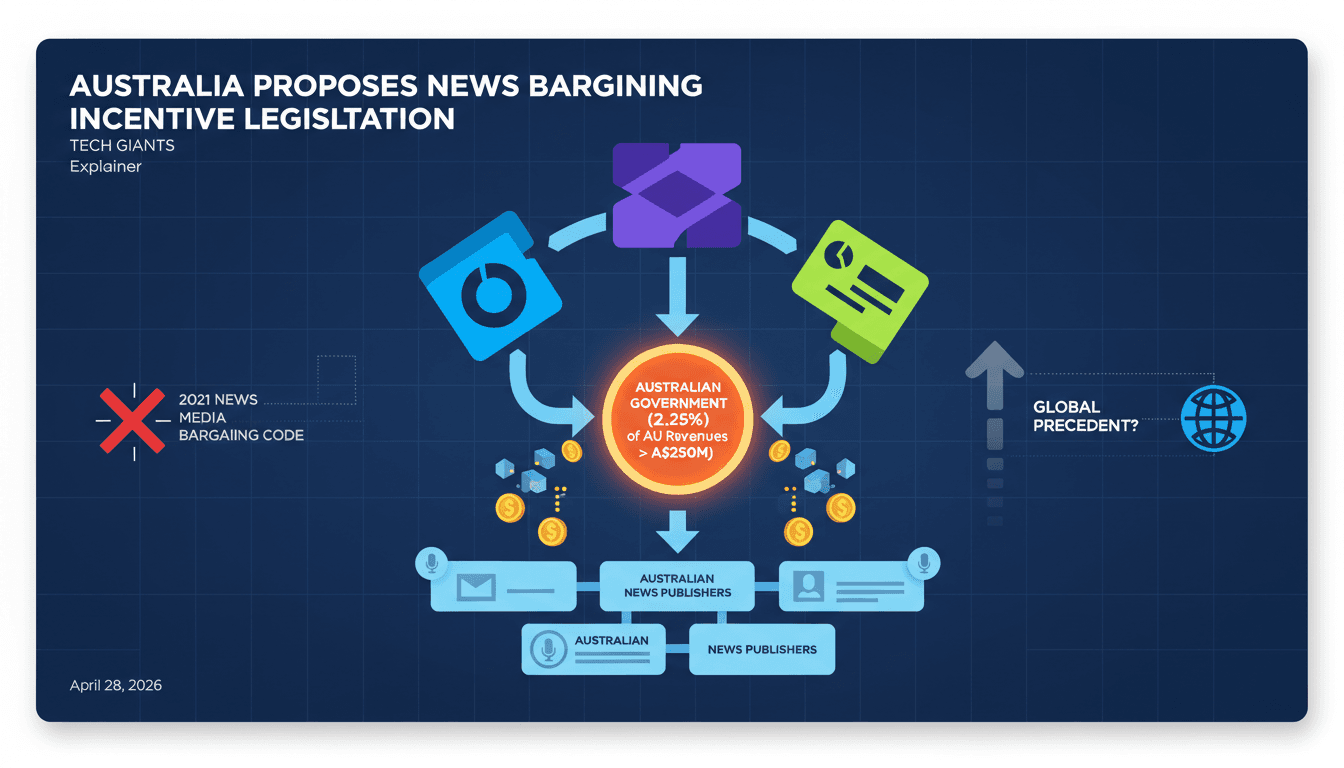
Here's what it means for you.
If you rely on news content, this legislation could reshape how tech platforms fund journalism in Australia and potentially influence global practices.
Why it matters
This legislation represents a significant shift in the relationship between tech giants and news publishers, potentially setting a precedent for similar policies worldwide.
What happened (in 30 seconds)
- On April 28, 2026, Communications Minister Anika Wells announced the draft News Bargaining Incentive legislation targeting Meta, Google, and TikTok.
- The legislation imposes a 2.25% levy on local revenues exceeding A$250 million unless these platforms negotiate payments to Australian news publishers.
- Public consultation is open until May 18, 2026, with the law set to take effect on July 1, 2026.
The context you actually need
- The 2021 News Media Bargaining Code aimed to facilitate negotiations between tech platforms and publishers but fell short after Meta withdrew from agreements in March 2024.
- The new legislation seeks to enforce contributions from platforms with significant Australian user bases, addressing the shortcomings of the previous code.
- Projected annual revenue from the levy is estimated at A$200–250 million, which will be distributed to newsrooms based on journalist employment numbers.
What's really happening
The Australian government's draft News Bargaining Incentive legislation is a direct response to the perceived failures of the 2021 News Media Bargaining Code. Initially designed to compel tech platforms like Meta and Google to negotiate payments for news content, the code yielded limited results, with only A$250 million in deals over three years. The situation escalated when Meta terminated its agreements in March 2024, effectively blocking news content and circumventing its obligations. This move highlighted the vulnerabilities in the existing framework, prompting media coalitions to call for reforms.
The new legislation introduces a 2.25% levy on local revenues exceeding A$250 million, which applies regardless of whether the platforms use news content. This approach aims to ensure that tech giants contribute to the sustainability of journalism in Australia, particularly as traditional revenue streams for news organizations have dwindled. The levy is designed to generate an estimated A$200–250 million annually, which will be allocated to newsrooms based on the number of employed journalists, thereby directly linking funding to workforce size.
The legislation also includes provisions for reducing the levy to approximately 1.5% for platforms that negotiate deals valued at 150–170% of the levy amount. This incentivizes platforms to engage in negotiations rather than simply paying the tax, creating a potential win-win scenario for both tech companies and news publishers.
However, the response from the tech giants has been critical. Meta has labeled the levy a "digital services tax" and a "wealth transfer," arguing that publishers voluntarily post content on their platforms. Google has similarly rejected the necessity of the legislation, citing over 90 existing deals with publishers and questioning the exclusion of AI firms like OpenAI from the requirements. TikTok has remained silent on the matter.
The joint media statement from major Australian news organizations, including ABC, News Corp, and Nine, welcomed the draft legislation as vital for the sustainability of journalism. Prime Minister Anthony Albanese emphasized the importance of national sovereignty in the face of global tech influence, framing the legislation as a necessary step to protect local media.
As the public consultation period unfolds, the outcome of this legislation could have far-reaching implications, not just for Australia but for how tech platforms engage with news publishers globally. The potential for similar measures in other countries looms large, as governments grapple with the challenges posed by digital monopolies.
Who feels it first (and how)
- Australian news publishers: They stand to gain direct financial support, which could stabilize their operations.
- Tech platforms (Meta, Google, TikTok): They will need to navigate new financial obligations or negotiate deals, impacting their revenue models.
- Journalists and media employees: Increased funding could lead to job security and potentially more hiring in the news sector.
What to watch next
- Public consultation outcomes: The feedback received by May 18, 2026, could influence the final form of the legislation.
- Negotiation dynamics: Watch how tech platforms respond in terms of deal-making with news publishers before the law takes effect.
- Global reactions: Other countries may consider similar legislation based on Australia's approach, impacting international tech-media relations.
The legislation is set to take effect on July 1, 2026, pending public consultation.
Tech platforms will seek to negotiate deals to minimize their financial liabilities under the new law.
The long-term impact on the sustainability of journalism in Australia and potential global policy shifts remains to be seen.
Frequently Asked Questions
- Why it matters?
- This legislation represents a significant shift in the relationship between tech giants and news publishers, potentially setting a precedent for similar policies worldwide.
- What happened (in 30 seconds)?
- On April 28, 2026, Communications Minister Anika Wells announced the draft News Bargaining Incentive legislation targeting Meta, Google, and TikTok. The legislation imposes a 2.25% levy on local revenues exceeding A$250 million unless these platforms negotiate payments to Australian news publishers. Public consultation is open until May 18, 2026, with the law set to take effect on July 1, 2026.
- What's really happening?
- The Australian government's draft News Bargaining Incentive legislation is a direct response to the perceived failures of the 2021 News Media Bargaining Code. Initially designed to compel tech platforms like Meta and Google to negotiate payments for news content, the code yielded limited results, with only A$250 million in deals over three years. The situation escalated when Meta terminated its agreements in March 2024, effectively blocking news content and circumventing its obligations. This mo
- Who feels it first (and how)?
- Australian news publishers: They stand to gain direct financial support, which could stabilize their operations. Tech platforms (Meta, Google, TikTok): They will need to navigate new financial obligations or negotiate deals, impacting their revenue models. Journalists and media employees: Increased funding could lead to job security and potentially more hiring in the news sector.
- What to watch next?
- Public consultation outcomes: The feedback received by May 18, 2026, could influence the final form of the legislation. Negotiation dynamics: Watch how tech platforms respond in terms of deal-making with news publishers before the law takes effect. Global reactions: Other countries may consider similar legislation based on Australia's approach, impacting international tech-media relations.
Breaking news, politics, business, and entertainment from the U.S. and around the world.
"The New York Post is a tabloid-format newspaper known for its sensationalist headlines and conservative-leaning editorial tone."
— A47 Editor
Australia to require Google, Meta, TikTok to pay for local news — or face new tax
Australia is set to introduce the “News Bargaining Incentive,” a proposed law that would require social media giants Google, Meta, and TikTok to pay for local news content or face a 2.25% tax on their local revenues if they fail to negotiate agreemen...
International coverage from The Guardian's global desks.
"The Guardian is known for its progressive editorial stance and in-depth analysis."
— A47 Editor
Trump administration labels Australia’s media bargaining laws ‘foreign extortion’
The Trump administration has criticized Australia's proposed media bargaining laws, labeling them as 'foreign extortion.' Prime Minister Anthony Albanese is advocating for a 2.25% levy on revenues from tech giants Meta, Google, and TikTok, compelling...
International stories from NPR’s global desk.
"NPR is an American public media organization known for thoughtful reporting and a slightly left-leaning editorial tone."
— A47 Editor
Australia moves to tax Meta, Google and TikTok to fund newsrooms
The Australian government is proposing a new tax on major tech companies, including Meta, Google, and TikTok, to fund local newsrooms. This draft legislation aims to introduce a 2.25% levy on the local revenues of these companies, which will be prese...
Science discoveries, research, and analysis.
"NPR is a nonprofit media organization offering thoughtful, in-depth journalism and storytelling, often with a liberal or progressive slant."
— A47 Editor
Australia moves to tax Meta, Google and TikTok to fund newsrooms
The Australian government is proposing a new tax on major tech companies, including Meta, Google, and TikTok, to fund local newsrooms. This draft legislation aims to introduce a 2.25% levy on the local revenues of these companies, which will be prese...
Arabic-language coverage of international news and geopolitics.
"RT Arabic is a Russian state-funded outlet often criticized for promoting Kremlin-aligned narratives."
— A47 Editor
أستراليا تقترح فرض ضريبة على عمالقة التكنولوجيا
Australia has proposed a tax on major digital technology companies such as Meta, Google, and TikTok, calculated as a percentage of their revenues, with the aim of funding journalists and supporting the news sector.
Startup news with frequent AI coverage.
"Covers launches, funding, and product updates in AI."
— A47 Editor
Australia forces Big Tech firms to pay for news or face a 2.25% tax
The Australian government has introduced a draft legislation imposing a 2.25% levy on the local revenues of major tech companies, including Meta, Google, and TikTok, effective July 1, 2026. This initiative aims to ensure these firms compensate local ...
Tech news, hardware, and AI tools coverage.
"PC/tech site increasingly covering AI hardware and apps."
— A47 Editor
Australia gives Google, Meta, and TikTok a choice: pay news outlets or pay a 2.25% tax
The Australian government has proposed a new framework requiring major digital platforms, including Google, Meta, and TikTok, to either compensate local news publishers for their content or face a 2.25% levy on their local revenues, effective July 1,...
Regional and international reporting focused on Middle Eastern politics, diplomacy, and economics.
"Asharq Al-Awsat is a Saudi-owned international newspaper reflecting mainstream Gulf political perspectives."
— A47 Editor
Australia Aims to Tax Tech Giants Unless They Pay News Outlets
Australia is moving forward with plans to impose taxes on major tech companies unless they compensate news outlets for the content they utilize, reflecting ongoing tensions between traditional media and digital platforms.
News and features on AI from The Guardian.
"Progressive-leaning international outlet with critical AI coverage."
— A47 Editor
Tech giants face new levy to pay for Australian news as Meta calls position ‘simply wrong’
The Australian government has proposed a new 2.25% levy on local revenues of tech giants Google, Meta, and TikTok, aimed at ensuring these companies compensate local media outlets for news content. Prime Minister Anthony Albanese emphasized that digi...
International coverage from The Guardian's global desks.
"The Guardian is known for its progressive editorial stance and in-depth analysis."
— A47 Editor
Tech giants face new levy to pay for Australian news as Meta calls position ‘simply wrong’
The Australian government has proposed a new 2.25% levy on local revenues of tech giants Google, Meta, and TikTok, aimed at ensuring these companies compensate local media outlets for news content. Prime Minister Anthony Albanese emphasized that digi...
24/7 international news from a French perspective in multiple languages.
"France 24 is viewed as a globally focused outlet with balanced coverage and a European perspective."
— A47 Editor
Australia targets tech giants with levy unless they pay for local news
Australia has introduced draft legislation requiring tech giants Meta, Google, and TikTok to pay local publishers for news content, or face a 2.25% levy on their Australian revenue. This move aims to bolster struggling media outlets and reduce the in...
Political, social, and economic news across Asia and the Pacific.
"France 24 is viewed as a globally focused outlet with balanced coverage and a European perspective."
— A47 Editor
Australia targets tech giants with levy unless they pay local news outlets
Australia has proposed draft legislation requiring tech giants Meta, Google, and TikTok to compensate local news publishers for their content, or face a 2.25% levy on their Australian revenues. This initiative aims to support struggling media outlets...