
Malik Beasley Agrees to Plead Guilty in Federal Sports Betting Conspiracy Case
Why it matters
The formal admission of on-court statistical manipulation by an active professional athlete exposes how personal liquidity shortfalls intersect with sports wagering markets to compromise institutional asset integrity.
What happened (in 30 seconds)
- The formal plea: On October 28, 2026, 29-year-old former NBA guard Malik Beasley reached an agreement to plead guilty in Brooklyn federal court to charges connected to an illegal sports wagering conspiracy.
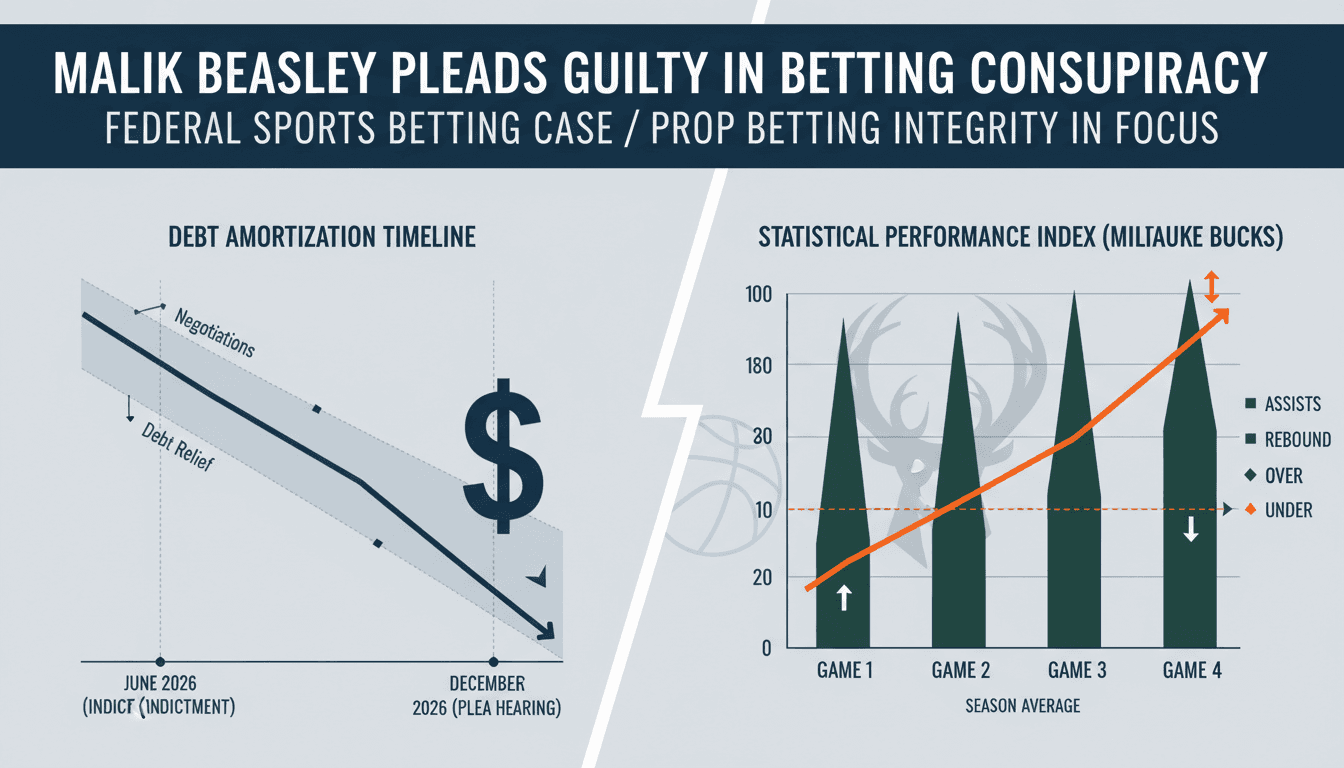
- The underlying scheme: Federal prosecutors established that Beasley intentionally manipulated his statistical output across four Milwaukee Bucks games during the 2023-2024 season to influence proposition bets in exchange for personal debt relief.
- The legal schedule: A change-of-plea hearing is set for December 9, 2026, in the U.S. District Court for the Eastern District of New York, following earlier guilty pleas by co-conspirators.
The context you actually need
- A multi-million-dollar deficit: Beasley entered the arrangement after accumulating substantial gambling debts during his playing career, ultimately borrowing funds from former teammate Ed Davis before agreeing to alter his performance.
- The second federal benchmark: Beasley represents the second NBA player to enter a federal guilty plea concerning betting manipulation, following the prior prosecution and lifetime ban of Jontay Porter.
- A wider syndicate: The federal indictment unsealed on June 29, 2026, named six individuals—including Beasley, Davis, Paolo Zamorano, William Brown, Robert Gorodetsky, and Ernesto Plascencia—on charges ranging from wire fraud to sports bribery and money laundering conspiracy.
What's really happening
The underlying mechanics of this case highlight a structural vulnerability within modern professional athletics: the misalignment between high top-line earnings and acute balance-sheet distress. Beasley’s agreement to alter his on-court metrics across four discrete contests illustrates how proposition bets—wagers tied to individual micro-statistics such as points, rebounds, or three-pointers rather than aggregate game outcomes—create targeted exposure for institutional franchises.
In traditional point-shaving schemes, an athlete had to alter the final outcome of a game, an intervention that required considerable disruption to team performance and carried high operational visibility. By contrast, individual statistical proposition markets allow an athlete to underperform or overperform within routine rotational variances. When a player agrees to miss statistical thresholds in a handful of appearances, the manipulation registers externally as routine athletic variance, injury precaution, or tactical coaching adjustments rather than intentional interference.
The economic incentive structure detailed by federal prosecutors reveals how secondary debt markets exploit this asymmetry. Beasley did not receive direct cash payouts for these performances; instead, his micro-actions functioned as debt amortization. Faced with multi-million-dollar liabilities accumulated through persistent wagering, Beasley leveraged his access to the court as a non-cash settlement asset. Creditors and organized syndicates, including figures such as William Brown and Robert Gorodetsky, held the debt instruments and generated their returns downstream by taking leveraged positions on predictable statistical underperformance.
For league administrators and commercial operators, this introduces significant operational risk. Franchise valuations and broadcast partnerships rely heavily on market confidence in outcome authenticity. While sports entertainment conglomerates have integrated real-time wagering platforms to boost audience engagement and data licensing revenue, the Beasley indictment demonstrates that the regulatory perimeter remains permeable at the athlete liquidity level.
When player compensation fails to mitigate external creditor leverage, the integrity of the core media product degrades. The legal resolution in the Eastern District of New York establishes that federal authorities are applying enterprise-level conspiracy statutes—including honest services wire fraud and commercial sports bribery—to penalize the exploitation of these analytical micro-markets.
Who feels it first (and how)
- Franchise legal and compliance officers: Face heightened exposure regarding athlete financial monitoring, requiring more rigorous reporting frameworks around uncollateralized personal debts.
- Sports betting platform operators: Face increased regulatory scrutiny regarding suspicious volume detection on low-liquidity proposition markets tied to individual player milestones.
- Professional sports unions and agents: Must address structural debt management interventions earlier in player careers to insulate athletes from predatory debt-settlement arrangements.
What to watch next
- The December 9 plea allocation: The specific statutory charge Beasley admits to will signal the baseline legal exposure for future institutional bribery cases in professional sports.
- Co-defendant sentencing disparities: The judicial terms handed down to non-athlete facilitators, including Ed Davis and Robert Gorodetsky, will define how federal courts penalize the financing side of statistical manipulation rings.
- Prop-bet monitoring revisions: Whether sportsbook compliance desks and sports integrity firms adjust liquidity caps or limit specific in-game proposition lines on secondary rotational players.
Beasley has agreed to plead guilty in the Eastern District of New York on December 9, 2026, for manipulating stats in four 2023-2024 Milwaukee Bucks games to service personal debts.
The NBA will formalize permanent disciplinary disqualification actions consistent with precedents established in previous federal betting guilty pleas.
The precise custodial sentence Beasley faces, and the extent to which offshore or unregulated betting syndicates captured margins on the four documented games.
Frequently Asked Questions
- Why it matters?
- The formal admission of on-court statistical manipulation by an active professional athlete exposes how personal liquidity shortfalls intersect with sports wagering markets to compromise institutional asset integrity.
- What happened (in 30 seconds)?
- The formal plea: On October 28, 2026, 29-year-old former NBA guard Malik Beasley reached an agreement to plead guilty in Brooklyn federal court to charges connected to an illegal sports wagering conspiracy. The underlying scheme: Federal prosecutors established that Beasley intentionally manipulated his statistical output across four Milwaukee Bucks games during the 2023-2024 season to influence proposition bets in exchange for personal debt relief. The legal schedule: A change-of-plea hearing i
- What's really happening?
- The underlying mechanics of this case highlight a structural vulnerability within modern professional athletics: the misalignment between high top-line earnings and acute balance-sheet distress. Beasley’s agreement to alter his on-court metrics across four discrete contests illustrates how proposition bets—wagers tied to individual micro-statistics such as points, rebounds, or three-pointers rather than aggregate game outcomes—create targeted exposure for institutional franchises. In traditiona
- Who feels it first (and how)?
- Franchise legal and compliance officers: Face heightened exposure regarding athlete financial monitoring, requiring more rigorous reporting frameworks around uncollateralized personal debts. Sports betting platform operators: Face increased regulatory scrutiny regarding suspicious volume detection on low-liquidity proposition markets tied to individual player milestones. Professional sports unions and agents: Must address structural debt management interventions earlier in player careers to insu
- What to watch next?
- The December 9 plea allocation: The specific statutory charge Beasley admits to will signal the baseline legal exposure for future institutional bribery cases in professional sports. Co-defendant sentencing disparities: The judicial terms handed down to non-athlete facilitators, including Ed Davis and Robert Gorodetsky, will define how federal courts penalize the financing side of statistical manipulation rings. Prop-bet monitoring revisions: Whether sportsbook compliance desks and sports integr
Coverage of professional and college sports, with a West Coast perspective.
"The Los Angeles Times is a major West Coast newspaper offering in-depth reporting with a liberal editorial tone and strong regional focus."
— A47 Editor
Former Laker Malik Beasley agrees to plead guilty in federal court over gambling ring involvement
Former NBA guard Malik Beasley has agreed to plead guilty in a federal case tied to an alleged gambling ring, in which he is accused of illegally manipulating his performance in NBA games. He was indicted in June after prosecutors alleged he manipula...
Commentary, news, and media analysis across major leagues and sports culture.
"Deadspin delivers sports commentary and news with a humorous, sometimes irreverent editorial tone."
— A47 Editor
Reports: Malik Beasley to plead guilty in federal betting case
Veteran guard Malik Beasley is set to enter a guilty plea in a federal betting-related bribery and conspiracy case, according to his attorney, Steve Haney, as reported by Deadspin. Beasley, a former NBA player, was indicted in June after prosecutors ...
General sports headlines, features, and player interviews.
"Yahoo Sports offers broad sports coverage including exclusive interviews and multimedia content."
— A47 Editor
Ex-NBA guard Malik Beasley to plead guilty after involvement in gambling scheme
Former NBA guard Malik Beasley was indicted in June after prosecutors alleged he manipulated several NBA games as part of a larger gambling scheme, and he is set to plead guilty to the charges.