
DOJ Investigates Andreessen Horowitz for Antitrust Violations in AI Sector
Why it matters
This probe could redefine how venture capital firms manage board memberships across competing companies, impacting investment dynamics.
What happened (in 30 seconds)
- The U.S. Department of Justice launched an antitrust investigation into Andreessen Horowitz (a16z) in August 2025.
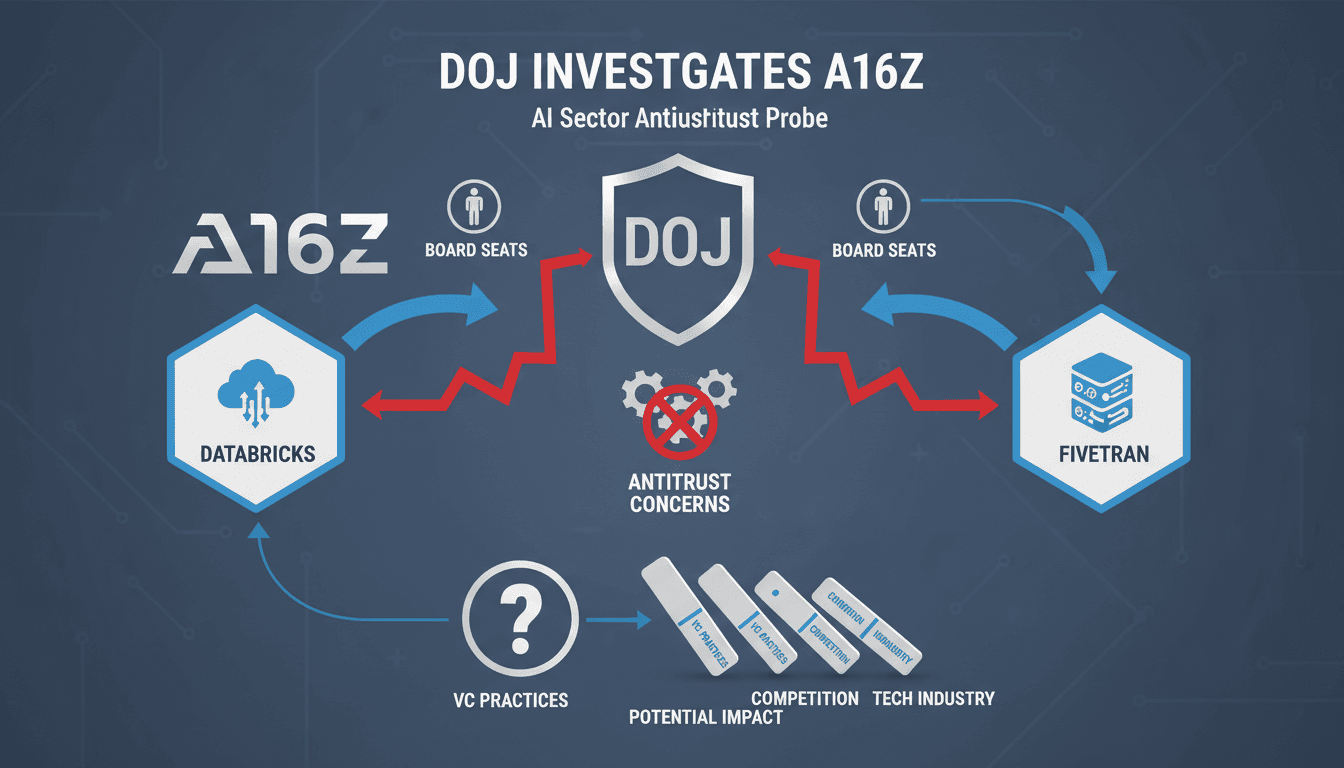
- Key partners Ben Horowitz and Martin Casado are under scrutiny for serving on boards of competing AI data firms, Databricks and Fivetran.
- The investigation invokes Section 8 of the Clayton Act, a rarely applied provision in the venture capital space.
The context you actually need
- Section 8 of the Clayton Act prohibits individuals from serving on boards of competing companies if it may lessen competition.
- Venture capital firms often have overlapping investments, making such investigations uncommon but increasingly relevant in the rapidly evolving AI sector.
- Andreessen Horowitz's extensive portfolio includes hundreds of startups, raising the likelihood of interlocking directorates in a competitive landscape.
What's really happening
The DOJ's investigation into Andreessen Horowitz (a16z) marks a significant moment in the intersection of venture capital and antitrust law. The focus on co-founders Ben Horowitz and Martin Casado, who hold board positions at Databricks and Fivetran respectively, highlights a growing concern over competitive practices in the booming AI data sector. Both companies, while initially positioned in different niches, have increasingly overlapped in their offerings related to data analytics and AI pipelines.
Historically, the application of Section 8 of the Clayton Act has been rare in the venture capital world, where portfolio overlaps are common due to the nature of investment strategies. However, the rapid growth of the AI sector has led to a surge in companies pivoting into adjacent markets, raising the stakes for potential conflicts of interest. The DOJ's scrutiny suggests a shift in regulatory focus, potentially signaling a new era of oversight for venture capital firms.
The investigation has left many in the venture capital community baffled, as board memberships have typically been viewed as standard practice, often managed through information firewalls to mitigate conflicts. The rarity of such probes into VC practices raises questions about the future of board governance and the implications for investment strategies. If the DOJ decides to enforce action, it could lead to a reevaluation of how venture capital firms structure their boards and manage their investments.
Market observers are already speculating about the potential ripple effects on VC commitments and the broader investment landscape. While no immediate shifts in valuations or portfolio adjustments have been documented as of late August 2026, the uncertainty surrounding the investigation could lead to a more cautious approach among venture capitalists. The implications extend beyond a16z, as other firms may reconsider their board structures to avoid similar scrutiny.
As the investigation unfolds, the venture capital community will be watching closely. The outcome could set a precedent for how interlocking directorates are viewed in the context of competition law, potentially reshaping the landscape of venture capital investment in the tech sector.
Who feels it first (and how)
- Venture Capitalists: They may need to reassess board structures and investment strategies to avoid scrutiny.
- Tech Startups: Companies with overlapping interests may face increased regulatory pressure and scrutiny.
- Investors: Changes in governance practices could impact investment confidence and valuations.
What to watch next
- Regulatory Developments: Keep an eye on any formal actions or resolutions from the DOJ regarding this investigation, as they could set new standards for board governance.
- Market Reactions: Watch for shifts in investment strategies among venture capital firms as they adapt to potential new regulations.
- Industry Responses: Observe how other firms in the tech sector respond to this investigation, particularly regarding board memberships and competitive practices.
The DOJ is actively investigating Andreessen Horowitz for potential antitrust violations.
Other venture capital firms may begin to reevaluate their board structures in light of this investigation.
The long-term implications for venture capital practices and the tech sector remain uncertain.
Frequently Asked Questions
- Why it matters?
- This probe could redefine how venture capital firms manage board memberships across competing companies, impacting investment dynamics.
- What happened (in 30 seconds)?
- The U.S. Department of Justice launched an antitrust investigation into Andreessen Horowitz (a16z) in August 2025. Key partners Ben Horowitz and Martin Casado are under scrutiny for serving on boards of competing AI data firms, Databricks and Fivetran. The investigation invokes Section 8 of the Clayton Act, a rarely applied provision in the venture capital space.
- What's really happening?
- The DOJ's investigation into Andreessen Horowitz (a16z) marks a significant moment in the intersection of venture capital and antitrust law. The focus on co-founders Ben Horowitz and Martin Casado, who hold board positions at Databricks and Fivetran respectively, highlights a growing concern over competitive practices in the booming AI data sector. Both companies, while initially positioned in different niches, have increasingly overlapped in their offerings related to data analytics and AI pipe
- Who feels it first (and how)?
- Venture Capitalists: They may need to reassess board structures and investment strategies to avoid scrutiny. Tech Startups: Companies with overlapping interests may face increased regulatory pressure and scrutiny. Investors: Changes in governance practices could impact investment confidence and valuations.
- What to watch next?
- Regulatory Developments: Keep an eye on any formal actions or resolutions from the DOJ regarding this investigation, as they could set new standards for board governance. Market Reactions: Watch for shifts in investment strategies among venture capital firms as they adapt to potential new regulations. Industry Responses: Observe how other firms in the tech sector respond to this investigation, particularly regarding board memberships and competitive practices.
Startup news with frequent AI coverage.
"Covers launches, funding, and product updates in AI."
— A47 Editor
DOJ’s probe into Andreessen Horowitz over board seats baffles VCs
The U.S. Department of Justice (DOJ) is investigating venture capital firm Andreessen Horowitz regarding potential antitrust violations linked to its partners serving on the boards of competing artificial intelligence companies. This inquiry has rais...
Daily AI news: models, tools, and policy.
"Independent outlet tracking the fast pace of AI."
— A47 Editor
DOJ probes Andreessen Horowitz over partners sitting on competing AI boards
<p><img width="2560" height="1429" src="https://the-decoder.com/wp-content/uploads/2026/02/Office-Work-AI-scaled.jpg" class="attachment-full size-full wp-post-image" alt="" style="height: auto; margin-bottom: 10px;" decoding="async" /></p> <p> ...
Real-time updates, analysis, and reports on the blockchain and cryptocurrency sectors.
"Crypto News delivers real-time updates, analysis, and reports on the blockchain and cryptocurrency sectors."
— A47 Editor
DOJ antitrust probe targets a16z over competing AI board roles
The U.S. Department of Justice (DOJ) is investigating Andreessen Horowitz (a16z) for potential antitrust violations related to its partners serving on the boards of competing artificial intelligence companies. This inquiry has been ongoing for nearly...