
Z.ai's GLM-5.3 Achieves Top Ranking in Open AI Models with Delayed Weight Release
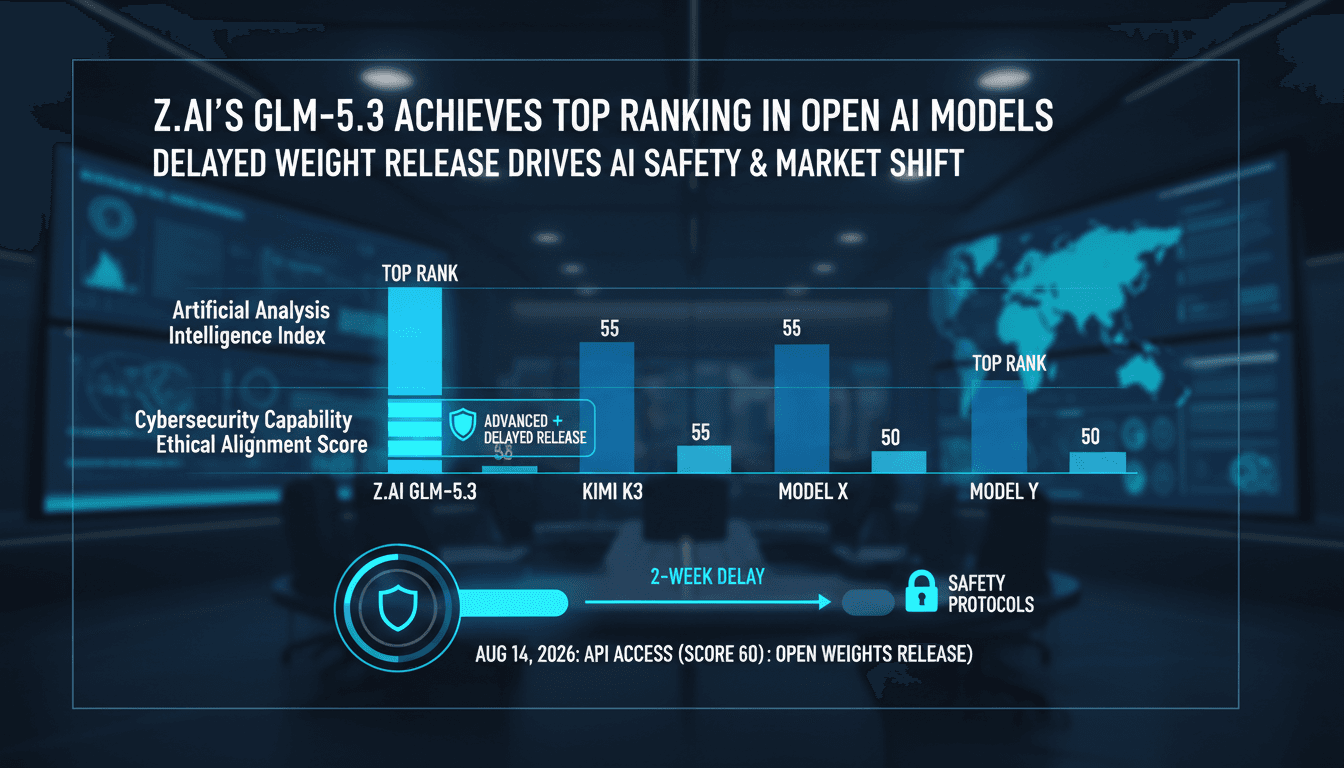
Here's what it means for you.
If you're in tech or cybersecurity, the delayed open-weights release of GLM-5.3 could impact your access to cutting-edge AI capabilities.
Why it matters
The staged rollout of GLM-5.3 reflects a strategic shift in AI model deployment, prioritizing safety and security in a competitive landscape.
What happened (in 30 seconds)
- On August 14, 2026, Z.ai launched GLM-5.3, achieving a top score of 60 on the Artificial Analysis Intelligence Index.
- API access is live, but public open-weights distribution is delayed until approximately August 28, 2026, for safety evaluations.
- GLM-5.3 outperforms its predecessor, GLM-5.2, by seven points and excels in coding and cybersecurity tasks.
The context you actually need
- Chinese AI labs are rapidly advancing in open-weight model development to compete with Western systems, leveraging shared base models.
- Z.ai's previous model, GLM-5.2, had immediate open weights, making the delay for GLM-5.3 notable and indicative of evolving safety protocols.
- Emerging cybersecurity capabilities in GLM-5.3 prompted the need for additional safety evaluations, highlighting the model's potential risks and rewards.
What's really happening
Z.ai's GLM-5.3 launch marks a significant moment in the AI landscape, particularly in the realm of open models. By tying for the highest score on the Artificial Analysis Intelligence Index, GLM-5.3 not only showcases Z.ai's technical prowess but also reflects a broader trend in AI development where safety and security are becoming paramount. The decision to delay the public release of open weights for approximately two weeks is a strategic move aimed at ensuring that the model's emergent cybersecurity capabilities are thoroughly vetted before widespread access.
This cautious approach stems from the increasing recognition of the potential risks associated with advanced AI models. As AI systems become more capable, they also become more attractive targets for exploitation. The strong performance of GLM-5.3 in vulnerability detection and exploitation benchmarks indicates that while the model can be a powerful tool for developers, it could also pose significant risks if misused. By prioritizing safety evaluations, Z.ai aims to mitigate these risks, ensuring that the model can be deployed responsibly.
The competitive pricing of $0.68 per task for GLM-5.3 further underscores Z.ai's strategy to position itself favorably against rivals like Kimi K3. This pricing strategy, combined with the model's enhanced capabilities, is likely to attract early adopters in coding workflows, even with the temporary limitation on open weights. The immediate API access through the GLM Coding Plan and ZCode allows developers to start integrating GLM-5.3 into their projects, albeit with some constraints.
The staged rollout also reflects a shift in market dynamics, where companies are increasingly aware of the implications of releasing powerful AI tools without adequate safety measures. As the AI landscape evolves, the balance between innovation and safety will be crucial. Z.ai's approach may set a precedent for other companies, encouraging them to adopt similar practices in their model releases.
In summary, the launch of GLM-5.3 is not just about a new AI model; it's a reflection of the changing priorities in the AI industry, where safety and security are becoming as important as performance and cost.
Who feels it first (and how)
- Tech developers: Immediate access to API allows integration into workflows, but limited open weights may restrict full utilization.
- Cybersecurity professionals: Enhanced capabilities in vulnerability detection could improve security measures but require careful handling.
- AI researchers: The staged release prompts discussions on safety protocols and model evaluation standards in the AI community.
What to watch next
- August 28, 2026: The release of open weights will be a critical date, determining how quickly the model can be adopted across various sectors.
- Market response: Monitor how competitors react to Z.ai's pricing and safety strategy, which could influence future AI model releases.
- Regulatory developments: Increased scrutiny on AI safety may lead to new guidelines that impact how models like GLM-5.3 are developed and released.
GLM-5.3 achieved a score of 60 on the Artificial Analysis Intelligence Index, tying it with Kimi K3.
The staged release will influence other AI companies to adopt similar safety-first approaches in their model launches.
The long-term impact of GLM-5.3's cybersecurity capabilities on the market and potential regulatory responses remains to be seen.
Frequently Asked Questions
- Why it matters?
- The staged rollout of GLM-5.3 reflects a strategic shift in AI model deployment, prioritizing safety and security in a competitive landscape.
- What happened (in 30 seconds)?
- On August 14, 2026, Z.ai launched GLM-5.3, achieving a top score of 60 on the Artificial Analysis Intelligence Index. API access is live, but public open-weights distribution is delayed until approximately August 28, 2026, for safety evaluations. GLM-5.3 outperforms its predecessor, GLM-5.2, by seven points and excels in coding and cybersecurity tasks.
- What's really happening?
- Z.ai's GLM-5.3 launch marks a significant moment in the AI landscape, particularly in the realm of open models. By tying for the highest score on the Artificial Analysis Intelligence Index, GLM-5.3 not only showcases Z.ai's technical prowess but also reflects a broader trend in AI development where safety and security are becoming paramount. The decision to delay the public release of open weights for approximately two weeks is a strategic move aimed at ensuring that the model's emergent cyberse
- Who feels it first (and how)?
- Tech developers: Immediate access to API allows integration into workflows, but limited open weights may restrict full utilization. Cybersecurity professionals: Enhanced capabilities in vulnerability detection could improve security measures but require careful handling. AI researchers: The staged release prompts discussions on safety protocols and model evaluation standards in the AI community.
- What to watch next?
- August 28, 2026: The release of open weights will be a critical date, determining how quickly the model can be adopted across various sectors. Market response: Monitor how competitors react to Z.ai's pricing and safety strategy, which could influence future AI model releases. Regulatory developments: Increased scrutiny on AI safety may lead to new guidelines that impact how models like GLM-5.3 are developed and released.
Daily AI news: models, tools, and policy.
"Independent outlet tracking the fast pace of AI."
— A47 Editor
GLM-5.3 tops the open-model rankings and undercuts rivals on price, but its release is delayed
Z.ai's GLM-5.3 has achieved a score of 60 on the Artificial Analysis Intelligence Index, tying it with Kimi K3 for the top position among open models, although its release has been delayed. This model represents a significant advancement over its pre...
Curated tech headlines including AI stories.
"Influential aggregator surfacing the day’s top tech/AI links."
— A47 Editor
Z.ai prices GLM-5.3 API access at $1.40 per million input tokens and $4.40 per million output tokens, unchanged from GLM-5.2 (Carl Franzen/VentureBeat)
Z.ai has announced the pricing for its GLM-5.3 API access, maintaining the rates at $1.40 per million input tokens and $4.40 per million output tokens, consistent with the previous GLM-5.2 model. This pricing strategy follows the model's recent launc...
Focuses on transformative tech, AI, gaming, and startup innovation.
"VentureBeat is respected for its in-depth reporting on AI, startups, and disruptive technologies in Silicon Valley and beyond."
— A47 Editor
GLM-5.3 hits the API at $1.4/$4.4 per million tokens
GLM-5.3, the latest open-source language model from Chinese startup Z.ai, has been launched with advanced cyber capabilities and is now available via API, allowing developers to integrate it into their applications. The model has already identified a...