
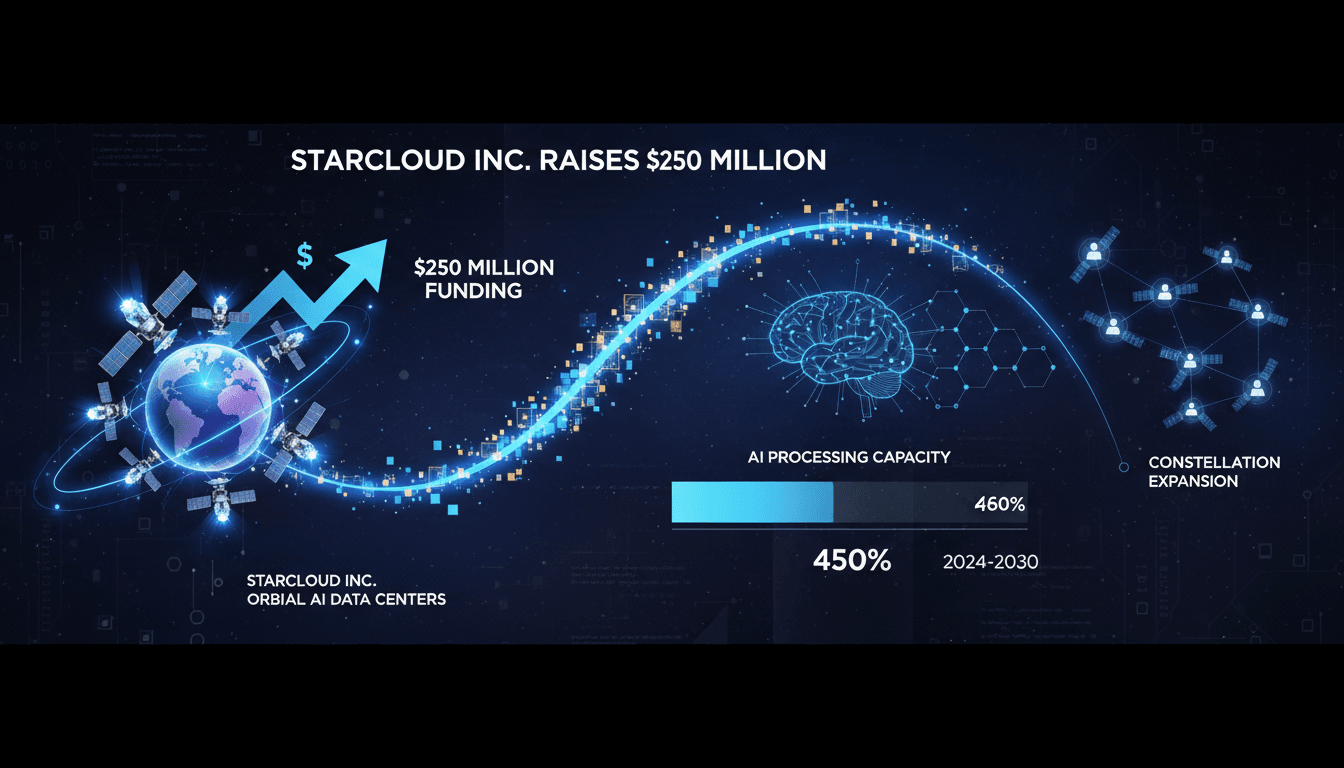
Starcloud Inc. raises $250 million to expand orbital AI data center capabilities
Why it matters
The demand for AI processing power is outpacing terrestrial capabilities, pushing innovation into space.
What happened (in 30 seconds)
- Starcloud Inc. announced a $250 million Series A extension funding round at a $2.3 billion valuation.
- Investors include Manhattan West, Nvidia, and Cisco, bringing total funding to $450 million since 2024.
- The capital will support the expansion of manufacturing and the development of orbital data centers to alleviate terrestrial constraints.
The context you actually need
- AI growth is straining existing data center infrastructure, leading to increased energy demands and regulatory hurdles.
- Starcloud's approach utilizes solar energy and passive cooling in low-Earth orbit, bypassing many terrestrial limitations.
- The company's trajectory includes plans for a constellation of 88,000 satellites, targeting a combined computing capacity of 20 gigawatts.
What's really happening
Starcloud Inc. is at the forefront of a transformative shift in how data centers are conceptualized and constructed, particularly in the context of artificial intelligence (AI). Founded in 2024, the company has quickly recognized the limitations of traditional data centers, which are increasingly unable to meet the surging demand for AI model training and inference. The recent $250 million Series A extension funding round, which brings the company's total funding to $450 million, is a strategic move to scale its operations and enhance its technological capabilities.
The core of Starcloud's innovation lies in its deployment of satellites equipped for AI processing in low-Earth orbit. This approach leverages continuous solar energy, eliminating the need for complex terrestrial power systems that are often constrained by regulatory and environmental factors. The passive radiative cooling technology employed by Starcloud further reduces the reliance on water and energy-intensive cooling systems that are typical in ground-based data centers. This not only addresses the immediate challenges of energy consumption and cooling but also positions Starcloud as a pioneer in sustainable computing.
The funding will facilitate the construction of a new 100,000-square-foot manufacturing facility in Woodinville, Washington, aimed at mass-producing the next generation of satellites, specifically the Starcloud-3 model. This satellite is designed to deliver a power footprint of 200 kW, significantly enhancing the company's capacity to process AI workloads in orbit. Additionally, the collaboration with industry giants like Nvidia and Cisco Investments underscores the growing interest and investment in orbital computing solutions.
As Starcloud continues to develop its satellite constellation, including the upcoming Starcloud-2 and the ambitious Starcloud-4, the implications for the tech industry are profound. The company aims to deploy a total of 88,000 satellites, which would collectively provide 20 gigawatts of computing power. This level of capacity could redefine the landscape of AI infrastructure, making it more scalable and efficient while reducing the environmental impact associated with traditional data centers.
However, this shift also raises questions about competition and market dynamics. With SpaceX and other companies exploring similar orbital computing solutions, the race for dominance in this emerging sector is heating up. As Starcloud secures its position, it will be crucial to monitor how these developments influence pricing, accessibility, and the overall landscape of AI technology.
Who feels it first (and how)
- Tech companies: Increased access to scalable AI processing power could enhance product development and innovation.
- Energy sectors: The shift to orbital data centers may impact energy consumption patterns and regulatory frameworks.
- Investors: Opportunities in the burgeoning space tech market could lead to significant returns, but also increased competition.
What to watch next
- Launch schedules: Keep an eye on Starcloud's satellite launches, particularly the Starcloud-2 in 2027, as they will indicate progress in orbital capabilities.
- Regulatory developments: Watch for any changes in regulations regarding space-based data centers, which could affect operational viability.
- Market competition: Monitor how competitors like SpaceX respond to Starcloud's advancements, as this will shape the future of orbital computing.
Starcloud has secured $250 million in funding and plans to expand its manufacturing capabilities.
The demand for AI processing power will continue to grow, driving further investment in orbital data centers.
The long-term regulatory landscape for space-based data centers remains uncertain and could impact operational strategies.
Frequently Asked Questions
- Why it matters?
- The demand for AI processing power is outpacing terrestrial capabilities, pushing innovation into space.
- What happened (in 30 seconds)?
- Starcloud Inc. announced a $250 million Series A extension funding round at a $2.3 billion valuation. Investors include Manhattan West, Nvidia, and Cisco, bringing total funding to $450 million since 2024. The capital will support the expansion of manufacturing and the development of orbital data centers to alleviate terrestrial constraints.
- What's really happening?
- Starcloud Inc. is at the forefront of a transformative shift in how data centers are conceptualized and constructed, particularly in the context of artificial intelligence (AI). Founded in 2024, the company has quickly recognized the limitations of traditional data centers, which are increasingly unable to meet the surging demand for AI model training and inference. The recent $250 million Series A extension funding round, which brings the company's total funding to $450 million, is a strategic
- Who feels it first (and how)?
- Tech companies: Increased access to scalable AI processing power could enhance product development and innovation. Energy sectors: The shift to orbital data centers may impact energy consumption patterns and regulatory frameworks. Investors: Opportunities in the burgeoning space tech market could lead to significant returns, but also increased competition.
- What to watch next?
- Launch schedules: Keep an eye on Starcloud's satellite launches, particularly the Starcloud-2 in 2027, as they will indicate progress in orbital capabilities. Regulatory developments: Watch for any changes in regulations regarding space-based data centers, which could affect operational viability. Market competition: Monitor how competitors like SpaceX respond to Starcloud's advancements, as this will shape the future of orbital computing.
AI news with an enterprise and cloud focus.
"Covers AI in the context of data infrastructure, cloud, and enterprise stacks."
— A47 Editor
Starcloud raises $250M to build AI data centers in orbit
Starcloud Inc. has successfully raised $250 million in funding, achieving a valuation of $2.3 billion, with Manhattan West leading the investment round. Notable backers include Nvidia Corp. and Cisco Investments, highlighting strong interest in the c...
Curated tech headlines including AI stories.
"Influential aggregator surfacing the day’s top tech/AI links."
— A47 Editor
Space data center startup Starcloud raised a $250M extension, at a $2.3B valuation, to its March $170M Series A; source: Nvidia invested $25M (Tim Fernholz/TechCrunch)
Starcloud, a startup focused on developing satellites for AI inference in orbit, has successfully raised a $250 million extension to its March $170 million Series A funding round, bringing its valuation to $2.3 billion. This funding is crucial as the...
Startup news with frequent AI coverage.
"Covers launches, funding, and product updates in AI."
— A47 Editor
Starcloud raises $250 million for orbital data centers as launch options dry up
Starcloud has successfully raised $250 million to develop orbital data centers, a significant move as competition for access to space intensifies. This funding comes at a time when launch options are becoming increasingly limited, highlighting the ur...