
Thomson Reuters Launches Proprietary Large Language Model for Legal Applications
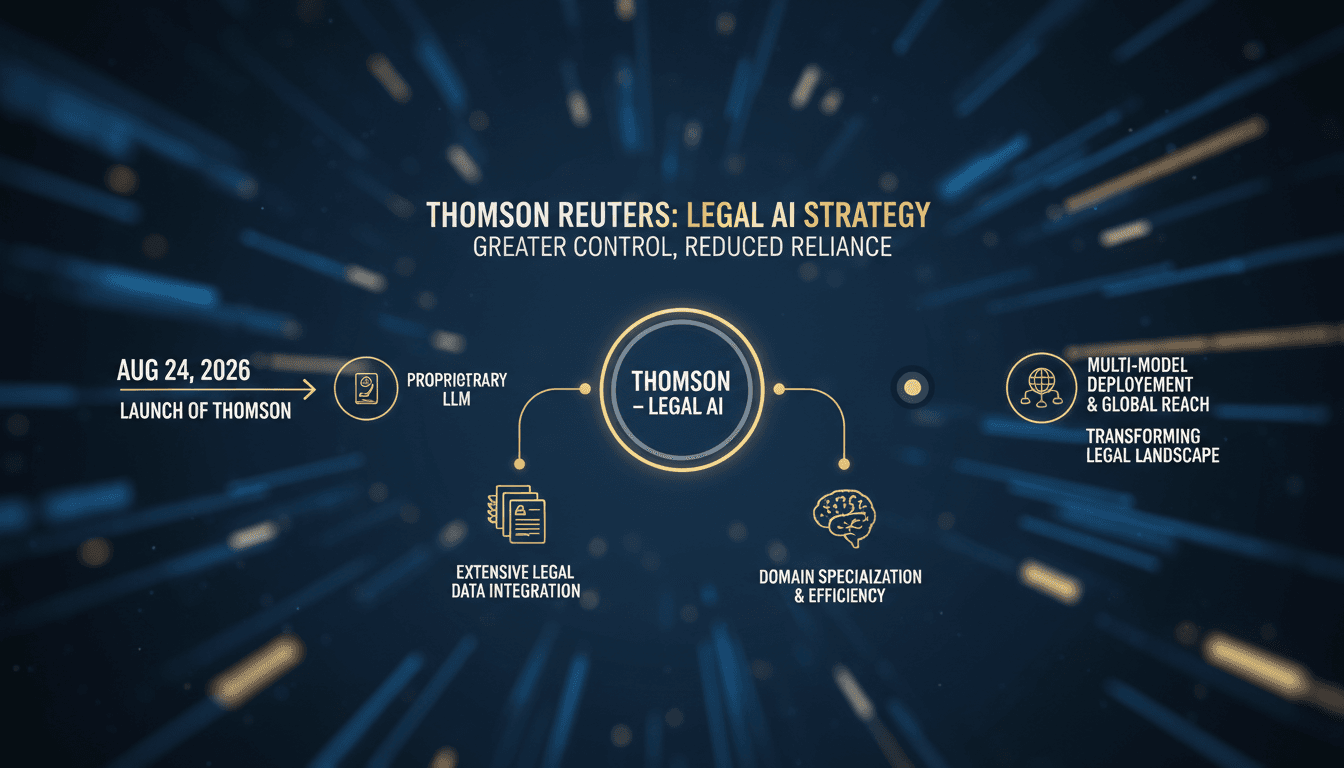
Here's what it means for you.
The launch of Thomson, a proprietary AI model, could redefine how legal professionals manage document review and analysis.
Why it matters
Thomson Reuters' move to develop its own AI model signals a significant shift in the legal tech landscape, emphasizing control over proprietary data and specialized applications.
What happened (in 30 seconds)
- Launch Date: Thomson Reuters introduced its proprietary large language model, Thomson, on August 24, 2026.
- Initial Deployment: The model is initially integrated into the Tabular Analysis feature of the CoCounsel Legal AI assistant, aimed at enhancing document review efficiency.
- Investment: The development of Thomson involved approximately $40 million over two years, focusing on leveraging the company's extensive legal data.
The context you actually need
- Strategic Shift: Thomson Reuters has transitioned from using third-party AI models to developing its own, allowing for greater control over training data and governance.
- Historical Expertise: With 175 years of curated legal content, the company aims to capitalize on its proprietary resources to enhance AI capabilities.
- Market Positioning: The launch reflects a broader trend in the legal sector towards specialized AI solutions that can outperform general-purpose models in specific applications.
What's really happening
On August 24, 2026, Thomson Reuters unveiled Thomson, its first in-house proprietary large language model (LLM), marking a pivotal moment in the legal technology sector. This development is not just a technological advancement; it represents a strategic pivot for Thomson Reuters, which has historically relied on third-party AI models. The company invested approximately $40 million over two years to create Thomson, with the final training run costing about $450,000. This investment was made possible by fine-tuning an open-weight foundation model with proprietary legal content and editorial expertise.
The decision to develop Thomson stems from a desire for greater control over AI capabilities and a reduction in reliance on external models. By leveraging its extensive database, including resources from Westlaw and Practical Law, Thomson Reuters aims to provide a more tailored and efficient solution for legal professionals. The initial deployment of Thomson in the Tabular Analysis feature of the CoCounsel Legal AI assistant is designed to support high-volume document review, a critical task for law firms and corporate legal departments.
Early evaluations indicate that Thomson performs competitively with leading frontier models, particularly when augmented with Thomson Reuters' proprietary content. This competitive edge is crucial as the legal sector increasingly seeks specialized AI tools that can enhance productivity and reduce costs. The company plans to share Thomson with legal experts and academics for external testing, further validating its capabilities.
Moreover, Thomson Reuters intends to release a smaller open-weight version of the model on Hugging Face under a noncommercial license, expanding access to its technology. This move aligns with the company's multi-model strategy, which continues to incorporate third-party providers like OpenAI and Anthropic, ensuring a diverse range of AI solutions for its clients.
The implications of this launch extend beyond just technological advancements; they reflect a broader trend in the legal industry towards sovereignty in AI development. By controlling its training data and deployment, Thomson Reuters is positioning itself as a leader in the legal AI space, emphasizing cost efficiency and domain specialization.
Who feels it first (and how)
- Law Firms: Increased efficiency in document review processes, leading to cost savings and faster turnaround times.
- Corporate Legal Departments: Enhanced capabilities for managing high-volume legal documents, improving overall productivity.
- Legal Tech Developers: Potential shifts in market dynamics as proprietary models gain traction over third-party solutions.
What to watch next
- Performance Metrics: Monitor Thomson's performance against leading models to gauge its effectiveness and adoption in the legal sector.
- User Feedback: Pay attention to feedback from legal professionals testing Thomson, as this will shape future iterations and enhancements.
- Market Trends: Watch for shifts in the legal tech landscape as more firms consider proprietary AI solutions, potentially impacting vendor relationships.
Thomson Reuters has launched its proprietary LLM, Thomson, with initial deployment in CoCounsel Legal.
The model will expand its applications across various legal and tax products, enhancing its utility.
The long-term market impact of Thomson on existing third-party AI providers remains to be seen.
Frequently Asked Questions
- Why it matters?
- Thomson Reuters' move to develop its own AI model signals a significant shift in the legal tech landscape, emphasizing control over proprietary data and specialized applications.
- What happened (in 30 seconds)?
- Launch Date: Thomson Reuters introduced its proprietary large language model, Thomson, on August 24, 2026. Initial Deployment: The model is initially integrated into the Tabular Analysis feature of the CoCounsel Legal AI assistant, aimed at enhancing document review efficiency. Investment: The development of Thomson involved approximately $40 million over two years, focusing on leveraging the company's extensive legal data.
- What's really happening?
- On August 24, 2026, Thomson Reuters unveiled Thomson, its first in-house proprietary large language model (LLM), marking a pivotal moment in the legal technology sector. This development is not just a technological advancement; it represents a strategic pivot for Thomson Reuters, which has historically relied on third-party AI models. The company invested approximately $40 million over two years to create Thomson, with the final training run costing about $450,000. This investment was made possi
- Who feels it first (and how)?
- Law Firms: Increased efficiency in document review processes, leading to cost savings and faster turnaround times. Corporate Legal Departments: Enhanced capabilities for managing high-volume legal documents, improving overall productivity. Legal Tech Developers: Potential shifts in market dynamics as proprietary models gain traction over third-party solutions.
- What to watch next?
- Performance Metrics: Monitor Thomson's performance against leading models to gauge its effectiveness and adoption in the legal sector. User Feedback: Pay attention to feedback from legal professionals testing Thomson, as this will shape future iterations and enhancements. Market Trends: Watch for shifts in the legal tech landscape as more firms consider proprietary AI solutions, potentially impacting vendor relationships.
AI news with an enterprise and cloud focus.
"Covers AI in the context of data infrastructure, cloud, and enterprise stacks."
— A47 Editor
Thomson Reuters launches proprietary AI model for legal work
Thomson Reuters Corp. has launched its first proprietary large language model, named Thomson, which integrates the company's extensive legal knowledge with external LLMs to provide legal advice. The initial deployment will focus on Tabular Analysis, ...
Business and tech news excluding paywalled content.
"High-volume business/tech outlet with frequent AI coverage."
— A47 Editor
Thomson Reuters built its own AI model off Chinese tech to rely less on Claude
Thomson Reuters has launched its first AI model, named Thomson-1, as part of a strategic initiative to reduce its reliance on Anthropic's Claude for AI solutions. This move marks a significant step for the company in developing proprietary technology...
Daily AI news: models, tools, and policy.
"Independent outlet tracking the fast pace of AI."
— A47 Editor
Thomson Reuters bets $40M on owning its AI instead of renting from OpenAI or Anthropic
Thomson Reuters is investing approximately $40 million over two years to develop its own language model named 'Thomson,' built on Alibaba's Qwen. This strategic move aims to leverage the company's proprietary content, such as Westlaw, to enhance the ...