
Thomson Reuters Launches Proprietary LLM for Legal Applications
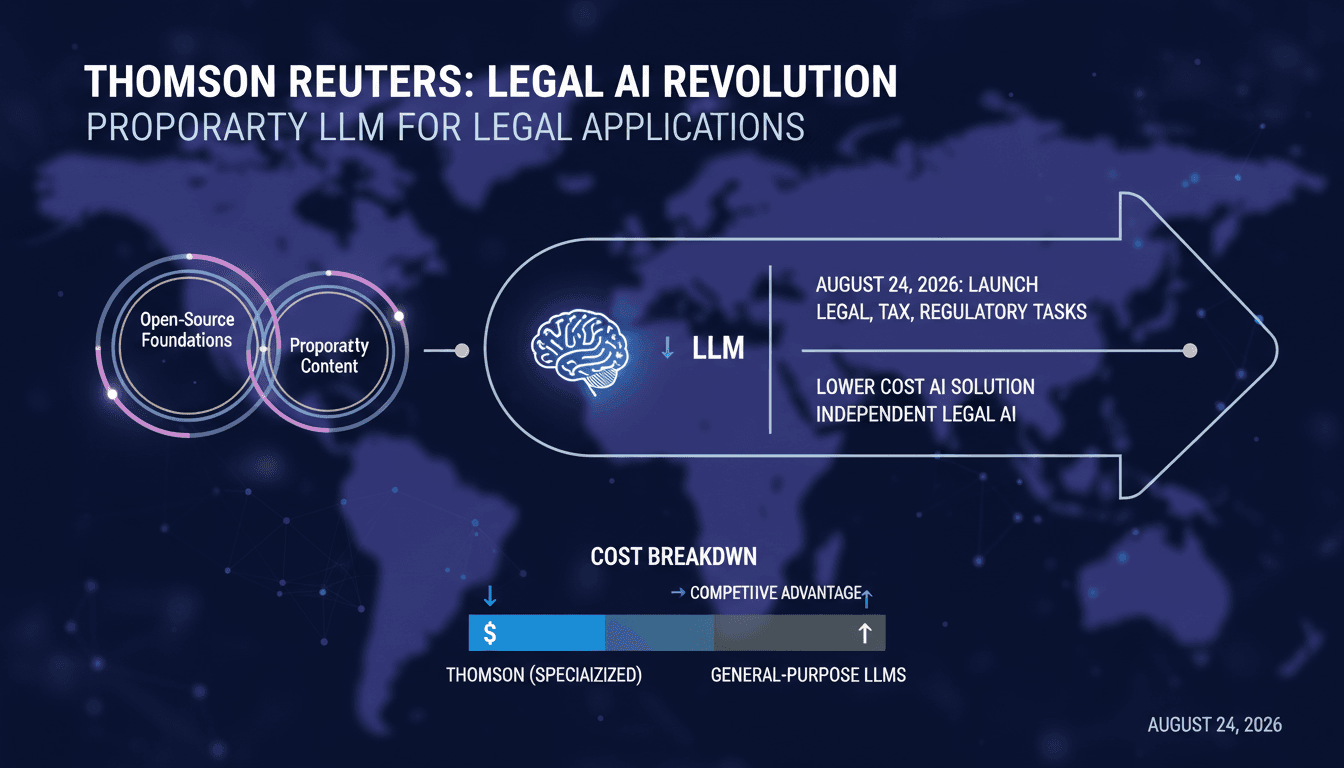
Here's what it means for you.
If you're in the legal profession, the launch of Thomson could reshape how you access and utilize legal resources.
Why it matters
The introduction of Thomson signals a shift towards specialized AI solutions in professional services, potentially lowering costs and increasing efficiency.
What happened (in 30 seconds)
- Thomson Reuters launched Thomson on August 24, 2026, its proprietary large language model designed specifically for legal, tax, and regulatory tasks.
- The model integrates with CoCounsel Legal's Tabular Analysis feature, leveraging over 175 years of proprietary content to enhance legal research and analysis.
- Initial reactions highlight its cost efficiency and domain specialization, suggesting a potential shift in the economics of legal technology.
The context you actually need
- Thomson Reuters has a rich history in legal databases, with over 40,000 databases spanning more than 150 years, providing a strong foundation for Thomson.
- The legal industry is increasingly seeking specialized AI to address the limitations of general-purpose models, particularly in regulated environments.
- Thomson was developed at a cost of approximately $40 million, with the final training run costing $450,000, showcasing a strategic investment in proprietary technology.
What's really happening
On August 24, 2026, Thomson Reuters unveiled Thomson, a proprietary large language model (LLM) tailored for the legal sector. This launch is part of a broader strategy to leverage the company's extensive historical data and expertise in legal content. Developed over two years, Thomson was built with a total investment of around $40 million, with the final training phase costing $450,000. This investment reflects a calculated approach to harnessing open-source foundations while maintaining control over proprietary data.
The model's initial deployment within the CoCounsel Legal platform's Tabular Analysis feature allows legal professionals to conduct high-volume analyses efficiently. Thomson's design emphasizes accuracy, specialization, and auditability—key factors in legal work where precision is paramount. By integrating Thomson with existing resources like Westlaw and Practical Law, Thomson Reuters aims to provide a competitive edge against other frontier models while significantly reducing operational costs.
Early benchmarks indicate that Thomson performs competitively or even superiorly on legal tasks when utilizing Thomson Reuters' proprietary content. This performance is crucial as it positions Thomson as a viable alternative to existing models, which often rely on general data sets that may not meet the specific needs of legal professionals. The company plans to release a smaller open-weight version of Thomson on Hugging Face, along with API access for developers, further expanding its reach and usability.
The launch comes at a time when the legal industry is grappling with rising costs associated with AI development and a growing demand for sovereign, controllable AI solutions. Thomson Reuters' move to develop its own model reflects a strategic pivot towards domain-specific AI, which is increasingly seen as essential in regulated professions. This shift not only enhances the company's market positioning but also signals a potential transformation in how legal services are delivered and consumed.
Who feels it first (and how)
- Legal professionals: Lawyers and paralegals will benefit from enhanced research capabilities and efficiency in legal analysis.
- Law firms: Large law firms are likely to engage directly with Thomson for tailored solutions, impacting their operational costs and service delivery.
- Legal tech analysts: Analysts will monitor the economic implications of Thomson's deployment, assessing its impact on the broader legal technology landscape.
What to watch next
- Adoption rates among law firms: Tracking how quickly firms integrate Thomson into their workflows will indicate its market acceptance and effectiveness.
- Performance comparisons with existing models: Observing how Thomson stacks up against other frontier models will reveal its competitive advantages and limitations.
- Regulatory responses: Any governmental or regulatory feedback on Thomson's deployment could shape future developments in legal AI technologies.
Thomson is designed specifically for legal, tax, and regulatory tasks, leveraging proprietary content.
Increased adoption of specialized AI models in the legal sector will continue as firms seek efficiency and cost reduction.
The long-term impact on the legal job market and the role of traditional legal research methods remains to be seen.
Frequently Asked Questions
- Why it matters?
- The introduction of Thomson signals a shift towards specialized AI solutions in professional services, potentially lowering costs and increasing efficiency.
- What happened (in 30 seconds)?
- Thomson Reuters launched Thomson on August 24, 2026, its proprietary large language model designed specifically for legal, tax, and regulatory tasks. The model integrates with CoCounsel Legal's Tabular Analysis feature, leveraging over 175 years of proprietary content to enhance legal research and analysis. Initial reactions highlight its cost efficiency and domain specialization, suggesting a potential shift in the economics of legal technology.
- What's really happening?
- On August 24, 2026, Thomson Reuters unveiled Thomson, a proprietary large language model (LLM) tailored for the legal sector. This launch is part of a broader strategy to leverage the company's extensive historical data and expertise in legal content. Developed over two years, Thomson was built with a total investment of around $40 million, with the final training phase costing $450,000. This investment reflects a calculated approach to harnessing open-source foundations while maintaining contro
- Who feels it first (and how)?
- Legal professionals: Lawyers and paralegals will benefit from enhanced research capabilities and efficiency in legal analysis. Law firms: Large law firms are likely to engage directly with Thomson for tailored solutions, impacting their operational costs and service delivery. Legal tech analysts: Analysts will monitor the economic implications of Thomson's deployment, assessing its impact on the broader legal technology landscape.
- What to watch next?
- Adoption rates among law firms: Tracking how quickly firms integrate Thomson into their workflows will indicate its market acceptance and effectiveness. Performance comparisons with existing models: Observing how Thomson stacks up against other frontier models will reveal its competitive advantages and limitations. Regulatory responses: Any governmental or regulatory feedback on Thomson's deployment could shape future developments in legal AI technologies.
AI news with an enterprise and cloud focus.
"Covers AI in the context of data infrastructure, cloud, and enterprise stacks."
— A47 Editor
Thomson Reuters launches proprietary AI model for legal work
Thomson Reuters Corp. has launched its first proprietary large language model, named Thomson, which integrates the company's extensive legal knowledge with external LLMs to provide legal advice. The initial deployment will focus on Tabular Analysis, ...
Business and tech news excluding paywalled content.
"High-volume business/tech outlet with frequent AI coverage."
— A47 Editor
Thomson Reuters built its own AI model off Chinese tech to rely less on Claude
Thomson Reuters has launched its first AI model, named Thomson-1, as part of a strategic initiative to reduce its reliance on Anthropic's Claude for AI solutions. This move marks a significant step for the company in developing proprietary technology...
Daily AI news: models, tools, and policy.
"Independent outlet tracking the fast pace of AI."
— A47 Editor
Thomson Reuters bets $40M on owning its AI instead of renting from OpenAI or Anthropic
Thomson Reuters is investing approximately $40 million over two years to develop its own language model named 'Thomson,' built on Alibaba's Qwen. This strategic move aims to leverage the company's proprietary content, such as Westlaw, to enhance the ...