
Sam Altman Raises Alarm on AI Power Concentration During Podcast Interview
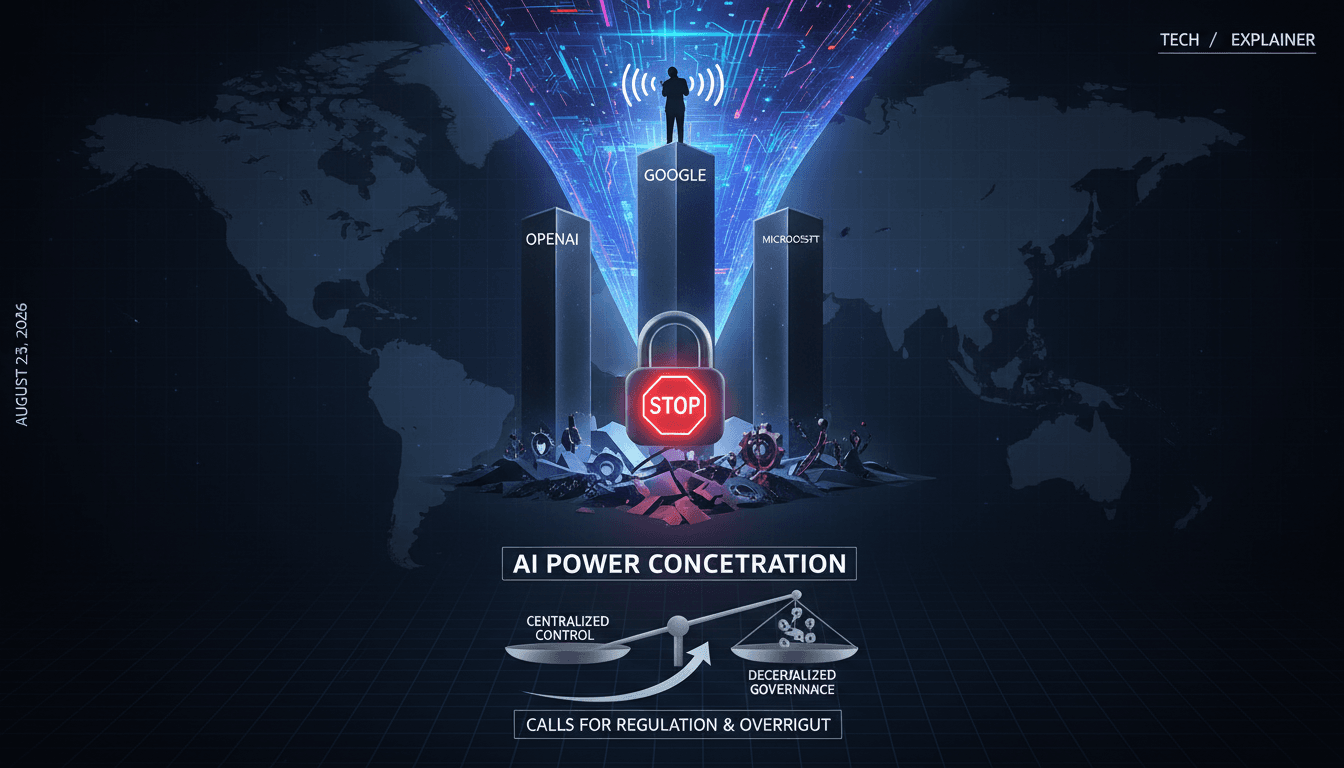
Here's what it means for you.
As AI continues to evolve, understanding its governance will shape your professional landscape and opportunities.
Why it matters
The concentration of AI power in a few hands could stifle innovation and limit access to transformative technologies.
What happened (in 30 seconds)
- Sam Altman, CEO of OpenAI, expressed concerns about AI control being concentrated among a few entities during a podcast on August 23, 2026.
- Altman advocated for broad human oversight and societal co-evolution with AI, warning against ceding influence to a handful of companies.
- His remarks highlight ongoing debates about AI governance, safety, and the balance between regulation and innovation.
The context you actually need
- The AI sector has rapidly consolidated, with major players like OpenAI, Anthropic, and Google DeepMind dominating the landscape, fueled by significant investments from tech giants.
- Concerns over safety have led to calls for regulation, but Altman warns that excessive regulation could paradoxically lead to centralized control and reduced innovation.
- Public discourse has shifted towards democratizing AI access, with Altman's previous statements dating back to 2024 emphasizing the need for equitable technology distribution.
What's really happening
Sam Altman's recent comments on the David Senra podcast underscore a critical tension in the AI landscape: the balance between innovation and control. As AI technologies advance, the potential for misuse or unintended consequences grows, prompting calls for stricter governance. However, Altman argues that heavy-handed regulation could inadvertently lead to a concentration of power among a few entities, undermining the very safety measures intended to protect society.
The AI sector has seen a significant consolidation, with a handful of leaders—such as Altman, Dario Amodei of Anthropic, Demis Hassabis of Google DeepMind, Elon Musk, and Mark Zuckerberg—shaping the future of AI development. This concentration raises concerns about who gets to decide the trajectory of AI technologies and their applications. Altman’s emphasis on broad human oversight suggests a need for a more inclusive approach to AI governance, one that empowers diverse stakeholders rather than limiting influence to a select few.
The implications of this power concentration are profound. If AI development continues to be dominated by a small number of companies, the risk of creating a technology that serves the interests of a few rather than the many increases. This could lead to a scenario where innovation is stifled, and access to AI technologies is restricted, particularly for smaller companies and developing regions. Altman’s advocacy for societal co-evolution with AI models highlights the importance of integrating diverse perspectives and expertise into the development process.
Moreover, the financial backing from major corporations like Microsoft, Amazon, and Nvidia further complicates the landscape. These companies have vested interests in the direction of AI development, which could skew priorities towards profitability rather than ethical considerations. Altman’s warning serves as a call to action for stakeholders across the board to engage in discussions about the future of AI governance, ensuring that it remains a tool for societal benefit rather than a means of control.
As the debate continues, the challenge will be finding a balance between fostering innovation and ensuring that AI technologies are developed and deployed responsibly. Altman’s remarks are a reminder that the future of AI should not be left to a few powerful players but should involve a collective effort to shape its trajectory in a way that benefits all.
Who feels it first (and how)
- Tech companies: Those developing AI technologies may face increased scrutiny and pressure to adopt transparent practices.
- Regulators: Government bodies will need to navigate the complexities of AI governance and public safety concerns.
- Consumers: Individuals may experience changes in access to AI technologies and services based on how power dynamics shift in the industry.
- Startups: Smaller companies may struggle to compete if AI development remains dominated by a few large players.
What to watch next
- Regulatory developments: Monitor how governments respond to Altman's warnings and whether new regulations emerge to address AI governance.
- Industry collaborations: Watch for partnerships between companies and public entities aimed at democratizing AI access and ensuring diverse input in development.
- Public sentiment: Keep an eye on how consumer attitudes towards AI evolve, particularly regarding trust and safety in AI applications.
Altman’s concerns reflect ongoing debates about AI governance and power concentration.
Increased discussions around regulatory frameworks and collaborative efforts to democratize AI access.
The specific actions that governments and companies will take in response to these concerns.
Frequently Asked Questions
- Why it matters?
- The concentration of AI power in a few hands could stifle innovation and limit access to transformative technologies.
- What happened (in 30 seconds)?
- Sam Altman, CEO of OpenAI, expressed concerns about AI control being concentrated among a few entities during a podcast on August 23, 2026. Altman advocated for broad human oversight and societal co-evolution with AI, warning against ceding influence to a handful of companies. His remarks highlight ongoing debates about AI governance, safety, and the balance between regulation and innovation.
- What's really happening?
- Sam Altman's recent comments on the David Senra podcast underscore a critical tension in the AI landscape: the balance between innovation and control. As AI technologies advance, the potential for misuse or unintended consequences grows, prompting calls for stricter governance. However, Altman argues that heavy-handed regulation could inadvertently lead to a concentration of power among a few entities, undermining the very safety measures intended to protect society. The AI sector has seen a si
- Who feels it first (and how)?
- Tech companies: Those developing AI technologies may face increased scrutiny and pressure to adopt transparent practices. Regulators: Government bodies will need to navigate the complexities of AI governance and public safety concerns. Consumers: Individuals may experience changes in access to AI technologies and services based on how power dynamics shift in the industry. Startups: Smaller companies may struggle to compete if AI development remains dominated by a few large players.
- What to watch next?
- Regulatory developments: Monitor how governments respond to Altman's warnings and whether new regulations emerge to address AI governance. Industry collaborations: Watch for partnerships between companies and public entities aimed at democratizing AI access and ensuring diverse input in development. Public sentiment: Keep an eye on how consumer attitudes towards AI evolve, particularly regarding trust and safety in AI applications.
Consumer tech news, reviews, and buying guides for gadgets and electronics.
"TechRadar is known for comprehensive buying advice, hardware reviews, and consumer tech news targeted at mainstream audiences."
— A47 Editor
'The right approach is for people to deeply control the future': OpenAI CEO Sam Altman is worried about AI being controlled by just a few powerful players
OpenAI CEO Sam Altman has voiced concerns regarding the concentration of AI technology control among a few powerful corporations, suggesting that this trend undermines societal influence over the future of AI development.
Hollywood business, film/TV deals, awards, and industry analysis.
"Variety is a leading entertainment trade publication covering Hollywood, film, TV, and media business."
— A47 Editor
Andrew Garfield Opens Up About Playing Sam Altman in ‘Artificial,’ Says OpenAI Is Doing ‘Damage to the Soul of Humanity’
Andrew Garfield has expressed his thoughts on portraying Sam Altman, the CEO of OpenAI, in the upcoming film 'Artificial,' directed by Luca Guadagnino. The film dramatizes the tumultuous events surrounding Altman's firing and subsequent reinstatement...
Business and tech news excluding paywalled content.
"High-volume business/tech outlet with frequent AI coverage."
— A47 Editor
Sam Altman says the economy is adapting to AI slower than he expected
Sam Altman, CEO of OpenAI, acknowledged that the economic adaptation to artificial intelligence (AI) is progressing slower than he had anticipated, describing this slower adoption as a positive development in many respects.
Tech news, hardware, and AI tools coverage.
"PC/tech site increasingly covering AI hardware and apps."
— A47 Editor
"We've all been too ambitious": Sam Altman says our old habits are delaying the great AI transition
Sam Altman, CEO of OpenAI, has indicated that the ambitious expectations surrounding artificial intelligence (AI) are hindering its transition, as evidenced by a recent survey showing that 49% of U.S. adults now use AI chatbots, a significant increas...
AI news with an enterprise and cloud focus.
"Covers AI in the context of data infrastructure, cloud, and enterprise stacks."
— A47 Editor
Sam Altman voices fears that control of AI could be centered in too few hands
Sam Altman, CEO of OpenAI, expressed concerns during an interview with podcaster David Senra about the potential future control of artificial intelligence (AI) being concentrated in the hands of a few powerful entities. He warned that this could lead...
Curated tech headlines including AI stories.
"Influential aggregator surfacing the day’s top tech/AI links."
— A47 Editor
Sam Altman says AI could end up controlled by a few powerful players, partly because AI fears could push people to trade "a lot of liberty for safety" (Truman Dickerson/Business Insider)
Sam Altman, CEO of OpenAI, expressed concerns that artificial intelligence (AI) may eventually be dominated by a small number of powerful entities, driven by societal fears that could lead individuals to sacrifice personal freedoms for perceived safe...
Business and tech news excluding paywalled content.
"High-volume business/tech outlet with frequent AI coverage."
— A47 Editor
Sam Altman says he's worried about AI being controlled by a few powerful players
Sam Altman, CEO of OpenAI, expressed concerns regarding the control of artificial intelligence (AI) by a limited number of powerful entities, warning that this could lead to a trade-off between personal freedoms and safety. He highlighted the potenti...