
Nvidia Launches Groq 3 LPX Inference Accelerator with Record Benchmarking Claims
Here's what it means for you.
If you're in tech or AI, Nvidia's latest hardware could redefine your approach to inference tasks.
Why it matters
The competition between Nvidia and Cerebras highlights the rapid evolution of AI hardware, impacting performance benchmarks and market strategies.
What happened (in 30 seconds)
- Nvidia announced full production of its Groq 3 LPX inference accelerator at the Hot Chips 2026 conference.
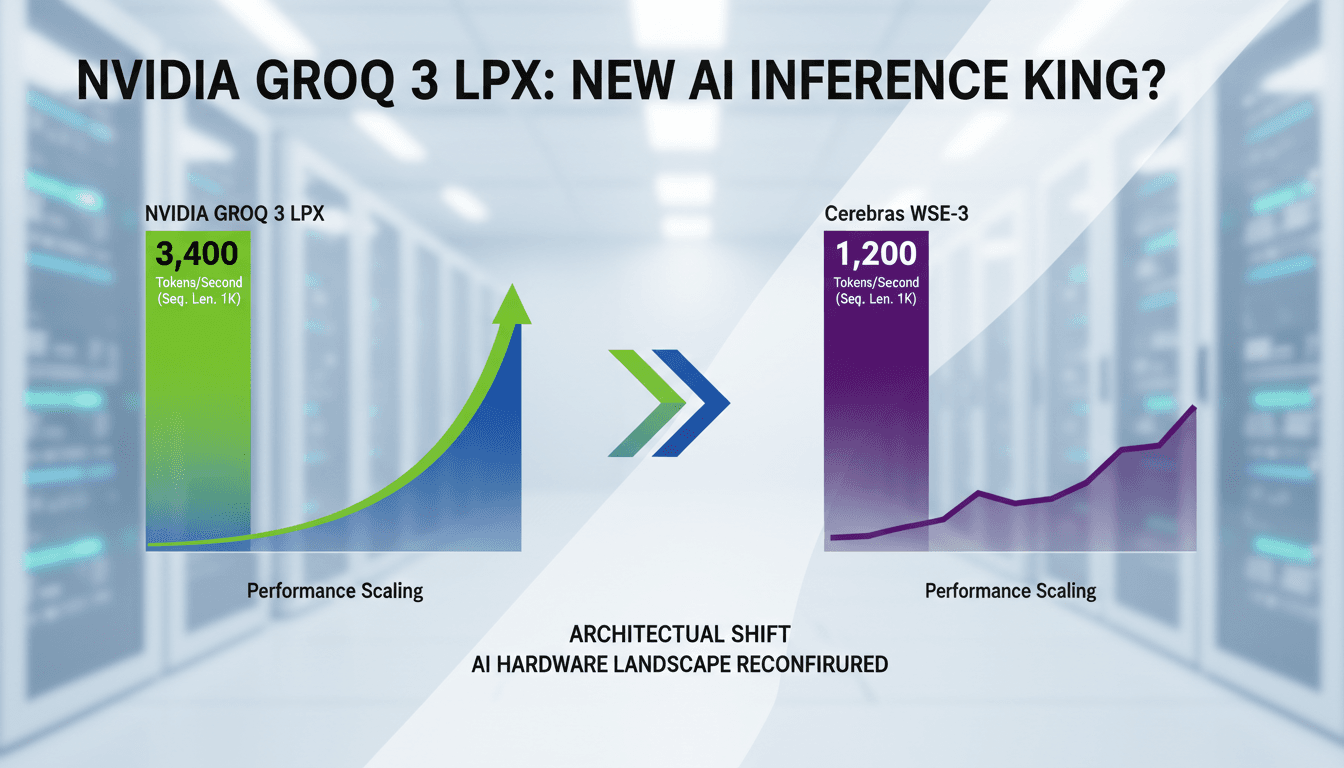
- Independent benchmarks showed Groq 3 LPX achieving 3,400 tokens per second, significantly faster than Cerebras' 882 tokens per second.
- Market reactions included Nebius committing to offer the LPX, while Cerebras emphasized its architectural advantages.
The context you actually need
- Nvidia's licensing of Groq technology for $20 billion in late 2025 aimed to meet the growing demand for specialized inference hardware.
- Cerebras' approach contrasts with a wafer-scale architecture, focusing on fewer chips with high on-chip memory for efficiency.
- The AI landscape is shifting towards heterogeneous systems that combine GPUs and specialized accelerators for optimized performance.
What's really happening
Nvidia's announcement of the Groq 3 LPX marks a significant milestone in the AI hardware landscape, particularly for inference tasks that require rapid token generation. The LPX is designed as a dedicated decode-phase accelerator, working in tandem with Nvidia's Rubin GPUs to enhance prefill tasks. This integration is crucial for agentic AI workloads, which demand high-speed processing across multiple reasoning steps.
The benchmarks released by Artificial Analysis indicate that the Groq 3 LPX can achieve an impressive 3,400 tokens per second on the Gemma 4 31B model, under conditions that involve a 100,000-token context. This performance is touted as four times faster than the nearest competitor, Cerebras, which recorded 882 tokens per second. However, the comparison is complicated by architectural differences. Nvidia's configuration requires a minimum of 64 chips to achieve these results, while Cerebras can operate effectively with just one or two chips due to its wafer-scale design.
This divergence in architecture reflects broader trends in the AI hardware market, where companies are exploring various approaches to meet the demands of increasingly complex AI models. Nvidia's strategy appears to be focused on maximizing throughput through a higher chip count, while Cerebras emphasizes efficiency and simplicity with fewer, more powerful chips. This competition is not just about speed; it also involves trade-offs in terms of cost, energy consumption, and scalability.
The implications of this competition extend beyond just performance metrics. As companies like Nvidia and Cerebras vie for dominance in the inference accelerator market, they are also shaping the future of AI applications. The demand for specialized hardware is driven by the need for faster and more efficient processing capabilities, particularly in sectors such as cloud computing, autonomous systems, and real-time data analysis.
As the market evolves, the focus will likely shift towards heterogeneous systems that can leverage the strengths of both GPUs and specialized accelerators. This trend could lead to new architectures that combine the best of both worlds, optimizing for speed while maintaining efficiency. The ongoing developments in this space will be critical for businesses looking to harness the power of AI in their operations.
Who feels it first (and how)
- AI Developers: Need to adapt to new hardware capabilities for enhanced performance.
- Cloud Service Providers: Companies like Nebius will integrate LPX into their offerings, impacting service delivery.
- Tech Startups: Startups focused on AI applications will need to consider hardware choices for competitive advantage.
What to watch next
- Benchmark Comparisons: Keep an eye on future benchmarks from both Nvidia and Cerebras to see how performance claims hold up.
- Adoption Rates: Monitor how quickly cloud providers adopt the Groq 3 LPX and its impact on service offerings.
- Architectural Innovations: Watch for new developments in AI hardware architectures that may emerge as companies respond to market demands.
Nvidia's Groq 3 LPX is now in full production.
The competition between Nvidia and Cerebras will intensify, leading to further innovations.
How the market will respond to the architectural trade-offs between chip count and efficiency.
Frequently Asked Questions
- Why it matters?
- The competition between Nvidia and Cerebras highlights the rapid evolution of AI hardware, impacting performance benchmarks and market strategies.
- What happened (in 30 seconds)?
- Nvidia announced full production of its Groq 3 LPX inference accelerator at the Hot Chips 2026 conference. Independent benchmarks showed Groq 3 LPX achieving 3,400 tokens per second, significantly faster than Cerebras' 882 tokens per second. Market reactions included Nebius committing to offer the LPX, while Cerebras emphasized its architectural advantages.
- What's really happening?
- Nvidia's announcement of the Groq 3 LPX marks a significant milestone in the AI hardware landscape, particularly for inference tasks that require rapid token generation. The LPX is designed as a dedicated decode-phase accelerator, working in tandem with Nvidia's Rubin GPUs to enhance prefill tasks. This integration is crucial for agentic AI workloads, which demand high-speed processing across multiple reasoning steps. The benchmarks released by Artificial Analysis indicate that the Groq 3 LPX c
- Who feels it first (and how)?
- AI Developers: Need to adapt to new hardware capabilities for enhanced performance. Cloud Service Providers: Companies like Nebius will integrate LPX into their offerings, impacting service delivery. Tech Startups: Startups focused on AI applications will need to consider hardware choices for competitive advantage.
- What to watch next?
- Benchmark Comparisons: Keep an eye on future benchmarks from both Nvidia and Cerebras to see how performance claims hold up. Adoption Rates: Monitor how quickly cloud providers adopt the Groq 3 LPX and its impact on service offerings. Architectural Innovations: Watch for new developments in AI hardware architectures that may emerge as companies respond to market demands.
Daily AI news: models, tools, and policy.
"Independent outlet tracking the fast pace of AI."
— A47 Editor
Nvidia says its Groq 3 LPX is four times faster than Cerebras, but the math is more complicated
Nvidia has announced that its Groq 3 LPX inference chip has entered full production, achieving a performance of 3,400 tokens per second on the Gemma 4 31B model, which is reported to be four times faster than Cerebras. However, this performance requi...
Curated tech headlines including AI stories.
"Influential aggregator surfacing the day’s top tech/AI links."
— A47 Editor
Nvidia says its Groq 3 LPX racks delivered 3,400 tokens per second in an Artificial Analysis benchmark running Gemma 4 31B with a 100,000-token input sequence (The Register)
Nvidia announced that its Groq 3 LPX racks achieved a performance of 3,400 tokens per second in an Artificial Analysis benchmark using the Gemma 4 31B model with a 100,000-token input sequence. This milestone highlights the capabilities of Nvidia's l...
Curated tech headlines including AI stories.
"Influential aggregator surfacing the day’s top tech/AI links."
— A47 Editor
Nvidia says its inference accelerator Groq 3 LPX has entered full production and Nebius has signed on as the first customer; SpaceXAI will adopt Vera CPUs (Mike Wheatley/SiliconANGLE)
Nvidia has announced that its Groq 3 LPX inference accelerator has entered full production, with Nebius as its first customer. This development signifies a significant step in Nvidia's efforts to enhance its AI capabilities and market presence.
U.S. company headlines: M&A, product launches, legal/regulatory actions, and leadership moves.
"U.S.-centric corporate tape; good for tracking single-name catalysts."
— A47 Editor
Nvidia launches Groq 3 LPX AI inference accelerator
Nvidia has launched the Groq 3 LPX AI inference accelerator, marking a significant advancement in its AI technology offerings. This new product aims to enhance the performance and efficiency of AI applications, catering to the growing demand in vario...