
ECB Confirms Digital Euro Will Offer Cash-Like Privacy Protections
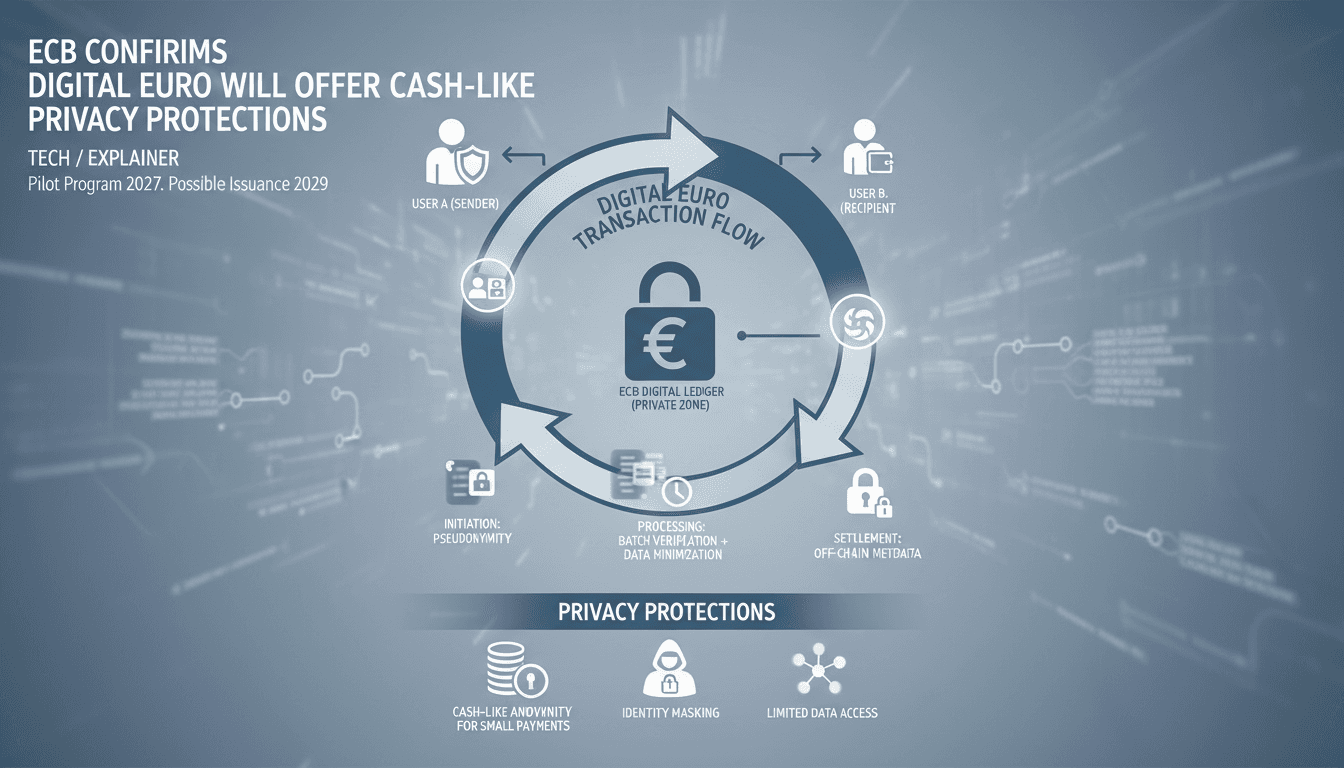
Here's what it means for you.
If you engage in digital transactions, the ECB's new privacy measures could reshape your financial interactions in Europe.
Why it matters
The ECB's commitment to privacy in its digital euro could influence global standards for digital currencies and user data protection.
What happened (in 30 seconds)
- On August 26, 2026, the European Central Bank announced that its proposed digital euro would offer privacy protections similar to cash.
- Piero Cipollone, an ECB Executive Board member, stated that the Eurosystem would not link individual users to transactions, addressing surveillance concerns.
- Legislative negotiations are ongoing, with a pilot program set for late 2027 and potential issuance in 2029, contingent on final legislation.
The context you actually need
- Declining cash usage in Europe has prompted the ECB to explore a digital currency that complements physical cash while enhancing payment sovereignty.
- Privacy concerns have been central to the digital euro's design, balancing EU data protection standards with anti-money laundering (AML) requirements.
- Civil society groups are advocating for stronger technical measures, such as zero-knowledge proofs, to ensure privacy beyond institutional assurances.
What's really happening
The European Central Bank (ECB) is navigating a complex landscape as it develops the digital euro, a central bank digital currency (CBDC) aimed at modernizing the Eurozone's payment systems. The ECB's recent announcement emphasizes a commitment to privacy, positioning the digital euro as a viable alternative to cash. This move is particularly significant given the declining use of physical currency and the increasing reliance on non-EU payment providers.
Piero Cipollone's statements clarify that the Eurosystem will not have the capability to link individual users to specific transactions. This is crucial in addressing public concerns about surveillance and data privacy. Online transactions will be processed through payment service providers, which will conduct AML checks. However, the ECB will only receive pseudonymized data, meaning it cannot directly attribute transactions to individuals. This structure aims to maintain user anonymity while still complying with regulatory requirements.
For offline transactions, the digital euro will function similarly to cash, allowing device-to-device payments where only the payer and payee can see transaction details. AML checks will occur only when wallets are funded or defunded, further preserving user privacy during everyday transactions. This dual approach seeks to balance the need for regulatory compliance with the public's desire for privacy.
The ECB's announcement comes amid ongoing legislative negotiations, with the European Parliament having approved its negotiating position in July 2026. A pilot program involving 36 providers is slated for late 2027, with the potential for the digital euro to be issued by 2029, contingent on the completion of legislative processes and ECB Governing Council decisions.
Despite these assurances, privacy advocacy groups have expressed skepticism. They argue that the ECB's safeguards rely too heavily on policy commitments that could be reinterpreted in the future. These groups are calling for verifiable technical implementations to ensure that privacy protections are not merely theoretical.
As the ECB moves forward, it must navigate the delicate balance between fostering innovation in digital payments and addressing the legitimate concerns of privacy advocates. The outcome of this initiative could set a precedent for how digital currencies are designed and regulated globally.
Who feels it first (and how)
- Consumers in the Eurozone: They will experience enhanced privacy in digital transactions, potentially increasing trust in digital payments.
- Payment service providers: They will need to adapt to new compliance requirements and technology integrations for the digital euro.
- Privacy advocacy groups: They will monitor the implementation of privacy measures and may push for stronger technical safeguards.
What to watch next
- Legislative developments: Keep an eye on the progress of negotiations in the European Parliament, as they will determine the final structure of the digital euro.
- Pilot program outcomes: The results of the late 2027 pilot involving 36 providers will provide insights into the practical application of privacy measures.
- Global CBDC discussions: Watch for how the ECB's approach influences other countries' digital currency initiatives and privacy standards.
The ECB aims to issue the digital euro by 2029, pending legislative approval.
Privacy concerns will continue to shape the development of the digital euro and influence global CBDC discussions.
The effectiveness of the ECB's privacy measures in practice and their acceptance by the public and stakeholders remains uncertain.
Frequently Asked Questions
- Why it matters?
- The ECB's commitment to privacy in its digital euro could influence global standards for digital currencies and user data protection.
- What happened (in 30 seconds)?
- On August 26, 2026, the European Central Bank announced that its proposed digital euro would offer privacy protections similar to cash. Piero Cipollone, an ECB Executive Board member, stated that the Eurosystem would not link individual users to transactions, addressing surveillance concerns. Legislative negotiations are ongoing, with a pilot program set for late 2027 and potential issuance in 2029, contingent on final legislation.
- What's really happening?
- The European Central Bank (ECB) is navigating a complex landscape as it develops the digital euro, a central bank digital currency (CBDC) aimed at modernizing the Eurozone's payment systems. The ECB's recent announcement emphasizes a commitment to privacy, positioning the digital euro as a viable alternative to cash. This move is particularly significant given the declining use of physical currency and the increasing reliance on non-EU payment providers. Piero Cipollone's statements clarify tha
- Who feels it first (and how)?
- Consumers in the Eurozone: They will experience enhanced privacy in digital transactions, potentially increasing trust in digital payments. Payment service providers: They will need to adapt to new compliance requirements and technology integrations for the digital euro. Privacy advocacy groups: They will monitor the implementation of privacy measures and may push for stronger technical safeguards.
- What to watch next?
- Legislative developments: Keep an eye on the progress of negotiations in the European Parliament, as they will determine the final structure of the digital euro. Pilot program outcomes: The results of the late 2027 pilot involving 36 providers will provide insights into the practical application of privacy measures. Global CBDC discussions: Watch for how the ECB's approach influences other countries' digital currency initiatives and privacy standards.
Real-time updates, analysis, and reports on the blockchain and cryptocurrency sectors.
"Crypto News delivers real-time updates, analysis, and reports on the blockchain and cryptocurrency sectors."
— A47 Editor
Digital euro promises cash-like privacy, ECB says
The European Central Bank (ECB) has announced that the digital euro will offer cash-like privacy, assuring that it cannot link users to their payments. However, privacy advocates are calling for stronger technical safeguards as the European Union fin...
Covers blockchain, cryptocurrency news, project analysis, and market insights.
"CoinDesk is a well-established cryptocurrency and blockchain news provider, offering comprehensive insights, market data, and industry research."
— A47 Editor
ECB claims digital euro will offer 'maximum level of privacy' amid surveillance fears
The European Central Bank (ECB) has asserted that the forthcoming digital euro will provide a 'maximum level of privacy' for users, addressing concerns over surveillance and data tracking. ECB officials claim that the Eurosystem will be designed to p...
Covers blockchain, cryptocurrency news, project analysis, and market insights.
"Cointelegraph is a leading crypto-focused media outlet known for timely news, analysis, and educational content related to blockchain and digital assets."
— A47 Editor
ECB defends digital euro privacy as CBDCs face global scrutiny
Piero Cipollone, a representative of the European Central Bank (ECB), has defended the privacy of the digital euro amidst growing global scrutiny of central bank digital currencies (CBDCs). He emphasized that the Eurosystem will not track digital eur...