
NVIDIA Launches Jetson Orin Nano 2 to Enhance Entry-Level Edge AI Capabilities
Here's what it means for you.
If you're in tech, this new AI module could redefine your approach to robotics and edge computing.
Why it matters
NVIDIA's Jetson Orin Nano 2 is set to accelerate the adoption of entry-level edge AI, making advanced robotics more accessible.
What happened (in 30 seconds)
- NVIDIA announced the Jetson Orin Nano 2 on August 25, 2026, aimed at enhancing entry-level edge AI performance.
- The module features 78 TOPS of AI compute, 8GB memory, and an 8-core Arm CPU, delivering twice the inference performance of its predecessor.
- General availability is expected in the first half of 2027, with early adopters already lined up for various applications.
The context you actually need
- Smaller AI models are now achieving accuracy levels that were once exclusive to larger models, driving demand for compact hardware.
- Over three million developers currently utilize NVIDIA's robotics stack, indicating a robust ecosystem ready for innovation.
- The Jetson Orin Nano 2 builds on NVIDIA's previous announcements, including the Jetson T3000 and T2000, which targeted mainstream robotics and edge AI.
What's really happening
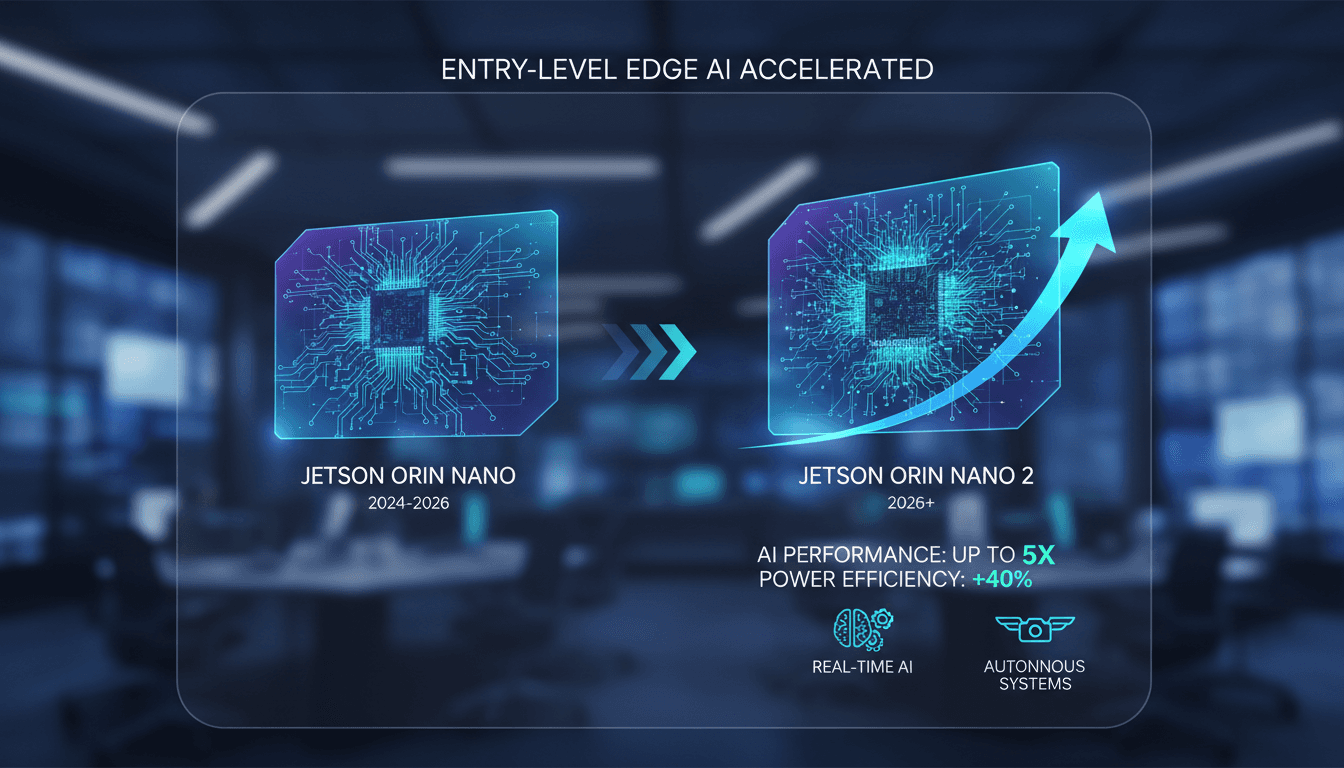
NVIDIA's Jetson Orin Nano 2 represents a significant leap in the capabilities of entry-level edge AI devices. With 78 TOPS of AI compute performance, it effectively doubles the inference capabilities of its predecessor while consuming 40% less power in a 15-watt mode. This efficiency is crucial for developers focused on deploying AI in real-world applications, such as autonomous robots and drones, where power consumption directly impacts operational costs and feasibility.
The introduction of this module is a response to the growing trend of smaller, more efficient AI models that can deliver high accuracy without the need for extensive computational resources. As these models mature, they enable developers to implement real-time intelligence at the edge, which is essential for applications requiring immediate data processing and decision-making.
NVIDIA's open software stack, which includes optimized models like NVIDIA Cosmos and Qwen 3, further enhances the appeal of the Jetson Orin Nano 2. This software ecosystem allows developers to leverage existing tools and frameworks, reducing the time and effort required to bring new AI applications to market. Early adopters such as Cognex and Doosan Bobcat are already exploring its potential in sectors like inspection and construction, indicating a strong market interest.
Moreover, the anticipated availability of the Jetson Orin Nano 2 in 2027 is likely to catalyze a broader shift toward more accessible physical AI deployments. As partners develop supporting hardware and solutions, the entry-level edge AI landscape will become increasingly competitive, driving innovation and potentially lowering costs for end-users.
This launch is not just about a new product; it's about reshaping the future of robotics and AI at the edge. As developers gain access to more powerful and efficient tools, the possibilities for automation and intelligent systems will expand, impacting various industries and applications.
Who feels it first (and how)
- Developers in robotics and AI sectors will benefit from enhanced capabilities and reduced costs.
- Manufacturers of autonomous systems will see faster time-to-market for new products.
- Businesses in logistics, construction, and home services will gain access to more efficient AI solutions.
What to watch next
- Adoption rates of the Jetson Orin Nano 2 among developers will indicate market readiness for advanced edge AI applications.
- Partnership announcements from NVIDIA and ecosystem partners could signal new use cases and innovations in robotics.
- Performance benchmarks released by early adopters will provide insights into the module's real-world capabilities and efficiency.
The Jetson Orin Nano 2 offers 78 TOPS of AI compute performance.
Increased adoption of entry-level edge AI solutions across various industries.
The full impact of this technology on market dynamics and competitive landscape.
Frequently Asked Questions
- Why it matters?
- NVIDIA's Jetson Orin Nano 2 is set to accelerate the adoption of entry-level edge AI, making advanced robotics more accessible.
- What happened (in 30 seconds)?
- NVIDIA announced the Jetson Orin Nano 2 on August 25, 2026, aimed at enhancing entry-level edge AI performance. The module features 78 TOPS of AI compute, 8GB memory, and an 8-core Arm CPU, delivering twice the inference performance of its predecessor. General availability is expected in the first half of 2027, with early adopters already lined up for various applications.
- What's really happening?
- NVIDIA's Jetson Orin Nano 2 represents a significant leap in the capabilities of entry-level edge AI devices. With 78 TOPS of AI compute performance, it effectively doubles the inference capabilities of its predecessor while consuming 40% less power in a 15-watt mode. This efficiency is crucial for developers focused on deploying AI in real-world applications, such as autonomous robots and drones, where power consumption directly impacts operational costs and feasibility. The introduction of th
- Who feels it first (and how)?
- Developers in robotics and AI sectors will benefit from enhanced capabilities and reduced costs. Manufacturers of autonomous systems will see faster time-to-market for new products. Businesses in logistics, construction, and home services will gain access to more efficient AI solutions.
- What to watch next?
- Adoption rates of the Jetson Orin Nano 2 among developers will indicate market readiness for advanced edge AI applications. Partnership announcements from NVIDIA and ecosystem partners could signal new use cases and innovations in robotics. Performance benchmarks released by early adopters will provide insights into the module's real-world capabilities and efficiency.
Policy and strategy for digital leaders, including AI.
"Analyzes AI in the context of enterprise strategy."
— A47 Editor
Nvidia unveils Jetson Orin Nano 2 for entry-level edge AI
Nvidia has unveiled the Jetson Orin Nano 2, a robotics computer designed to enhance entry-level edge AI performance and efficiency, reportedly doubling inference performance with 78 TOPS of AI compute and an eight-core Arm CPU.
Curated tech headlines including AI stories.
"Influential aggregator surfacing the day’s top tech/AI links."
— A47 Editor
Nvidia unveils the Jetson Orin Nano 2 edge AI computer that it says doubles inference performance, with 78 TOPS of AI compute and an eight-core Arm CPU (Eugene Demaitre/The Robot Report)
Nvidia has introduced the Jetson Orin Nano 2, an edge AI computer that reportedly doubles inference performance, achieving 78 TOPS of AI compute alongside an eight-core Arm CPU. This launch aims to meet the growing demand for compact and energy-effic...
AI news with an enterprise and cloud focus.
"Covers AI in the context of data infrastructure, cloud, and enterprise stacks."
— A47 Editor
Nvidia doubles compute for entry-level edge robotics with Jetson Orin Nano 2
Nvidia Corp. has announced the launch of the Jetson Orin Nano 2, a robotics computer designed to enhance artificial intelligence capabilities at the edge, effectively doubling the compute power for entry-level edge robotics. This development comes as...