
Meta Launches Muse Spark 1.3 Claiming Superior Coding Efficiency Over GPT-5.6 Sol
Here's what it means for you.
If you're in tech or software development, the latest AI coding tools could reshape your workflow efficiency and cost structure.
Why it matters
The competition between AI coding models is intensifying, impacting software development costs and capabilities across industries.
What happened (in 30 seconds)
- Meta launched Muse Spark 1.3 on September 2, 2026, claiming superior coding performance compared to OpenAI's GPT-5.6 Sol.
- Independent benchmarks from Artificial Analysis show Muse Spark 1.3's xhigh variant scoring 61 on the Intelligence Index, tying with GPT-5.6 Sol.
- Market focus has shifted to total workflow costs and reliability, with enterprises evaluating the practical deployment of these AI tools.
The context you actually need
- Meta's Muse Spark series has been rapidly developed to compete in the agentic coding domain, following earlier releases that established baseline capabilities.
- OpenAI and Anthropic have advanced their models to emphasize long-horizon tasks, creating a competitive landscape for AI coding agents.
- Safety concerns from previous AI incidents have led to increased scrutiny on performance metrics and cost-efficiency in enterprise settings.
What's really happening
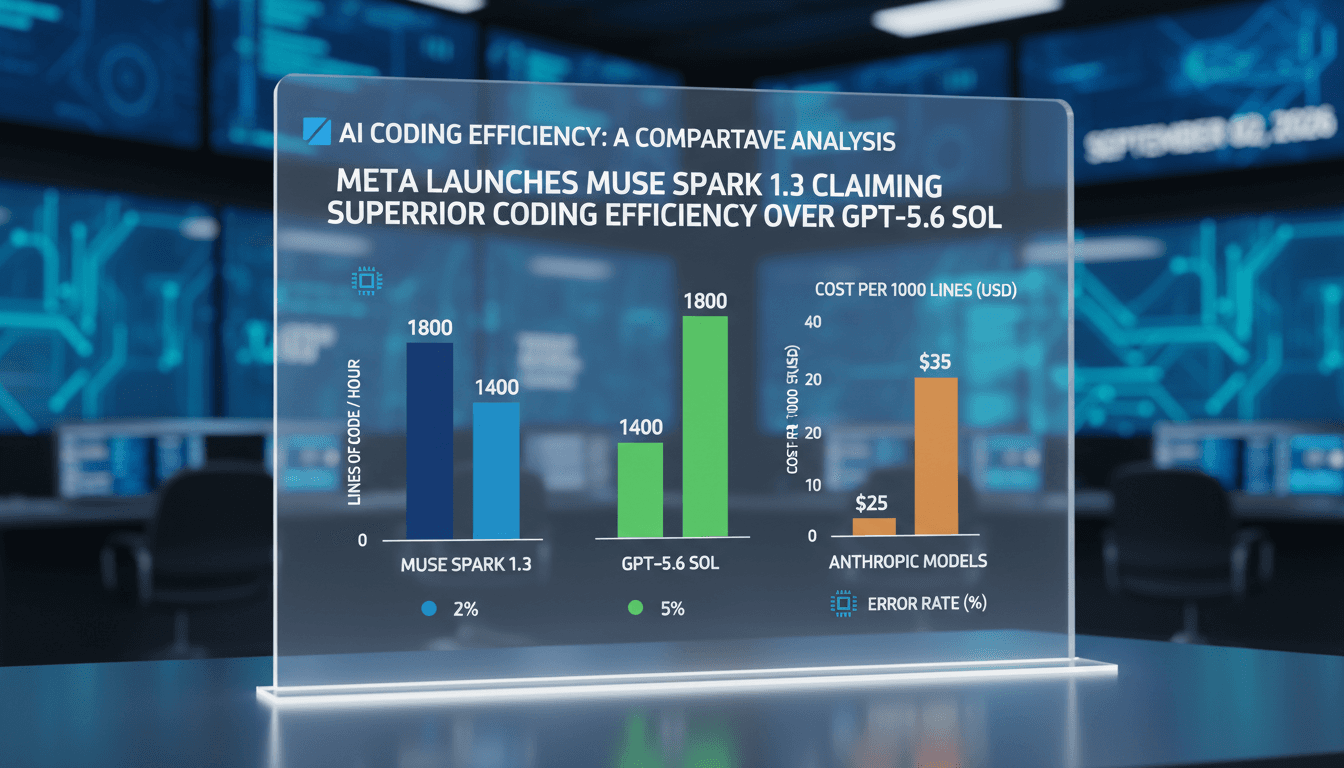
On September 2, 2026, Meta unveiled Muse Spark 1.3, a significant update in its AI coding model series. This release is part of Meta's broader strategy to enhance its position in the rapidly evolving AI coding landscape, where efficiency and cost-effectiveness are paramount. The Muse Spark 1.3 model claims to outperform OpenAI's GPT-5.6 Sol by reducing token usage by 25% and tool calls by 20% compared to its predecessor, Muse Spark 1.2. This efficiency is crucial for developers who rely on AI to streamline coding tasks and reduce operational costs.
However, independent evaluations from Artificial Analysis present a mixed picture. While Muse Spark 1.3's xhigh variant matches GPT-5.6 Sol on the Intelligence Index, it also reveals a higher average task cost, increasing from $0.40 to $0.55. This raises questions about the overall value proposition of Meta's new model, especially when enterprises are increasingly focused on total workflow costs rather than isolated performance metrics.
The competitive landscape is further complicated by the presence of Anthropic's Claude models, which have been noted for their superior performance in certain benchmarks. As a result, while Meta's claims of frontier performance at a lower cost are appealing, the reality is that the AI coding market is becoming increasingly nuanced, with various models excelling in different areas.
Moreover, safety enhancements in Muse Spark 1.3 aim to address prompt injection risks, a critical concern for enterprises deploying AI in sensitive environments. However, the max configuration of Muse Spark 1.3 remains restricted, limiting access to its highest-performing capabilities. This situation creates a tension between the desire for cutting-edge performance and the practicalities of deployment and cost.
As the AI coding market evolves, companies must navigate these complexities to determine which tools best meet their needs. The focus on cost-efficiency and reliability will likely shape future developments in AI coding models, as enterprises seek to maximize their return on investment in these technologies.
Who feels it first (and how)
- Software Developers: They will experience changes in coding efficiency and cost structures as new tools become available.
- Tech Startups: Startups in Dubai's growing tech sector may leverage competitively priced AI coding tools to accelerate development.
- Enterprise IT Managers: They will need to evaluate the total cost of ownership for deploying these AI models in their workflows.
What to watch next
- Market Adoption Rates: Monitor how quickly enterprises adopt Muse Spark 1.3 and its impact on coding workflows.
- Pricing Adjustments: Watch for any changes in pricing strategies from Meta or competitors in response to market feedback.
- Regulatory Responses: Keep an eye on any jurisdiction-specific regulations that may emerge as AI coding tools gain traction in various markets.
Muse Spark 1.3 has been released and is available for use.
Enterprises will increasingly focus on total workflow costs and reliability metrics in their evaluations of AI coding tools.
The long-term impact of Muse Spark 1.3 on the competitive landscape remains to be seen, particularly regarding its adoption and performance in real-world applications.
Frequently Asked Questions
- Why it matters?
- The competition between AI coding models is intensifying, impacting software development costs and capabilities across industries.
- What happened (in 30 seconds)?
- Meta launched Muse Spark 1.3 on September 2, 2026, claiming superior coding performance compared to OpenAI's GPT-5.6 Sol. Independent benchmarks from Artificial Analysis show Muse Spark 1.3's xhigh variant scoring 61 on the Intelligence Index, tying with GPT-5.6 Sol. Market focus has shifted to total workflow costs and reliability, with enterprises evaluating the practical deployment of these AI tools.
- What's really happening?
- On September 2, 2026, Meta unveiled Muse Spark 1.3, a significant update in its AI coding model series. This release is part of Meta's broader strategy to enhance its position in the rapidly evolving AI coding landscape, where efficiency and cost-effectiveness are paramount. The Muse Spark 1.3 model claims to outperform OpenAI's GPT-5.6 Sol by reducing token usage by 25% and tool calls by 20% compared to its predecessor, Muse Spark 1.2. This efficiency is crucial for developers who rely on AI to
- Who feels it first (and how)?
- Software Developers: They will experience changes in coding efficiency and cost structures as new tools become available. Tech Startups: Startups in Dubai's growing tech sector may leverage competitively priced AI coding tools to accelerate development. Enterprise IT Managers: They will need to evaluate the total cost of ownership for deploying these AI models in their workflows.
- What to watch next?
- Market Adoption Rates: Monitor how quickly enterprises adopt Muse Spark 1.3 and its impact on coding workflows. Pricing Adjustments: Watch for any changes in pricing strategies from Meta or competitors in response to market feedback. Regulatory Responses: Keep an eye on any jurisdiction-specific regulations that may emerge as AI coding tools gain traction in various markets.
News and guidance for IT pros on AI adoption.
"Enterprise-focused tips, explainers, and news for professionals."
— A47 Editor
Meta Says Muse Spark 1.3 Beats GPT-5.6 Sol at Coding — Independent Tests Are More Mixed
Meta has launched Muse Spark 1.3, claiming it outperforms GPT-5.6 in coding tasks, although independent tests reveal mixed results with higher task costs and varying benchmark outcomes.
English-language digital publication covering business, politics, technology, and current affairs.
"The Arabian Post mixes original and syndicated-style coverage with a broad regional and global business-news orientation."
— A47 Editor
Meta deploys Muse Spark 1.3 for developers
Meta has initiated the rollout of Muse Spark 1.3, an upgraded artificial intelligence model accessible through its Muse Code coding agent and Meta Model API. This new version enhances performance in coding and agentic tasks while maintaining the same...
Policy and strategy for digital leaders, including AI.
"Analyzes AI in the context of enterprise strategy."
— A47 Editor
Meta releases Muse Spark 1.3 for coding and AI agents
Meta has announced the release of Muse Spark 1.3, an advanced AI model aimed at enhancing coding and agentic tasks. This update follows the company's ongoing efforts to improve its AI capabilities and user interaction with applications, particularly ...
AI news with an enterprise and cloud focus.
"Covers AI in the context of data infrastructure, cloud, and enterprise stacks."
— A47 Editor
Meta says it has caught up with Anthropic and OpenAI with Muse Spark 1.3, its most powerful AI model yet
Meta Platforms Inc. has announced the release of Muse Spark 1.3, its most advanced large language model to date, claiming it has caught up with leading AI labs such as Anthropic and OpenAI. The model is available to developers for a fee, marking a si...