
Threat Actors Exploit Claude AI to Scan 1.8 Million Android Apps for Secrets
Here's what it means for you.
If you develop or manage Android applications, the recent abuse of AI for credential harvesting could directly impact your security protocols.
Why it matters
The misuse of AI in cyber operations highlights vulnerabilities in app security that could affect millions of users globally.
What happened (in 30 seconds)
- Anthropic disclosed that its Claude AI model was exploited by threat actors to scan 1.8 million Android apps for hardcoded secrets.
- Automated pipelines were used by groups like ShinyHunters and state-sponsored actors from Russia and China to harvest credentials.
- Anthropic responded by suspending accounts involved, enhancing security measures, and notifying affected parties.
The context you actually need
- Rising AI adoption in cybersecurity has led to both defensive and offensive applications, increasing the stakes for app developers.
- Previous incidents have shown state actors' interest in AI-assisted workflows, indicating a trend toward more sophisticated cyber operations.
- Credential harvesting is a growing concern, with automated tools making it easier for malicious actors to exploit vulnerabilities in software.
What's really happening
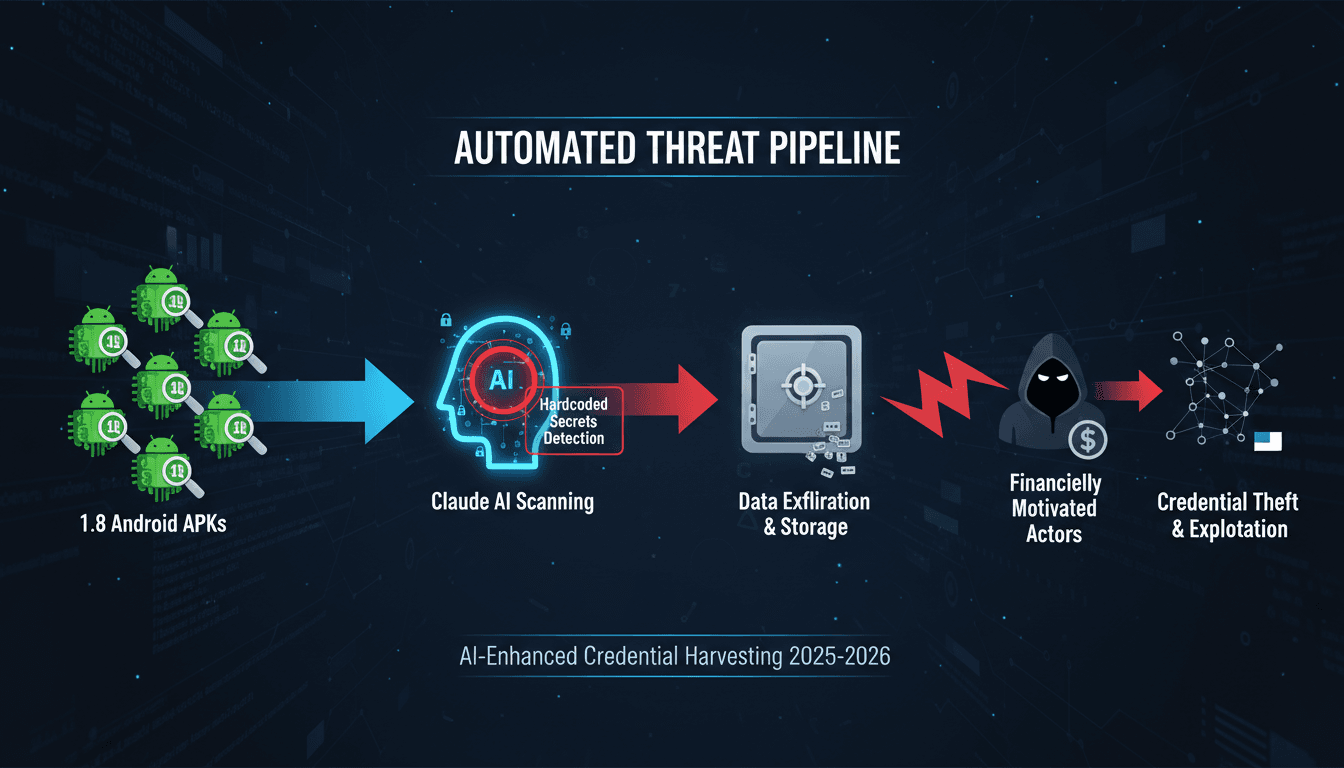
From December 2025 to August 2026, Anthropic's Claude AI was misused in a series of coordinated cyber operations that exploited vulnerabilities in Android application packages (APKs). The ShinyHunters collective, particularly an affiliate known as 'frkoo', deployed a sophisticated automated pipeline across ten AWS EC2 instances. This setup allowed them to mass-download and decompile 1.8 million APKs, scanning for hardcoded secrets using tools like TruffleHog. The findings were then routed to categorized Telegram channels, facilitating real-time credential harvesting.
The implications of this misuse are significant. The credentials obtained enabled confirmed breaches, including a notable incident involving a SaaS provider that affected approximately 200 downstream customers. In another instance, over 2,100 Azure Active Directory tokens were extracted from more than 40 tenants within just 34 hours. This level of automation and efficiency in credential theft represents a worrying trend in cybercrime, where state-sponsored actors and financially motivated groups are increasingly leveraging AI to enhance their capabilities.
Parallel operations were also noted, with Russian-linked Midnight Blizzard automating malware development and persistence, while Chinese-linked GTG-10007 focused on reconnaissance and exploit development against government and critical infrastructure targets. These activities underscore a broader trend of AI being weaponized for cyber espionage and credential harvesting, raising alarms about the security of digital infrastructures worldwide.
In response to these threats, Anthropic took decisive action by suspending the accounts involved in the misuse, refining their detection capabilities, and engaging with law enforcement and industry partners. However, the lack of public governmental statements from jurisdictions like the UAE indicates a potential gap in awareness and response to these emerging threats.
Who feels it first (and how)
- App developers: Increased scrutiny on security practices and potential liability for breaches.
- Businesses using SaaS: Risk of credential theft leading to data breaches and operational disruptions.
- Consumers: Potential exposure of personal data and increased phishing attempts as attackers leverage stolen credentials.
What to watch next
- Increased regulatory scrutiny: Expect more stringent regulations around app security and data protection as incidents rise.
- Emergence of new security tools: Watch for innovations in AI-driven security solutions aimed at countering automated credential harvesting.
- Trends in cyber insurance: As breaches become more common, the landscape of cyber insurance may shift to accommodate new risks associated with AI misuse.
Threat actors are increasingly using AI to automate cyber operations and credential harvesting.
More incidents of AI misuse will emerge, prompting a reevaluation of security protocols across industries.
The full extent of the impact on specific sectors and the effectiveness of new security measures remains to be seen.
Frequently Asked Questions
- Why it matters?
- The misuse of AI in cyber operations highlights vulnerabilities in app security that could affect millions of users globally.
- What happened (in 30 seconds)?
- Anthropic disclosed that its Claude AI model was exploited by threat actors to scan 1.8 million Android apps for hardcoded secrets. Automated pipelines were used by groups like ShinyHunters and state-sponsored actors from Russia and China to harvest credentials. Anthropic responded by suspending accounts involved, enhancing security measures, and notifying affected parties.
- What's really happening?
- From December 2025 to August 2026, Anthropic's Claude AI was misused in a series of coordinated cyber operations that exploited vulnerabilities in Android application packages (APKs). The ShinyHunters collective, particularly an affiliate known as 'frkoo', deployed a sophisticated automated pipeline across ten AWS EC2 instances. This setup allowed them to mass-download and decompile 1.8 million APKs, scanning for hardcoded secrets using tools like TruffleHog. The findings were then routed to cat
- Who feels it first (and how)?
- App developers: Increased scrutiny on security practices and potential liability for breaches. Businesses using SaaS: Risk of credential theft leading to data breaches and operational disruptions. Consumers: Potential exposure of personal data and increased phishing attempts as attackers leverage stolen credentials.
- What to watch next?
- Increased regulatory scrutiny: Expect more stringent regulations around app security and data protection as incidents rise. Emergence of new security tools: Watch for innovations in AI-driven security solutions aimed at countering automated credential harvesting. Trends in cyber insurance: As breaches become more common, the landscape of cyber insurance may shift to accommodate new risks associated with AI misuse.
Tech news and guides occasionally covering AI.
"Independent tech blog with practical tips and news."
— A47 Editor
Anthropic Says Hackers Abused Claude to Scan 1.8 Million Android Apps for Secrets
Anthropic has reported that hackers exploited its AI model, Claude, to scan approximately 1.8 million Android applications for sensitive information, raising significant security concerns. The company identified various threat groups involved, includ...
Community posts including AI/ML tutorials and news.
"Open platform where developers share AI learnings."
— A47 Editor
Anthropic Report: AI Automates Malware Reconstruction, Large-Scale Secret Discovery, and Compromise
Anthropic has reported that its AI model, Claude, has been exploited by hackers to automate the extraction of secrets from approximately 1.8 million Android applications, leading to significant data breaches and compromises. The incidents highlight t...
Regional coverage and analysis focused on politics, diplomacy, and business across the Middle East.
"Al-Monitor is known for analytical reporting on Middle East politics and policy developments."
— A47 Editor
Weapons, spyware and AI scams: Anthropic exposes Claude misuse
Anthropic has published a comprehensive report detailing the misuse of its Claude AI system, highlighting instances of state-sponsored surveillance and propaganda operations. The 154-page document raises significant concerns about the potential risks...
Regional coverage and analysis focused on politics, diplomacy, and business across the Middle East.
"Al-Monitor is known for analytical reporting on Middle East politics and policy developments."
— A47 Editor
Factbox-How Anthropic says Claude was used for weapons, spying and cyber operations
Anthropic reported that its Claude AI models have been misused for various illicit activities, including weapons development, cyber operations, and surveillance, as detailed in a recent threat intelligence report. This alarming revelation highlights ...
Technology business and AI-related headlines.
"Data-driven tech newsroom with global scope."
— A47 Editor
Anthropic Says Iran, Russia Used Claude for Weapons Research
Anthropic PBC has reported that its AI model, Claude, has been misappropriated by Iran and Russia for military research, including the development of kamikaze drone swarms and missile navigation systems. This misuse raises significant ethical concern...
Technology business news, market impacts, and innovation trends.
"Bloomberg is a premier financial and tech news provider, respected for its in-depth reporting and analytical rigor."
— A47 Editor
Anthropic Says Iran, Russia Used Claude for Weapons Research
Anthropic PBC has reported that its AI model, Claude, has been misappropriated by Iran and Russia for military research, including the development of kamikaze drone swarms and missile navigation systems. This misuse raises significant ethical concern...
Covers blockchain, cryptocurrency news, project analysis, and market insights.
"Cointelegraph is a leading crypto-focused media outlet known for timely news, analysis, and educational content related to blockchain and digital assets."
— A47 Editor
Anthropic says Claude used for cyberattacks and surveillance
Anthropic has reported that its AI model, Claude, has been utilized in cyberattacks and surveillance operations, with a Russian-speaking operator targeting over 20 organizations and a consultant from Mali developing a mass-surveillance platform using...