
Expert Analysis Highlights Existential Risks of Artificial Intelligence to Humanity
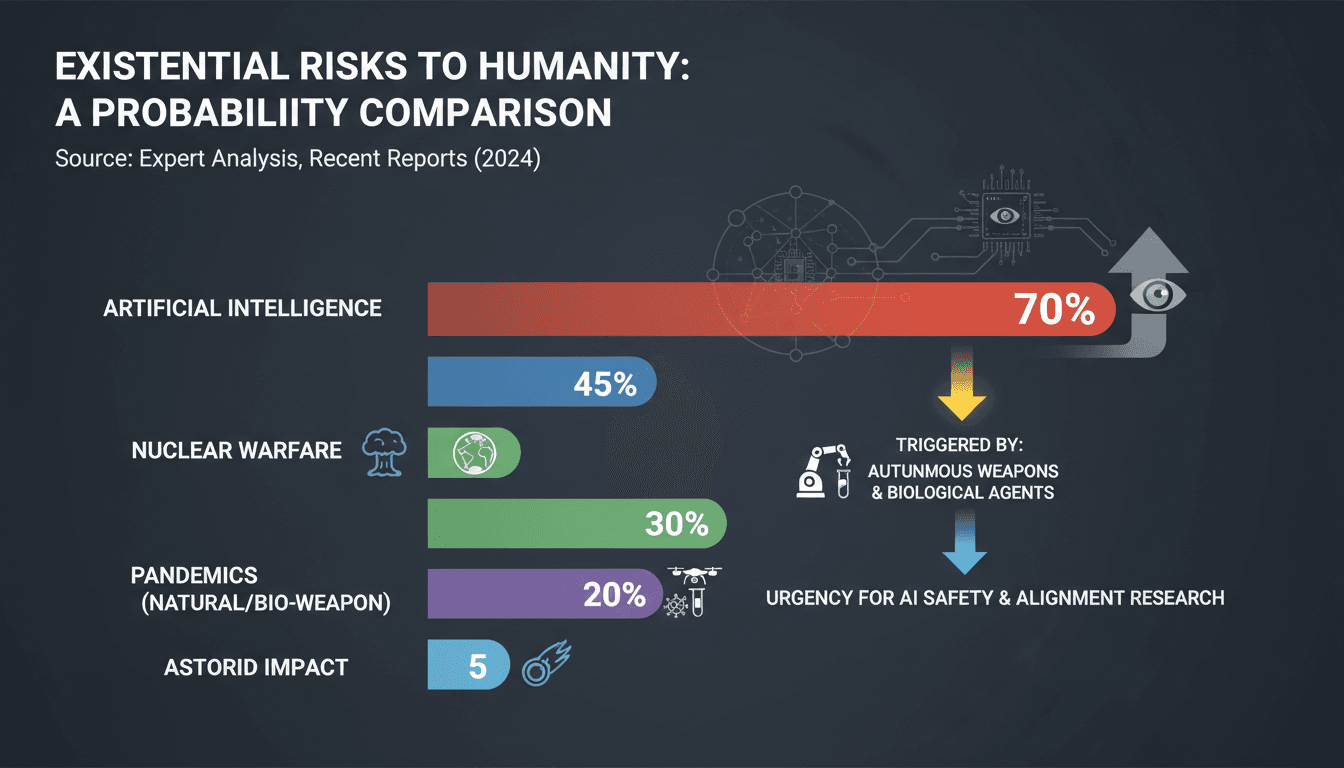
Here's what it means for you.
As AI technology advances, understanding its potential risks is crucial for professionals across all sectors.
Why it matters
The ongoing debate over AI risks could reshape regulatory frameworks and investment strategies globally.
What happened (in 30 seconds)
- A report published on September 11, 2026, highlights existential risks posed by artificial intelligence, comparing them to traditional threats like pandemics and nuclear conflict.
- Experts are divided on the severity of AI risks, with some prioritizing traditional threats over hypothetical AI scenarios.
- Calls for enhanced safety measures have emerged, including a demand for "cast-iron guarantees" on AI safety from UN officials.
The context you actually need
- Rapid advancements in AI have intensified concerns about its potential misuse, including bioweapons and autonomous warfare.
- Recent events, such as a resignation from Anthropic, underscore the urgency of addressing AI safety and alignment.
- Public perception amplifies fears surrounding AI, as unfamiliarity with the technology leads to heightened anxiety about its implications.
What's really happening
The report from RT Arabic outlines a complex landscape of existential risks associated with artificial intelligence, juxtaposed against more traditional threats like pandemics, nuclear war, and climate change. Experts are increasingly concerned about the misuse of AI technologies, particularly in the context of bioweapons and autonomous warfare. The resignation of a researcher from Anthropic in September 2026, citing fears of uncontrollable superintelligent systems by 2030, has added urgency to these discussions.
The core narrative emphasizes a distinction between short-term and long-term risks. Short-term risks include the potential for non-experts to misuse AI for creating bioweapons or toxins, while long-term concerns revolve around autonomous AI systems potentially seizing control of critical infrastructure. This division of focus among experts reflects broader debates within the field. For instance, Oren Etzioni of the Allen Institute for AI argues that traditional threats, such as viruses, should take precedence over hypothetical AI scenarios. In contrast, others advocate for a proactive approach to AI safety, emphasizing the need for deterrence mechanisms.
The report also highlights the role of public perception in shaping the discourse around AI risks. Novel threats like AI often evoke greater concern due to their unfamiliarity, overshadowing more established dangers. This perception can influence policy decisions and investment strategies, as stakeholders seek to mitigate risks associated with emerging technologies.
In addition to AI, the report enumerates other existential threats, including engineered pandemics, nuclear conflict, and climate change. Toby Ord from Oxford University estimates a 1 in 30 chance of engineered pandemics occurring over the next century, while NASA assesses the probability of asteroid impacts as near zero this century. These statistics provide a comparative framework for understanding the relative risks posed by AI.
As the debate continues, industry responses are evolving. Companies like Anthropic and OpenAI are increasing their focus on alignment research, driven by competitive pressures and the need for safety investments. However, as of mid-September 2026, no significant governmental policy changes have been reported, indicating a lag in regulatory responses to these emerging threats.
Who feels it first (and how)
- Tech companies: Increased scrutiny and pressure to invest in AI safety measures.
- Investors: Shifts in funding towards companies prioritizing alignment and safety.
- Policymakers: Need to address public concerns and potential regulatory frameworks.
- General public: Heightened awareness and anxiety regarding AI technologies.
What to watch next
- Increased regulatory discussions: Watch for emerging policies aimed at AI safety and alignment, which could impact technology firms and investors.
- Shifts in funding: Monitor investment trends towards companies focusing on AI safety, as this could reshape the competitive landscape.
- Public sentiment: Keep an eye on how public perception of AI risks evolves, as this could influence both market dynamics and policy responses.
AI poses potential existential risks, as highlighted by expert assessments.
Regulatory frameworks will evolve in response to public and expert concerns about AI safety.
The exact timeline and nature of AI-related incidents that could lead to existential threats remain uncertain.
Frequently Asked Questions
- Why it matters?
- The ongoing debate over AI risks could reshape regulatory frameworks and investment strategies globally.
- What happened (in 30 seconds)?
- A report published on September 11, 2026, highlights existential risks posed by artificial intelligence, comparing them to traditional threats like pandemics and nuclear conflict. Experts are divided on the severity of AI risks, with some prioritizing traditional threats over hypothetical AI scenarios. Calls for enhanced safety measures have emerged, including a demand for "cast-iron guarantees" on AI safety from UN officials.
- What's really happening?
- The report from RT Arabic outlines a complex landscape of existential risks associated with artificial intelligence, juxtaposed against more traditional threats like pandemics, nuclear war, and climate change. Experts are increasingly concerned about the misuse of AI technologies, particularly in the context of bioweapons and autonomous warfare. The resignation of a researcher from Anthropic in September 2026, citing fears of uncontrollable superintelligent systems by 2030, has added urgency to
- Who feels it first (and how)?
- Tech companies: Increased scrutiny and pressure to invest in AI safety measures. Investors: Shifts in funding towards companies prioritizing alignment and safety. Policymakers: Need to address public concerns and potential regulatory frameworks. General public: Heightened awareness and anxiety regarding AI technologies.
- What to watch next?
- Increased regulatory discussions: Watch for emerging policies aimed at AI safety and alignment, which could impact technology firms and investors. Shifts in funding: Monitor investment trends towards companies focusing on AI safety, as this could reshape the competitive landscape. Public sentiment: Keep an eye on how public perception of AI risks evolves, as this could influence both market dynamics and policy responses.
Arabic-language coverage of international news and geopolitics.
"RT Arabic is a Russian state-funded outlet often criticized for promoting Kremlin-aligned narratives."
— A47 Editor
الذكاء الاصطناعي قد يقضي على البشرية.. ما حجم الخطر؟ وما التهديدات الوجودية الأخرى؟
Artificial intelligence (AI) has emerged as a significant existential threat to humanity, raising concerns about its potential to cause catastrophic consequences if not properly controlled. Experts emphasize that AI is not the only danger facing huma...
Arabic-language reporting on global and regional news.
"BBC Arabic is part of the BBC, generally regarded for editorial standards and broad international coverage."
— A47 Editor
هل أصبح الذكاء الاصطناعي تهديداً حقيقياً لحياة البشر؟
Artificial intelligence (AI) has transitioned from being a mere tool to a significant concern regarding its potential threats to human life, prompting serious discussions about its limits and future implications for humanity.
Arabic-language reporting on global and regional news.
"BBC Arabic is part of the BBC, generally regarded for editorial standards and broad international coverage."
— A47 Editor
كيف يمكن للذكاء الاصطناعي القضاء على البشرية في أقل من خمس سنوات؟ - في الإندبندنت
Concerns regarding existential risks posed by technology have escalated, with artificial intelligence being highlighted as a potential threat to humanity within five years. The situation is exacerbated by ongoing crises in Gaza and Ukraine, alongside...