
Solana Reduces Target Slot Time to 250 Milliseconds Enhancing Blockchain Performance
Why it matters
This protocol upgrade enhances Solana's competitiveness in the blockchain space by reducing latency, which is crucial for real-time applications.
What happened (in 30 seconds)
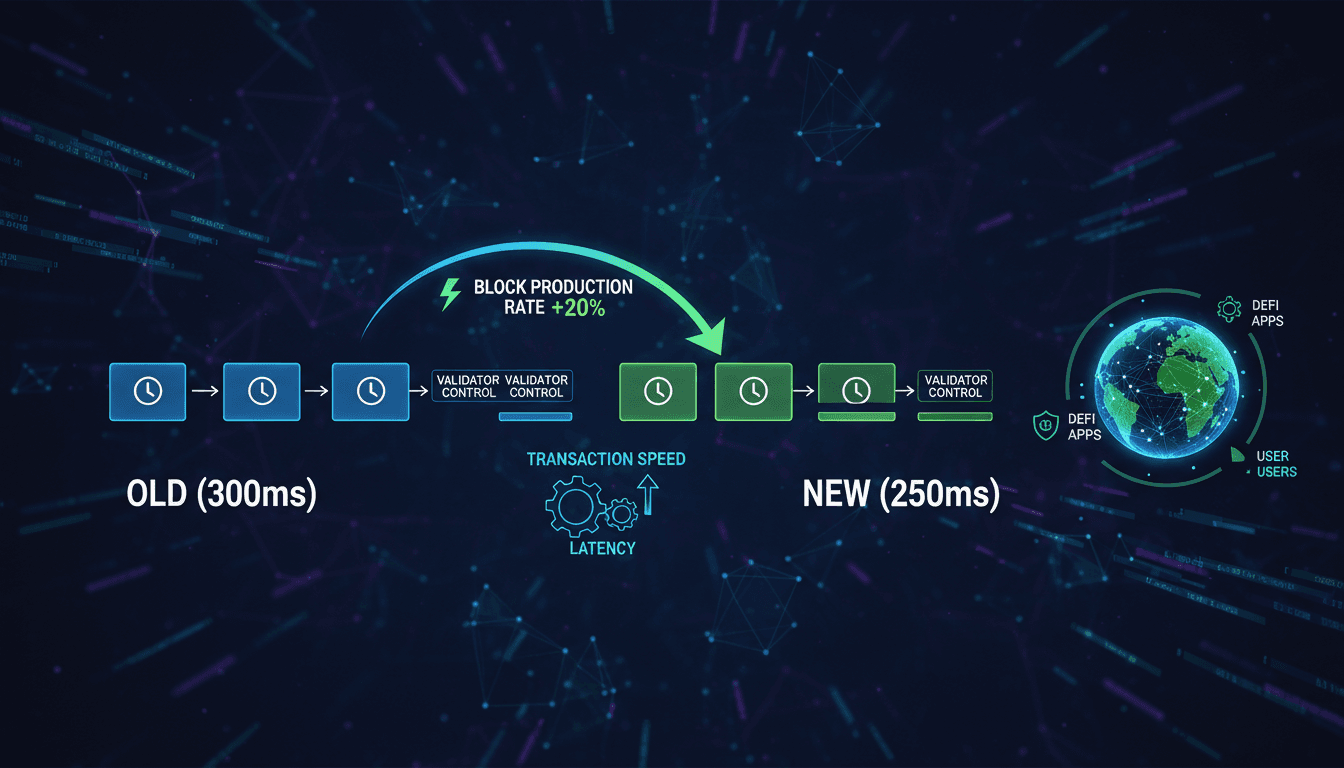
- Solana reduced its target slot time from 300 milliseconds to 250 milliseconds on September 18, 2026.
- The change increases block production rate from approximately 3.3 to 4 slots per second, enhancing transaction processing.
- Validator leader windows shortened from 1.2 seconds to 1 second, improving state freshness without expanding throughput.
The context you actually need
- Previous reductions: Solana had already reduced slot times from 400ms to 350ms and then to 300ms, establishing a trend of optimizing performance.
- Technical adjustments: The upgrade was implemented via SIMD-0525, which required validators to update their clients to Agave v4.3.
- Impact on transaction processing: By shortening the leader window and adjusting per-slot limits, the network maintains its overall transaction capacity while improving latency.
What's really happening
On September 18, 2026, Solana activated a significant protocol upgrade that reduced its target slot time from 300 milliseconds to 250 milliseconds. This change, part of the SIMD-0525 feature gate, is designed to enhance the network's efficiency and responsiveness. By increasing the block production rate from approximately 3.3 to 4 slots per second, Solana aims to improve the user experience for decentralized finance (DeFi) applications and trading platforms that rely on quick transaction confirmations.
The reduction in slot time also shortens the validator leader window from 1.2 seconds to 1 second. This means that each validator has less time to produce blocks, which can lead to a more decentralized network as it reduces the control any single validator has over the blockchain. This is particularly important for enhancing censorship resistance, a critical factor in maintaining the integrity of decentralized networks.
The adjustments made to per-slot compute and data limits ensure that while the slot time is reduced, the overall transaction processing capacity remains stable. This is crucial because it allows the network to handle a high volume of transactions without sacrificing performance. The protocol's design reflects a careful balance between speed and capacity, ensuring that applications built on Solana can operate efficiently without overwhelming the network.
The upgrade is also a response to the competitive landscape of blockchain technology, where latency can significantly impact user experience and market dynamics. By improving state freshness, Solana enables applications to respond more quickly to market changes, which is particularly beneficial for users in high-frequency trading environments.
As the blockchain ecosystem continues to evolve, Solana's proactive approach to optimizing its protocol positions it favorably against other networks. The focus on reducing latency while maintaining throughput is a strategic move that could attract more developers and users to the platform, further solidifying its place in the DeFi space.
Who feels it first (and how)
- DeFi developers: They will benefit from faster transaction confirmations, enhancing user experience.
- Traders and investors: Reduced latency will improve market responsiveness, leading to better execution prices.
- Validators: They will need to adapt to the new slot times and may experience changes in their operational dynamics.
What to watch next
- Block skip rates: Monitoring these rates will indicate the network's stability and performance under the new slot time.
- Adoption of Agave v4.3: The speed at which validators update to the latest client will impact overall network efficiency.
- Market reaction: Observing how trading volumes and transaction speeds evolve post-upgrade will provide insights into the upgrade's effectiveness.
The slot time has been officially reduced to 250 milliseconds.
Increased adoption of Solana for high-frequency trading and DeFi applications.
The long-term impact on validator dynamics and network decentralization.
Frequently Asked Questions
- Why it matters?
- This protocol upgrade enhances Solana's competitiveness in the blockchain space by reducing latency, which is crucial for real-time applications.
- What happened (in 30 seconds)?
- Solana reduced its target slot time from 300 milliseconds to 250 milliseconds on September 18, 2026. The change increases block production rate from approximately 3.3 to 4 slots per second, enhancing transaction processing. Validator leader windows shortened from 1.2 seconds to 1 second, improving state freshness without expanding throughput.
- What's really happening?
- On September 18, 2026, Solana activated a significant protocol upgrade that reduced its target slot time from 300 milliseconds to 250 milliseconds. This change, part of the SIMD-0525 feature gate, is designed to enhance the network's efficiency and responsiveness. By increasing the block production rate from approximately 3.3 to 4 slots per second, Solana aims to improve the user experience for decentralized finance (DeFi) applications and trading platforms that rely on quick transaction confirm
- Who feels it first (and how)?
- DeFi developers: They will benefit from faster transaction confirmations, enhancing user experience. Traders and investors: Reduced latency will improve market responsiveness, leading to better execution prices. Validators: They will need to adapt to the new slot times and may experience changes in their operational dynamics.
- What to watch next?
- Block skip rates: Monitoring these rates will indicate the network's stability and performance under the new slot time. Adoption of Agave v4.3: The speed at which validators update to the latest client will impact overall network efficiency. Market reaction: Observing how trading volumes and transaction speeds evolve post-upgrade will provide insights into the upgrade's effectiveness.
Beginner-friendly crypto tutorials, guides, and news.
"99Bitcoins is a crypto education and news site known for easy-to-understand content and comprehensive guides."
— A47 Editor
Solana’s 250ms Clock Shrinks Validator Control Windows
Solana has reduced its slot time to 250 milliseconds, which tightens the control windows for validators and decreases latency while keeping the network's capacity ceiling unchanged. This upgrade is part of Solana's ongoing efforts to enhance its bloc...
Real-time updates, analysis, and reports on the blockchain and cryptocurrency sectors.
"Crypto News delivers real-time updates, analysis, and reports on the blockchain and cryptocurrency sectors."
— A47 Editor
Solana moves closer to 200ms slots after latest speed upgrade
Solana has successfully reduced its target slot time from 300 milliseconds to 250 milliseconds, resulting in a nearly 17% increase in the speed at which the network produces slots. This upgrade is part of Solana's ongoing efforts to enhance its block...
Covers blockchain, cryptocurrency news, project analysis, and market insights.
"CoinDesk is a well-established cryptocurrency and blockchain news provider, offering comprehensive insights, market data, and industry research."
— A47 Editor
Solana speeds up blocks by 17%, but transaction capacity stays the same
Solana has announced a reduction in its target slot time to 250 milliseconds, resulting in a 17% increase in block speed while maintaining the same transaction capacity. This change aims to provide applications with more timely blockchain data and sh...