
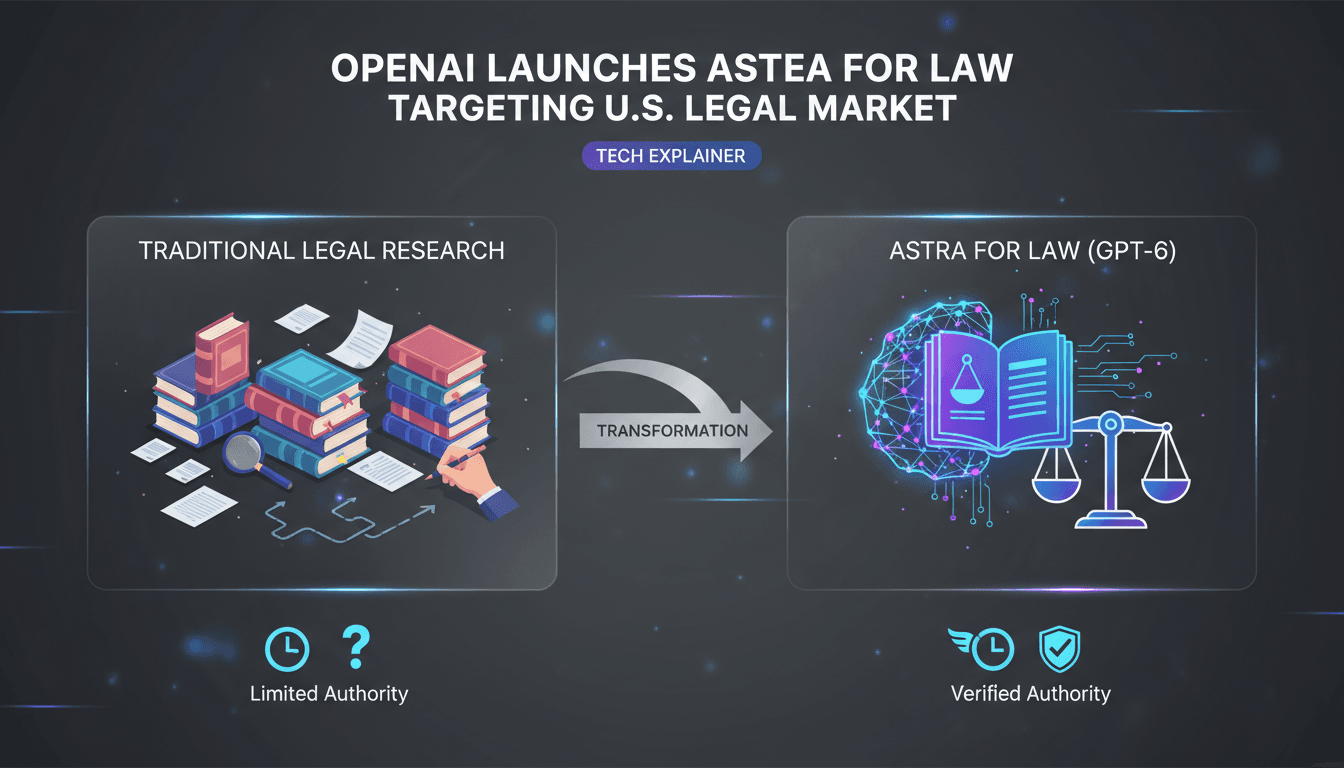
OpenAI Launches Astra for Law Targeting U.S. Legal Market
Why it matters
The legal market is rapidly evolving, and AI tools like Astra for Law are set to enhance efficiency and accuracy in legal workflows.
What happened (in 30 seconds)
- OpenAI launched Astra for Law on September 17, 2026, targeting U.S. law firms with a specialized AI configuration.
- The product features a dedicated legal search index covering over 230 million URLs, focusing on U.S. case law and privacy controls.
- Initial access is limited to selected law firms through a Trusted Access program, with broader API availability expected soon.
The context you actually need
- AI competition is heating up: Major players like Anthropic and Google have already introduced legal-focused AI tools, increasing pressure on OpenAI to deliver a robust product.
- Legal standards are high: The legal sector demands strict confidentiality and source verification, necessitating specialized tools that can meet these requirements.
- Data privacy is paramount: Astra for Law incorporates zero data retention policies, addressing concerns about client confidentiality in legal practices.
What's really happening
On September 17, 2026, OpenAI unveiled Astra for Law, a specialized configuration of its GPT-6 Astra model designed specifically for the legal sector. This product integrates a dedicated U.S. legal search index that encompasses over 230 million URLs, primarily sourced from the Free Law Project’s CourtListener collection. This index covers more than 99.9 percent of published U.S. precedential case law and is updated daily, ensuring that legal professionals have access to the most current information.
The launch comes at a time when competition among AI providers in the legal market is intensifying. OpenAI's benchmark results indicate that Astra for Law achieved a 54.0 percent pass rate on 200 questions from Vals AI’s Legal Research Bench, significantly outperforming the standard GPT-6 Astra, which had a pass rate of 38.7 percent. This 40% relative improvement highlights Astra for Law's potential to enhance legal research and argument development.
The initial rollout is limited to selected U.S. law firms through a Trusted Access program, which allows these firms to test the capabilities of Astra for Law in real-world scenarios. OpenAI has also committed to zero data retention on API usage, which is a critical feature for law firms that must adhere to strict confidentiality obligations. The company plans to expand access to its API for partners, including legal tech firms like Harvey and Legora, and will support 26 partner-built plugins that integrate with existing legal tools such as Relativity and Clio.
As the legal sector increasingly turns to AI for efficiency, Astra for Law represents a significant step forward. It not only addresses the unique challenges of legal research but also sets a new standard for AI applications in this highly regulated field. The implications of this launch extend beyond just improved research capabilities; they signal a shift in how legal professionals will approach their work in the future.
Who feels it first (and how)
- Law firms: Particularly those in the U.S. that are early adopters of AI technology.
- Legal tech providers: Companies developing tools that integrate with Astra for Law will need to adapt quickly.
- Legal professionals: Lawyers and paralegals will experience changes in their workflows and research methodologies.
What to watch next
- Adoption rates among law firms: Monitoring how quickly firms integrate Astra for Law will indicate its market impact.
- Regulatory responses: Watch for any commentary from U.S. bar associations regarding the use of AI in legal practice.
- Competitor reactions: Other AI vendors may accelerate their own product developments in response to Astra for Law's capabilities.
Astra for Law is designed specifically for the U.S. legal market and incorporates privacy controls.
Increased competition in the legal AI space will lead to rapid advancements in technology and features.
The long-term impact on legal employment and traditional workflows remains to be seen.
Frequently Asked Questions
- Why it matters?
- The legal market is rapidly evolving, and AI tools like Astra for Law are set to enhance efficiency and accuracy in legal workflows.
- What happened (in 30 seconds)?
- OpenAI launched Astra for Law on September 17, 2026, targeting U.S. law firms with a specialized AI configuration. The product features a dedicated legal search index covering over 230 million URLs, focusing on U.S. case law and privacy controls. Initial access is limited to selected law firms through a Trusted Access program, with broader API availability expected soon.
- What's really happening?
- On September 17, 2026, OpenAI unveiled Astra for Law, a specialized configuration of its GPT-6 Astra model designed specifically for the legal sector. This product integrates a dedicated U.S. legal search index that encompasses over 230 million URLs, primarily sourced from the Free Law Project’s CourtListener collection. This index covers more than 99.9 percent of published U.S. precedential case law and is updated daily, ensuring that legal professionals have access to the most current informat
- Who feels it first (and how)?
- Law firms: Particularly those in the U.S. that are early adopters of AI technology. Legal tech providers: Companies developing tools that integrate with Astra for Law will need to adapt quickly. Legal professionals: Lawyers and paralegals will experience changes in their workflows and research methodologies.
- What to watch next?
- Adoption rates among law firms: Monitoring how quickly firms integrate Astra for Law will indicate its market impact. Regulatory responses: Watch for any commentary from U.S. bar associations regarding the use of AI in legal practice. Competitor reactions: Other AI vendors may accelerate their own product developments in response to Astra for Law's capabilities.
Daily AI news: models, tools, and policy.
"Independent outlet tracking the fast pace of AI."
— A47 Editor
OpenAI takes aim at the legal market with Astra for Law
OpenAI has launched Astra for Law, a specialized version of its GPT-6 Astra model tailored for legal work, enhancing capabilities in legal research and drafting. This initiative targets AmLaw 200 firms, aiming to provide advanced AI tools for the leg...
AI news with an enterprise and cloud focus.
"Covers AI in the context of data infrastructure, cloud, and enterprise stacks."
— A47 Editor
OpenAI launches Astra for Law, a GPT-6 configuration for legal research
OpenAI Group PBC has launched Astra for Law, a specialized version of its GPT-6 Astra model tailored for legal research and drafting. This new configuration integrates a legal search index and specific instructions for legal analysis, enhancing the c...
Curated tech headlines including AI stories.
"Influential aggregator surfacing the day’s top tech/AI links."
— A47 Editor
OpenAI launches Astra for Law, combining GPT-6 Astra with a legal search index and instructions for legal analysis and writing, initially for select law firms (OpenAI)
OpenAI has launched Astra for Law, a specialized version of its GPT-6 Astra model, which integrates a legal search index and instructions for legal analysis and writing, initially targeting select law firms. This initiative aims to enhance the capabi...
News for senior developers on AI/ML and data engineering.
"Conference-linked outlet for practitioner news and Q&As."
— A47 Editor
GPT-6 Astra is the First Model OpenAI Classifies as Critical for Cybersecurity
OpenAI has classified its latest AI model, GPT-6 Astra, as Critical for cybersecurity under its Preparedness Framework, marking a significant milestone. In expert-led testing, the model identified previously unknown vulnerabilities in a browser and a...
Community posts including AI/ML tutorials and news.
"Open platform where developers share AI learnings."
— A47 Editor
OpenAI Launches GPT-6 Astra With a Phased Rollout Across ChatGPT and APIs
OpenAI has officially launched GPT-6 Astra, its most advanced AI model to date, with a phased rollout beginning for select organizations and planned broader access through platforms like ChatGPT Plus and the OpenAI API. The model emphasizes enhanced ...