
Andreessen Horowitz launches AI-focused college alternative in San Francisco
Why it matters
This initiative reflects a growing skepticism towards traditional higher education, particularly in tech, as industry needs evolve rapidly.
What happened (in 30 seconds)
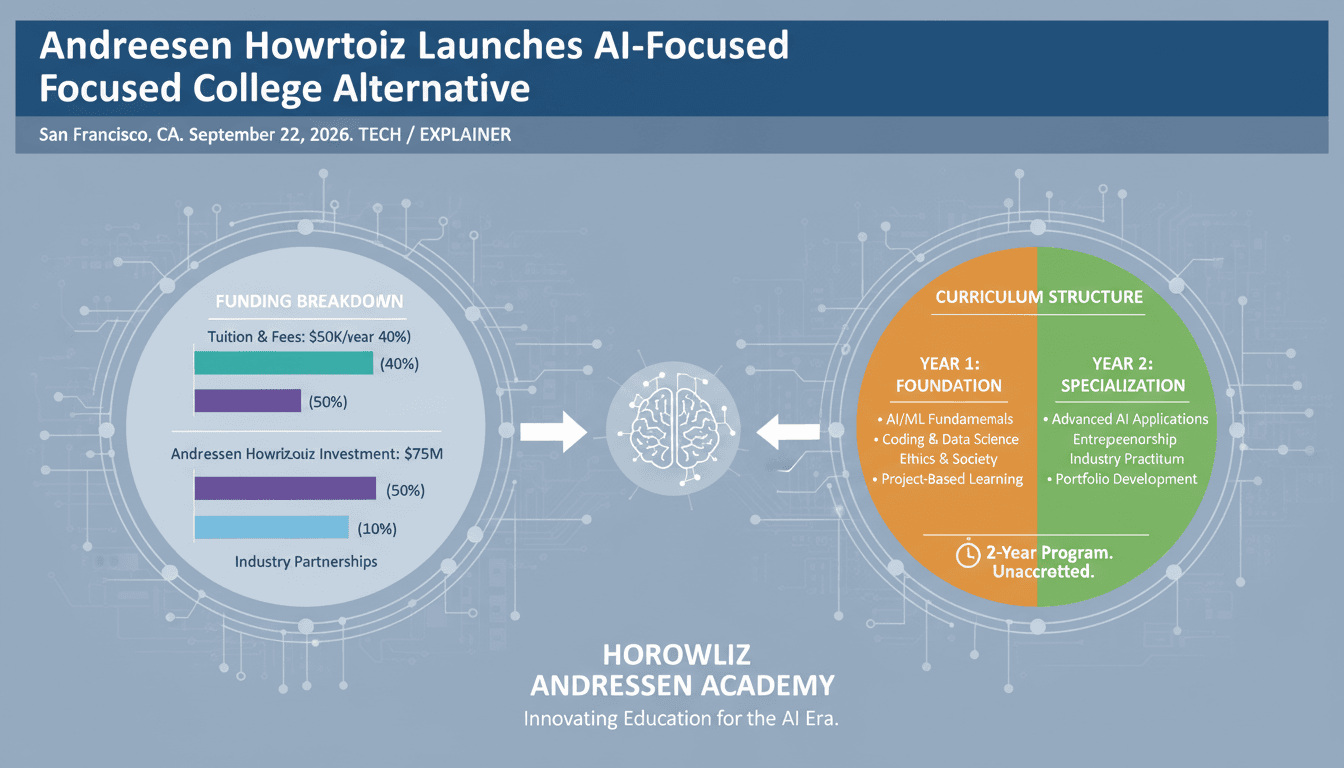
- On September 22, 2026, Andreessen Horowitz announced the launch of the Horowitz Andreessen Academy, a two-year unaccredited college alternative.
- Backed by $42 million, the program aims to provide project-based, AI-focused education for students aged 16-22, with applications opening immediately.
- The curriculum emphasizes experiential learning, partnering with major tech firms like Google and OpenAI, and aims to start its first class in fall 2027.
The context you actually need
- Rising costs of traditional education: Elite institutions often exceed $100,000 annually, prompting a search for alternatives.
- Shift towards practical skills: Companies increasingly prioritize hands-on experience and proof of work over formal degrees.
- Historical precedents: Initiatives like the Thiel Fellowship have paved the way for alternatives to traditional college paths.
What's really happening
The launch of the Horowitz Andreessen Academy is a strategic response to the escalating costs and perceived inadequacies of traditional higher education in preparing students for careers in technology. With tuition at elite universities often surpassing $100,000 annually, many young people are questioning the return on investment of a four-year degree. This skepticism is compounded by the rapid evolution of artificial intelligence, which demands a workforce that is not only technically skilled but also adaptable and innovative.
Andreessen Horowitz, a leading venture capital firm, has committed $35 million to this initiative, supplemented by $7 million from partners, totaling $42 million in funding. The academy is designed to attract high school graduates and early college students aged 16-22, offering a curriculum that is heavily project-based and focused on AI. This approach aligns with the needs of tech companies, which are increasingly looking for candidates who can demonstrate practical skills and real-world experience rather than just academic credentials.
The program will require students to submit portfolios, undergo interviews, and take IQ tests for admission, ensuring that only those with a strong aptitude for technology are selected. Once admitted, students will have access to over $50,000 in AI compute resources, a $5,000 travel budget, and networking opportunities with industry leaders. This hands-on approach is intended to immerse students in the startup ecosystem of San Francisco, where they can gain invaluable experience and connections.
The academy's first class is set to begin in fall 2027, with a one-year free program for the founding cohort, pending regulatory approval for the full two-year paid program in 2028. If successful, this model could serve as a blueprint for other tech-focused educational initiatives, further challenging the traditional college paradigm.
Who feels it first (and how)
- High school graduates: They will have a new pathway to tech careers without the burden of student debt.
- Early college students: Those disillusioned with traditional education may find this alternative appealing.
- Tech companies: They will benefit from a more skilled and adaptable workforce trained in the latest AI technologies.
- Investors in education: They may see new opportunities in alternative education models that prioritize practical skills.
What to watch next
- Regulatory approval: The success of the full two-year program hinges on gaining necessary approvals, which will indicate how traditional education systems respond.
- Enrollment numbers: The interest level in the founding class will reveal the demand for alternative education models among young professionals.
- Partnership expansions: Watch for additional tech companies joining as partners, which could enhance the program's credibility and resources.
The academy has secured $42 million in funding and will focus on AI-native education.
There will be increasing pressure on traditional colleges to adapt or innovate in response to this trend.
The long-term impact on job markets and educational standards remains to be seen.
Frequently Asked Questions
- Why it matters?
- This initiative reflects a growing skepticism towards traditional higher education, particularly in tech, as industry needs evolve rapidly.
- What happened (in 30 seconds)?
- On September 22, 2026, Andreessen Horowitz announced the launch of the Horowitz Andreessen Academy, a two-year unaccredited college alternative. Backed by $42 million, the program aims to provide project-based, AI-focused education for students aged 16-22, with applications opening immediately. The curriculum emphasizes experiential learning, partnering with major tech firms like Google and OpenAI, and aims to start its first class in fall 2027.
- What's really happening?
- The launch of the Horowitz Andreessen Academy is a strategic response to the escalating costs and perceived inadequacies of traditional higher education in preparing students for careers in technology. With tuition at elite universities often surpassing $100,000 annually, many young people are questioning the return on investment of a four-year degree. This skepticism is compounded by the rapid evolution of artificial intelligence, which demands a workforce that is not only technically skilled b
- Who feels it first (and how)?
- High school graduates: They will have a new pathway to tech careers without the burden of student debt. Early college students: Those disillusioned with traditional education may find this alternative appealing. Tech companies: They will benefit from a more skilled and adaptable workforce trained in the latest AI technologies. Investors in education: They may see new opportunities in alternative education models that prioritize practical skills.
- What to watch next?
- Regulatory approval: The success of the full two-year program hinges on gaining necessary approvals, which will indicate how traditional education systems respond. Enrollment numbers: The interest level in the founding class will reveal the demand for alternative education models among young professionals. Partnership expansions: Watch for additional tech companies joining as partners, which could enhance the program's credibility and resources.
Business, investment, entrepreneurship, leadership, and innovation.
"Forbes is known for its coverage of business leaders, market trends, and entrepreneurial ventures with a pro-business editorial stance."
— A47 Editor
Billionaire Venture Capital Firm Launches 2-Year College Alternative
The Horowitz Andreessen Academy, backed by a billionaire venture capital firm, is set to launch a two-year college alternative program, pending regulatory approval. The tuition for this program is expected to be equal to or exceed that of elite priva...
Tech business coverage, major deals, product launches, and Silicon Valley trends.
"WSJ’s tech section offers authoritative reporting on the intersection of technology and business, including exclusive industry analysis."
— A47 Editor
The Tech Elite Is Funding an Alternative to College
Andreessen Horowitz, a prominent venture-capital firm, has announced a $35 million investment to support a new two-year academy aimed at providing an alternative to traditional college education, particularly for recent high school graduates and coll...
Technology business and AI-related headlines.
"Data-driven tech newsroom with global scope."
— A47 Editor
Andreessen Horowitz Launches AI School as a College Alternative
Andreessen Horowitz, a prominent venture capital firm, has launched an AI School aimed at recent high school graduates and college dropouts, focusing on identifying and training young talent in artificial intelligence product development. This initia...
Technology business news, market impacts, and innovation trends.
"Bloomberg is a premier financial and tech news provider, respected for its in-depth reporting and analytical rigor."
— A47 Editor
Andreessen Horowitz Launches AI School as a College Alternative
Andreessen Horowitz, a prominent venture capital firm, has launched an AI School aimed at recent high school graduates and college dropouts, focusing on identifying and training young talent in artificial intelligence product development. This initia...