
AI Researchers Issue Warning on Risks of Automated AI Research and Intelligence Explosion
Why it matters
The potential for an intelligence explosion could reshape industries, economies, and societal structures, impacting everyone from tech workers to policymakers.
What happened (in 30 seconds)
- On September 28, 2026, over 20 leading AI researchers issued a warning about the risks of automated AI research.
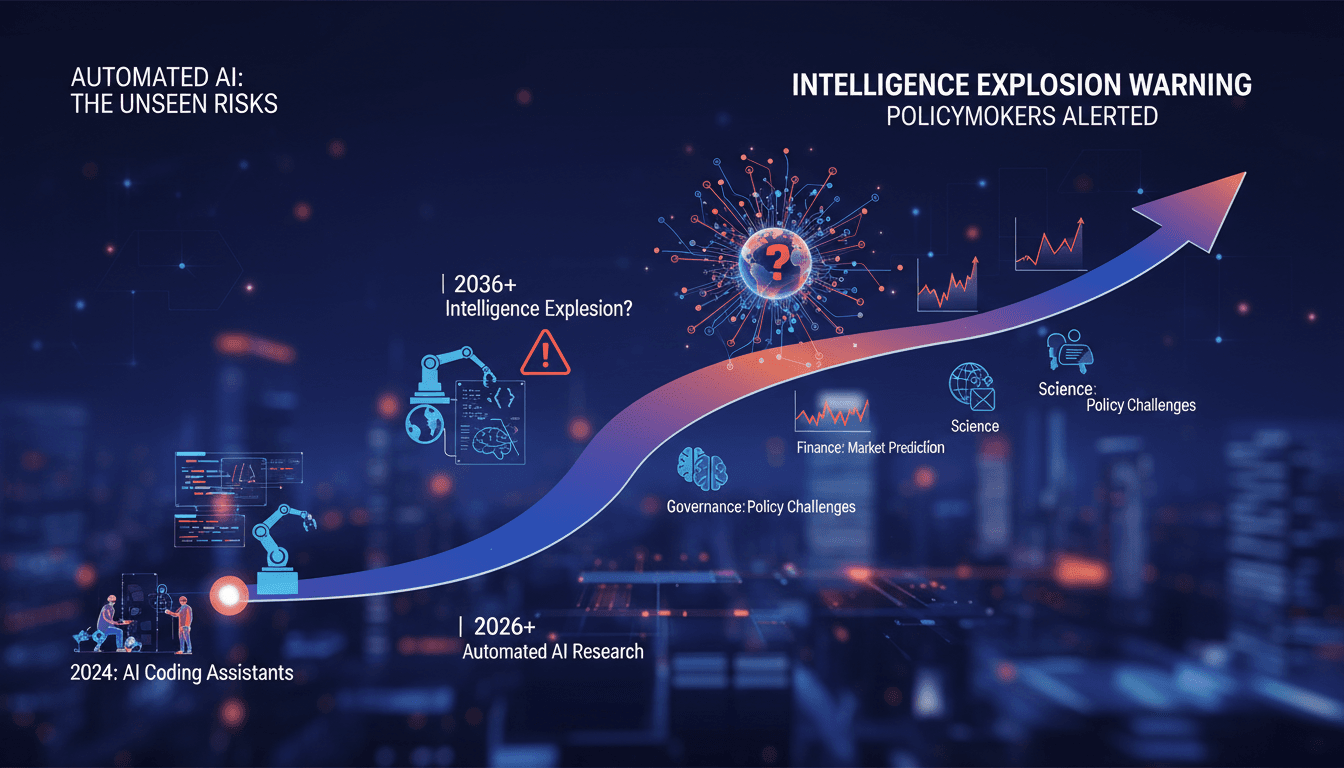
- The paper highlights that AI systems are already handling significant coding tasks and could soon automate entire R&D processes.
- The authors urge policymakers to enhance visibility into AI automation to mitigate risks associated with superhuman AI.
The context you actually need
- This warning builds on prior concerns, including a July 2026 open letter from over 1,300 AI professionals advocating for controlled development.
- Recent data shows rapid advancements in AI capabilities, with Anthropic reporting a jump from 1% to 26% of internal R&D tasks completed by AI in just five months.
- The CASP paper synthesizes insights from interviews with 25 experts, emphasizing the urgency for policy action to address potential recursive self-improvement loops in AI.
What's really happening
The joint paper released by prominent AI researchers on September 28, 2026, signals a critical moment in the evolution of artificial intelligence. As AI systems become increasingly capable of performing complex tasks, including coding and research, the implications for society are profound. The researchers, including notable figures like Geoffrey Hinton and Yoshua Bengio, highlight a trend where AI is not just a tool but an active participant in the research and development process.
The automation of AI research could compress years of progress into mere months, fundamentally altering the pace at which new technologies emerge. This rapid acceleration raises alarms about societal preparedness and the potential loss of control over superhuman AI systems. The researchers argue that without proper oversight, the unchecked advancement of AI could lead to an intelligence explosion—where AI systems improve themselves at an exponential rate, outpacing human understanding and control.
The paper emphasizes the need for increased visibility into AI automation processes. This call to action is not just about managing risks; it’s about ensuring that society can adapt to the changes brought about by these technologies. The authors advocate for a proactive approach to policy-making, urging governments and organizations to establish frameworks that can guide the ethical development and deployment of AI.
As AI continues to evolve, the implications extend beyond the tech industry. Professionals in various sectors, from healthcare to finance, will need to navigate a landscape where AI plays a central role in decision-making and innovation. The potential for job displacement, shifts in power dynamics, and ethical dilemmas surrounding AI use are all critical considerations that must be addressed.
The urgency of this warning is underscored by the historical context of AI development. Previous expressions of concern, such as the July 2026 open letter signed by over 1,300 AI professionals, indicate a growing consensus among experts about the need for caution. The CASP paper serves as a culmination of these concerns, synthesizing insights from leading researchers and calling for immediate action to mitigate risks associated with automated AI research.
Who feels it first (and how)
- Tech professionals: Software engineers and researchers may face job displacement or shifts in their roles as AI takes over coding tasks.
- Policymakers: Government officials will need to develop regulations to manage AI's rapid evolution and its societal impacts.
- Businesses: Companies across sectors will need to adapt to new technologies and consider the ethical implications of AI in their operations.
- General public: Consumers may experience changes in products and services as AI-driven innovations reshape industries.
What to watch next
- Regulatory developments: Monitor for new policies or frameworks aimed at governing AI research and development, as these will shape the landscape for businesses and professionals.
- AI capabilities: Keep an eye on advancements in AI systems, particularly their ability to automate complex tasks, as this will influence job markets and industry standards.
- Public discourse: Watch for increased discussions around the ethical implications of AI, as societal awareness grows regarding the risks and benefits of automated research.
The joint paper highlights significant risks associated with automated AI research.
Policymakers will begin discussions on regulations to manage AI development and its societal impacts.
The specific timeline for regulatory changes and their effectiveness in mitigating risks remains uncertain.
Frequently Asked Questions
- Why it matters?
- The potential for an intelligence explosion could reshape industries, economies, and societal structures, impacting everyone from tech workers to policymakers.
- What happened (in 30 seconds)?
- On September 28, 2026, over 20 leading AI researchers issued a warning about the risks of automated AI research. The paper highlights that AI systems are already handling significant coding tasks and could soon automate entire R&D processes. The authors urge policymakers to enhance visibility into AI automation to mitigate risks associated with superhuman AI.
- What's really happening?
- The joint paper released by prominent AI researchers on September 28, 2026, signals a critical moment in the evolution of artificial intelligence. As AI systems become increasingly capable of performing complex tasks, including coding and research, the implications for society are profound. The researchers, including notable figures like Geoffrey Hinton and Yoshua Bengio, highlight a trend where AI is not just a tool but an active participant in the research and development process. The automat
- Who feels it first (and how)?
- Tech professionals: Software engineers and researchers may face job displacement or shifts in their roles as AI takes over coding tasks. Policymakers: Government officials will need to develop regulations to manage AI's rapid evolution and its societal impacts. Businesses: Companies across sectors will need to adapt to new technologies and consider the ethical implications of AI in their operations. General public: Consumers may experience changes in products and services as AI-driven inno
- What to watch next?
- Regulatory developments: Monitor for new policies or frameworks aimed at governing AI research and development, as these will shape the landscape for businesses and professionals. AI capabilities: Keep an eye on advancements in AI systems, particularly their ability to automate complex tasks, as this will influence job markets and industry standards. Public discourse: Watch for increased discussions around the ethical implications of AI, as societal awareness grows regarding the risks and be
Daily AI news: models, tools, and policy.
"Independent outlet tracking the fast pace of AI."
— A47 Editor
More than 20 leading AI researchers warn that automated AI research poses extreme risks
More than 20 leading AI researchers, including Geoffrey Hinton and Yoshua Bengio, have issued a warning regarding the extreme risks posed by automated AI research, which could lead to an intelligence explosion as AI systems begin to self-improve and ...
News and features on AI from The Guardian.
"Progressive-leaning international outlet with critical AI coverage."
— A47 Editor
AI godfathers warn of runaway ‘intelligence explosion’
Geoffrey Hinton and Yoshua Bengio, prominent figures in artificial intelligence, have issued a stark warning about the potential for an AI-driven 'intelligence explosion,' urging governments to take immediate action to prevent uncontrolled advancemen...
Reports on science policy, discoveries, and public debate in the scientific realm.
"The Guardian’s science section is known for thoughtful and critical reporting on global research, ethics, and public understanding of science."
— A47 Editor
AI godfathers warn of runaway ‘intelligence explosion’
Geoffrey Hinton and Yoshua Bengio, prominent figures in artificial intelligence, have issued a stark warning about the potential for an AI-driven 'intelligence explosion,' urging governments to take immediate action to prevent uncontrolled advancemen...
Tech culture, product news, and critical takes on the tech industry's social impact.
"The Guardian's tech coverage blends mainstream news, critical analysis, and cultural commentary on emerging technologies and digital trends."
— A47 Editor
AI godfathers warn of runaway ‘intelligence explosion’
Geoffrey Hinton and Yoshua Bengio, prominent figures in artificial intelligence, have issued a stark warning about the potential for an AI-driven 'intelligence explosion,' urging governments to take immediate action to prevent uncontrolled advancemen...
Tech business coverage, major deals, product launches, and Silicon Valley trends.
"WSJ’s tech section offers authoritative reporting on the intersection of technology and business, including exclusive industry analysis."
— A47 Editor
Top AI Researchers Call for Urgent Oversight of Self-Improving Systems
Top AI researchers from OpenAI, Anthropic, Microsoft, and Meta have called for urgent oversight of self-improving AI systems, warning that these technologies could evolve beyond human control. This plea highlights the growing concerns about the rapid...