
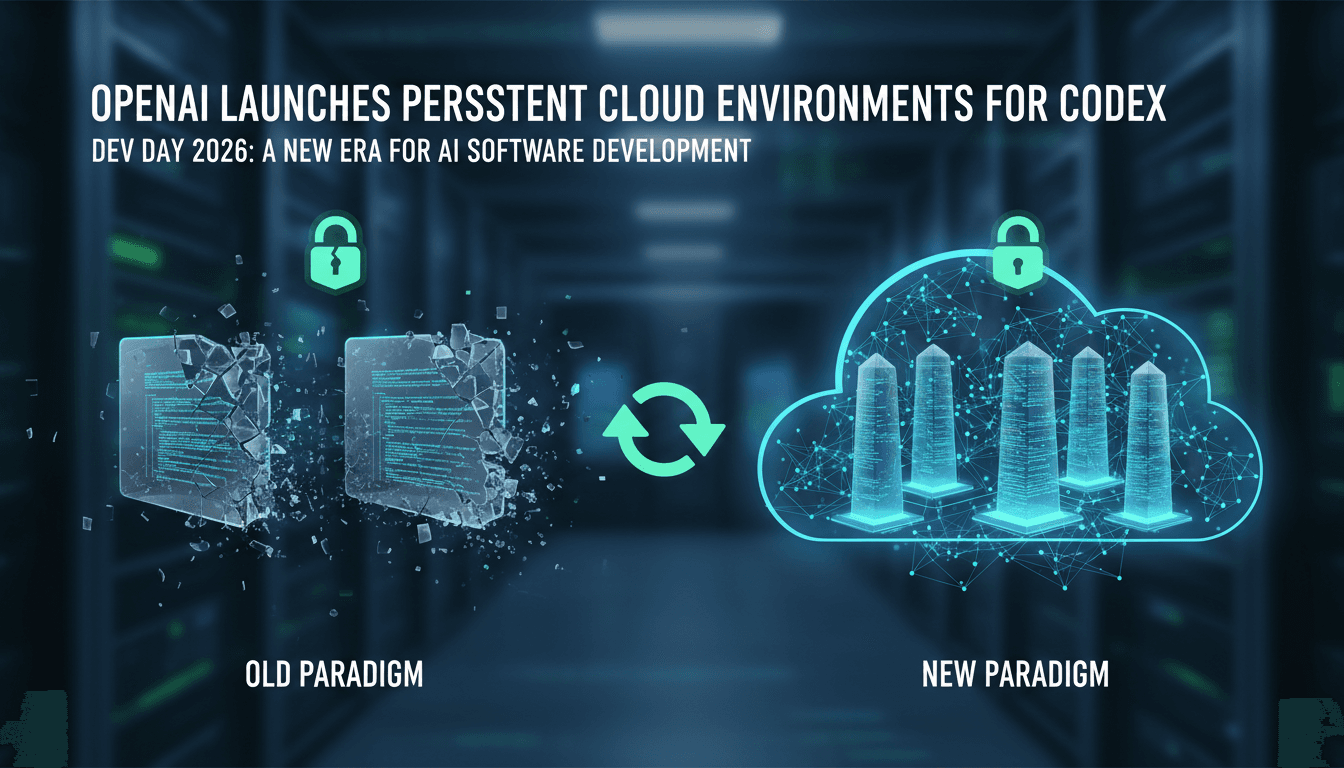
OpenAI Launches Persistent Cloud Environments for Codex at DevDay 2026
Why it matters
The introduction of persistent cloud environments marks a significant evolution in how software development teams operate, potentially increasing productivity and security.
What happened (in 30 seconds)
- OpenAI unveiled reusable cloud environments for its Codex software engineering agent at DevDay 2026 on September 29.
- These environments allow for persistent workspaces that retain project configurations and dependencies across devices, addressing previous limitations of temporary sandboxes.
- Additional updates include enhanced CLI tools, security scanning, and API improvements, all aimed at optimizing the coding experience.
The context you actually need
- Prior limitations: Before this update, Codex operated in isolated, ephemeral sandboxes, requiring repeated setup for each session, which slowed down development.
- Competitive landscape: OpenAI's DevDay has historically been a platform for major releases in AI coding tools, reflecting the growing competition in this space.
- Global availability: The new features are rolling out to various user tiers, including ChatGPT Plus, Pro, Business, Enterprise, Edu, and Healthcare, with no regional restrictions noted.
What's really happening
OpenAI's introduction of reusable cloud environments for Codex represents a pivotal shift in software development practices. By moving from temporary sandboxes to persistent workspaces, developers can now maintain their project configurations, dependencies, and permissions across sessions and devices. This change is not merely a convenience; it fundamentally alters the workflow dynamics for software teams.
Previously, developers faced the challenge of setting up their environments repeatedly, which could lead to wasted time and frustration. The new persistent environments eliminate this redundancy, allowing for faster task initiation and smoother transitions between devices. This is particularly beneficial for distributed teams, where members may be working from different locations and devices. The ability to share workspaces with approved settings enhances collaboration, enabling teams to work together more effectively, regardless of their physical location.
Moreover, the update includes a voice-enabled Codex CLI and improved session management tools, which further streamline the coding process. The integration of security features, such as automated scanning via Codex Security Cloud, addresses growing concerns about code security and integrity. As software development increasingly relies on collaboration and cloud-based tools, these enhancements position OpenAI's Codex as a formidable player in the AI coding assistant market.
The broader implications of this update extend beyond individual productivity. As teams adopt these new tools, we may see a shift in how software development is approached, with an emphasis on continuous integration and deployment practices. This could lead to faster release cycles and more robust software solutions, ultimately benefiting end-users and businesses alike.
Who feels it first (and how)
- Software Developers: They will experience immediate benefits in workflow efficiency and collaboration.
- Tech Teams: Distributed teams will find it easier to work together with shared, persistent environments.
- Businesses in Tech: Companies leveraging Codex for development will likely see improved productivity and security in their projects.
What to watch next
- Adoption rates among developers: Tracking how quickly teams integrate these new environments will indicate the update's impact on productivity.
- Feedback from early users: Insights from developers using the new features can reveal strengths and areas for improvement.
- Market response from competitors: Observing how other AI coding tools respond to this update will provide context on the competitive landscape.
OpenAI has rolled out the new features to various user tiers, enhancing accessibility.
Increased productivity and collaboration among software development teams as they adopt these tools.
The long-term impact on the competitive landscape of AI coding assistants and how other companies will respond.
Frequently Asked Questions
- Why it matters?
- The introduction of persistent cloud environments marks a significant evolution in how software development teams operate, potentially increasing productivity and security.
- What happened (in 30 seconds)?
- OpenAI unveiled reusable cloud environments for its Codex software engineering agent at DevDay 2026 on September 29. These environments allow for persistent workspaces that retain project configurations and dependencies across devices, addressing previous limitations of temporary sandboxes. Additional updates include enhanced CLI tools, security scanning, and API improvements, all aimed at optimizing the coding experience.
- What's really happening?
- OpenAI's introduction of reusable cloud environments for Codex represents a pivotal shift in software development practices. By moving from temporary sandboxes to persistent workspaces, developers can now maintain their project configurations, dependencies, and permissions across sessions and devices. This change is not merely a convenience; it fundamentally alters the workflow dynamics for software teams. Previously, developers faced the challenge of setting up their environments repeatedly, w
- Who feels it first (and how)?
- Software Developers: They will experience immediate benefits in workflow efficiency and collaboration. Tech Teams: Distributed teams will find it easier to work together with shared, persistent environments. Businesses in Tech: Companies leveraging Codex for development will likely see improved productivity and security in their projects.
- What to watch next?
- Adoption rates among developers: Tracking how quickly teams integrate these new environments will indicate the update's impact on productivity. Feedback from early users: Insights from developers using the new features can reveal strengths and areas for improvement. Market response from competitors: Observing how other AI coding tools respond to this update will provide context on the competitive landscape.
Startup news with frequent AI coverage.
"Covers launches, funding, and product updates in AI."
— A47 Editor
OpenAI gives Codex reusable cloud environments that work across devices
OpenAI has announced enhancements to its Codex platform, introducing reusable cloud development environments, a revamped command-line interface with voice controls, new code review tools, and a security-focused product for scanning repositories and p...
Daily AI news: models, tools, and policy.
"Independent outlet tracking the fast pace of AI."
— A47 Editor
OpenAI expands Codex and its API at DevDay with security scans, a Decisions API, and Ultrafast
At DevDay 2026, OpenAI announced significant enhancements to its Codex platform, including reusable cloud environments, automatic security scans for GitHub repositories, and a new Decisions API for rapid decision-making. The Ultrafast premium tier wa...
Microsoft developer news including AI tooling.
"Covers .NET/VS features intersecting with AI workloads."
— A47 Editor
Hands-On With OpenAI's Mandatory Custom GPT-to-Plugin Migration (Deadline Coming)
OpenAI is transitioning from Custom GPTs to a new plugin system that incorporates reusable skills, reference files, and connected tools, with a deadline for migration approaching. This change also affects developers through Codex, which is now integr...