
Microsoft AI Launches Advanced Voice Models for Real-Time Applications
Why it matters
The release of these models signals a significant shift towards more human-like AI interactions, impacting customer engagement strategies across industries.
What happened (in 30 seconds)
- Microsoft AI launched MAI-Transcribe-2-Streaming and MAI-Voice-2.1 on October 1, 2026.
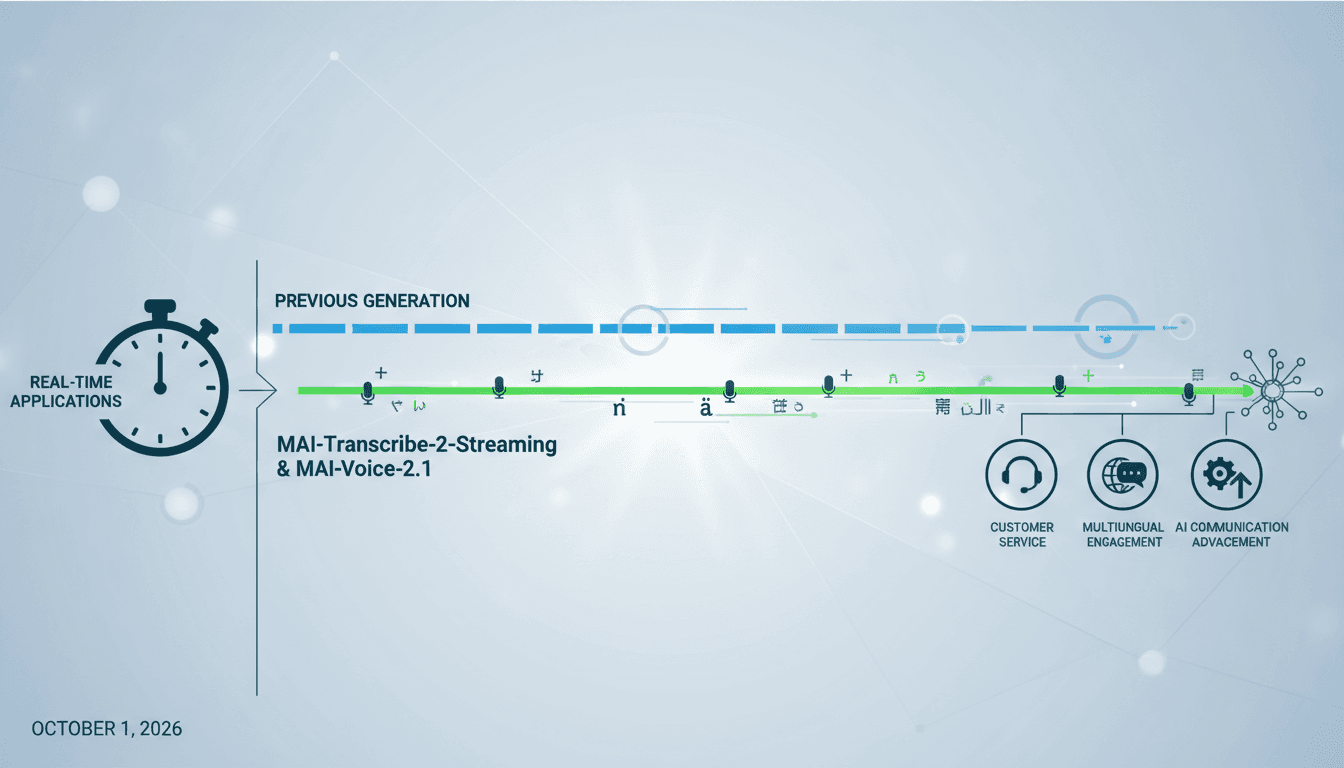
- MAI-Transcribe-2-Streaming supports 60 languages with transcription results in just over 100 milliseconds.
- MAI-Voice-2.1 offers multilingual text-to-speech capabilities with consistent voice identity and accents.
The context you actually need
- Growing demand for low-latency voice agents in customer service and multilingual applications has driven these developments.
- Previous models like MAI-Voice-2, introduced in June 2026, laid the groundwork for enhanced expressiveness and multilingual support.
- Microsoft's platforms such as Foundry and OpenRouter are now pivotal in distributing these advanced models to developers.
What's really happening
On October 1, 2026, Microsoft AI unveiled its latest innovations in voice technology: MAI-Transcribe-2-Streaming and MAI-Voice-2.1. These models are designed to meet the increasing demand for real-time voice processing, particularly in customer service and interactive applications. The MAI-Transcribe-2-Streaming model is notable for its ability to deliver partial transcription results in just over 100 milliseconds, a feat that positions it at the forefront of low-latency voice technology. This rapid response time is crucial for creating seamless conversational experiences, allowing voice agents to engage users in a more natural and fluid manner.
The MAI-Voice-2.1 model complements this by providing multilingual text-to-speech capabilities across 23 languages and 26 locales. This model ensures that voice agents can maintain a consistent voice identity and native accents, enhancing user trust and engagement. Additionally, the introduction of the MAI-Voice-2.1-Flash variant, which achieves a latency of 150 milliseconds at a lower cost, further democratizes access to high-quality voice technology for developers.
These advancements are not merely technical upgrades; they reflect a broader trend in the AI landscape where businesses are increasingly prioritizing user experience. The ability to process speech in real-time and deliver accurate responses is becoming a competitive necessity, especially in sectors like customer service, where responsiveness can significantly impact customer satisfaction and retention.
Moreover, the models incorporate safeguards against misuse, addressing ethical concerns surrounding voice cloning and AI-generated speech. This is particularly relevant as the technology becomes more accessible, raising questions about authenticity and trust in AI communications.
As these models become available through Microsoft Foundry, MAI Playground, and partner platforms like OpenRouter, developers are empowered to create more sophisticated voice interfaces. This shift not only enhances the capabilities of voice agents but also sets a new standard for what users can expect from AI interactions.
Who feels it first (and how)
- Developers: They will leverage these models to create more responsive and engaging voice applications.
- Customer service teams: Enhanced voice agents will improve customer interactions and satisfaction.
- Multilingual businesses: Companies operating in diverse markets will benefit from improved communication tools.
- Tech startups: New ventures focused on AI and voice technology will find opportunities to innovate using these models.
What to watch next
- Adoption rates: Monitor how quickly developers integrate these models into their applications, as this will indicate market readiness for advanced voice interactions.
- User feedback: Pay attention to customer responses to these new voice agents, which will reveal the effectiveness of the technology in real-world scenarios.
- Competitive landscape: Watch for responses from other tech companies, as they may accelerate their own developments in voice technology to keep pace with Microsoft.
Microsoft AI's new models are available through various platforms.
Increased adoption of low-latency voice agents in customer service and other sectors.
The long-term impact on user trust and ethical considerations surrounding voice cloning technology.
Frequently Asked Questions
- Why it matters?
- The release of these models signals a significant shift towards more human-like AI interactions, impacting customer engagement strategies across industries.
- What happened (in 30 seconds)?
- Microsoft AI launched MAI-Transcribe-2-Streaming and MAI-Voice-2.1 on October 1, 2026. MAI-Transcribe-2-Streaming supports 60 languages with transcription results in just over 100 milliseconds. MAI-Voice-2.1 offers multilingual text-to-speech capabilities with consistent voice identity and accents.
- What's really happening?
- On October 1, 2026, Microsoft AI unveiled its latest innovations in voice technology: MAI-Transcribe-2-Streaming and MAI-Voice-2.1. These models are designed to meet the increasing demand for real-time voice processing, particularly in customer service and interactive applications. The MAI-Transcribe-2-Streaming model is notable for its ability to deliver partial transcription results in just over 100 milliseconds, a feat that positions it at the forefront of low-latency voice technology. This r
- Who feels it first (and how)?
- Developers: They will leverage these models to create more responsive and engaging voice applications. Customer service teams: Enhanced voice agents will improve customer interactions and satisfaction. Multilingual businesses: Companies operating in diverse markets will benefit from improved communication tools. Tech startups: New ventures focused on AI and voice technology will find opportunities to innovate using these models.
- What to watch next?
- Adoption rates: Monitor how quickly developers integrate these models into their applications, as this will indicate market readiness for advanced voice interactions. User feedback: Pay attention to customer responses to these new voice agents, which will reveal the effectiveness of the technology in real-world scenarios. Competitive landscape: Watch for responses from other tech companies, as they may accelerate their own developments in voice technology to keep pace with Microsoft.
Daily AI news: models, tools, and policy.
"Independent outlet tracking the fast pace of AI."
— A47 Editor
Microsoft AI releases new transcription and text-to-speech models for voice agents
Microsoft AI has introduced MAI-Transcribe-2-Streaming, a new model designed for real-time transcription, enhancing the capabilities of voice agents. This model aims to provide low-latency transcription, improving the efficiency of audio processing i...
AI news with an enterprise and cloud focus.
"Covers AI in the context of data infrastructure, cloud, and enterprise stacks."
— A47 Editor
Microsoft targets ultra-realistic voice agents with its first streaming transcription model
Microsoft Corp. has introduced its first streaming transcription model as part of its MAI artificial intelligence model family, aimed at enabling developers to create ultra-realistic voice agents that can engage in real-time conversations. This model...
Curated tech headlines including AI stories.
"Influential aggregator surfacing the day’s top tech/AI links."
— A47 Editor
Microsoft launches MAI-Transcribe-2-Streaming, a model for low-latency, real-time transcripts, and two new voice models, MAI-Voice-2.1 and MAI-Voice-2.1-Flash (Microsoft AI)
Microsoft has launched MAI-Transcribe-2-Streaming, a new model designed for low-latency, real-time transcription, alongside two new voice models, MAI-Voice-2.1 and MAI-Voice-2.1-Flash. These advancements aim to enhance audio understanding and generat...