
Google Launches Nano Banana 2.1 Image Generation Model with Cost Reductions
Why it matters
The release of Nano Banana 2.1 signals a shift towards more affordable and efficient image generation tools in a competitive AI landscape.
What happened (in 30 seconds)
- Google launched Nano Banana 2.1 on 6 October 2026, enhancing its image generation capabilities.
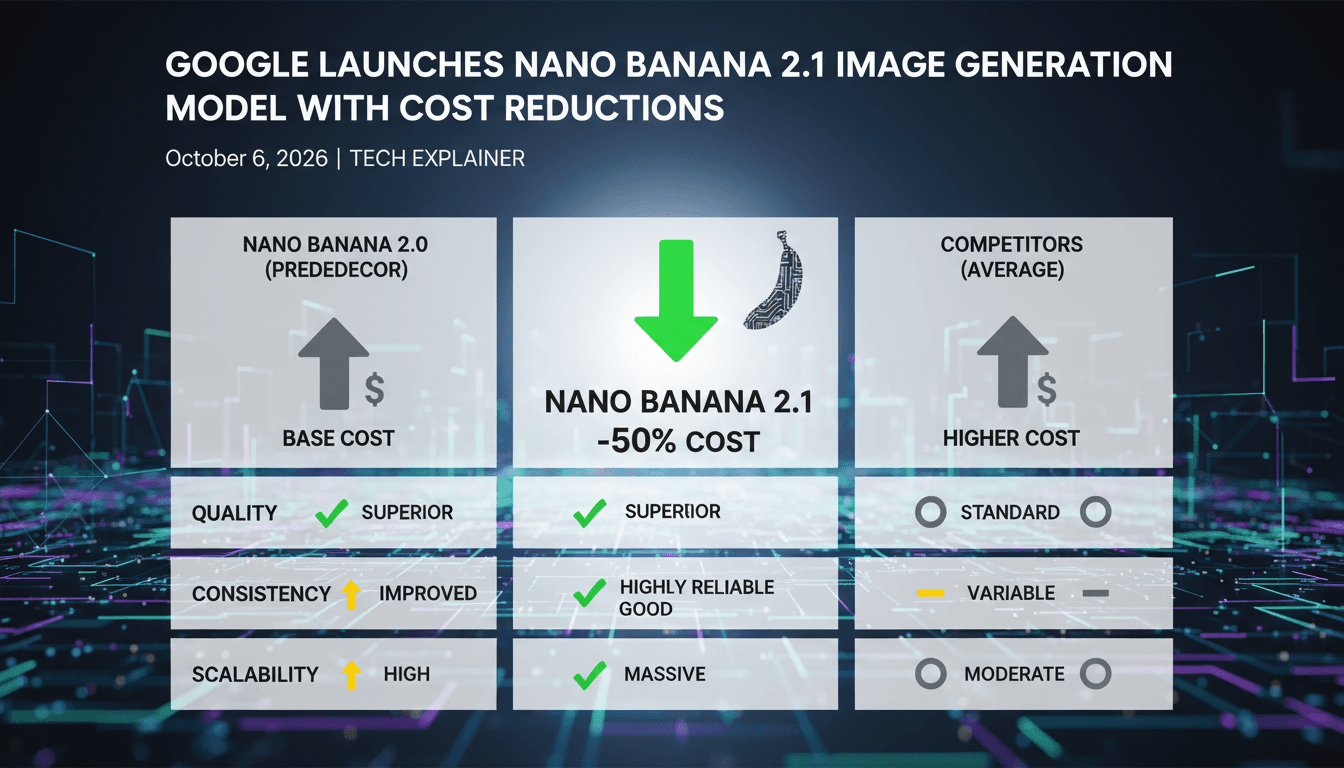
- Costs were halved, with the price for a standard 1K image dropping to $0.0336 from $0.067.
- Developers must migrate to the new model by 29 October 2026, as the previous version will be retired.
The context you actually need
- Previous models struggled with cost efficiency and editing consistency, limiting their appeal to developers and businesses.
- The AI market is competitive, with increasing demand for scalable, lower-cost image production solutions.
- Nano Banana 2.1 offers improved features like batch processing and enhanced text rendering, making it a strong contender against premium options.
What's really happening
On 6 October 2026, Google unveiled Nano Banana 2.1, a high-efficiency image generation model that aims to redefine cost structures in digital content creation. This model is positioned as a primary option within Google's Gemini ecosystem, delivering a significant 50% reduction in image output costs. For instance, the price for a standard 1K image is now approximately $0.0336, down from $0.067. This pricing strategy is designed to attract developers, businesses, and creative professionals who require scalable solutions for image production.
The model supports various resolutions—1K, 2K, and 4K—and allows for up to 14 reference images to ensure consistency across multiple characters and objects. Enhanced features such as mask-based editing and configurable reasoning levels further improve the user experience. Additionally, batch processing capabilities offer further discounts, making it even more appealing for high-volume users.
The timing of this release is crucial, as it comes amid growing competition in the multimodal AI tools market. Developers are increasingly seeking cost-effective solutions that do not compromise on quality. By addressing the limitations of its predecessor, Nano Banana 2, which struggled with editing consistency and text rendering accuracy, Google is positioning Nano Banana 2.1 as a viable alternative to more expensive models like Nano Banana Pro.
The migration deadline of 29 October 2026 for users of the previous version adds urgency to the transition, compelling developers to adapt quickly to the new model. This shift not only impacts individual users but also has broader implications for the digital content landscape, where cost efficiency is paramount.
As the demand for high-quality digital content continues to rise, the introduction of Nano Banana 2.1 could reshape production workflows, allowing businesses to produce more content at lower costs. This model's success will likely depend on how well it meets the needs of developers and creative professionals in a rapidly evolving market.
Who feels it first (and how)
- Developers: They will need to migrate to the new model quickly to avoid disruptions.
- Marketing firms: Cost reductions will benefit those producing high volumes of digital content.
- Creative professionals: Freelancers and agencies can leverage lower costs for enhanced project profitability.
- Businesses: Companies relying on visual content for advertising and branding will see significant savings.
What to watch next
- User adoption rates: Monitoring how quickly developers transition to Nano Banana 2.1 will indicate its market acceptance.
- Competitive responses: Watch for reactions from other AI image generation providers as they adjust their pricing and features.
- Performance benchmarks: Independent evaluations of Nano Banana 2.1’s capabilities compared to its competitors will reveal its effectiveness in real-world applications.
Nano Banana 2.1 is generally available and offers a 50% cost reduction for image generation.
Increased adoption among developers and businesses seeking cost-effective solutions.
The long-term impact on the competitive landscape and how other companies will respond to this pricing strategy.
Frequently Asked Questions
- Why it matters?
- The release of Nano Banana 2.1 signals a shift towards more affordable and efficient image generation tools in a competitive AI landscape.
- What happened (in 30 seconds)?
- Google launched Nano Banana 2.1 on 6 October 2026, enhancing its image generation capabilities. Costs were halved, with the price for a standard 1K image dropping to $0.0336 from $0.067. Developers must migrate to the new model by 29 October 2026, as the previous version will be retired.
- What's really happening?
- On 6 October 2026, Google unveiled Nano Banana 2.1, a high-efficiency image generation model that aims to redefine cost structures in digital content creation. This model is positioned as a primary option within Google's Gemini ecosystem, delivering a significant 50% reduction in image output costs. For instance, the price for a standard 1K image is now approximately $0.0336, down from $0.067. This pricing strategy is designed to attract developers, businesses, and creative professionals who req
- Who feels it first (and how)?
- Developers: They will need to migrate to the new model quickly to avoid disruptions. Marketing firms: Cost reductions will benefit those producing high volumes of digital content. Creative professionals: Freelancers and agencies can leverage lower costs for enhanced project profitability. Businesses: Companies relying on visual content for advertising and branding will see significant savings.
- What to watch next?
- User adoption rates: Monitoring how quickly developers transition to Nano Banana 2.1 will indicate its market acceptance. Competitive responses: Watch for reactions from other AI image generation providers as they adjust their pricing and features. Performance benchmarks: Independent evaluations of Nano Banana 2.1’s capabilities compared to its competitors will reveal its effectiveness in real-world applications.
English-language digital publication covering business, politics, technology, and current affairs.
"The Arabian Post mixes original and syndicated-style coverage with a broad regional and global business-news orientation."
— A47 Editor
Google introduces Nano Banana 2.1 with cheaper image generation
Google has launched Nano Banana 2.1, an upgraded artificial intelligence model that reduces image generation costs by approximately 50% while enhancing editing accuracy, visual consistency, and text rendering. This release, which occurred on October ...
News and guidance for IT pros on AI adoption.
"Enterprise-focused tips, explainers, and news for professionals."
— A47 Editor
Google Launches Nano Banana 2.1 With Better Image Editing and Lower Costs
Google has officially launched Nano Banana 2.1, an advanced image generation and editing model that significantly reduces costs and enhances editing consistency compared to its predecessor. The new model is based on the Gemini 3.6 Flash architecture ...
Curated tech headlines including AI stories.
"Influential aggregator surfacing the day’s top tech/AI links."
— A47 Editor
Google releases Nano Banana 2.1, based on Gemini 3.6 Flash, saying it improves on previous versions "across the board"; pricing is ~50% lower vs. Nano Banana 2 (Matthias Bastian/The Decoder)
Google has launched Nano Banana 2.1, an advanced image generation and editing model based on the Gemini 3.6 Flash architecture, claiming improvements across all functionalities while offering a pricing structure approximately 50% lower than its prede...
Arabic tech news covering startups, apps, AI, and gadgets.
"AITnews is a well-known Arabic technology outlet covering regional tech developments."
— A47 Editor
جوجل تطلق نموذج توليد الصور Nano Banana 2.1 بتحسينات كبيرة في إجراء التعديلات وثبات العناصر
Google has launched Nano Banana 2.1, an upgraded version of its AI-based image generation and editing model, featuring significant improvements in visual design, the ability to modify specific parts of images, and maintaining the stability of element...
Daily AI news: models, tools, and policy.
"Independent outlet tracking the fast pace of AI."
— A47 Editor
Google's new image model Nano Banana 2.1 generates better images for less money
Google has launched its new image model, Nano Banana 2.1, which utilizes the Gemini 3.6 Flash architecture, claiming to generate superior images at a reduced cost compared to its predecessor, the Pro model. This model reportedly outperforms the previ...