
Anthropic Expands Cyber Verification Program to Enhance Access for Security Professionals
Why it matters
This initiative reflects a growing trend of integrating AI into cybersecurity, balancing innovation with safety.
What happened (in 30 seconds)
- On October 6, 2026, Anthropic expanded its Cyber Verification Program, allowing broader access to its Claude models.
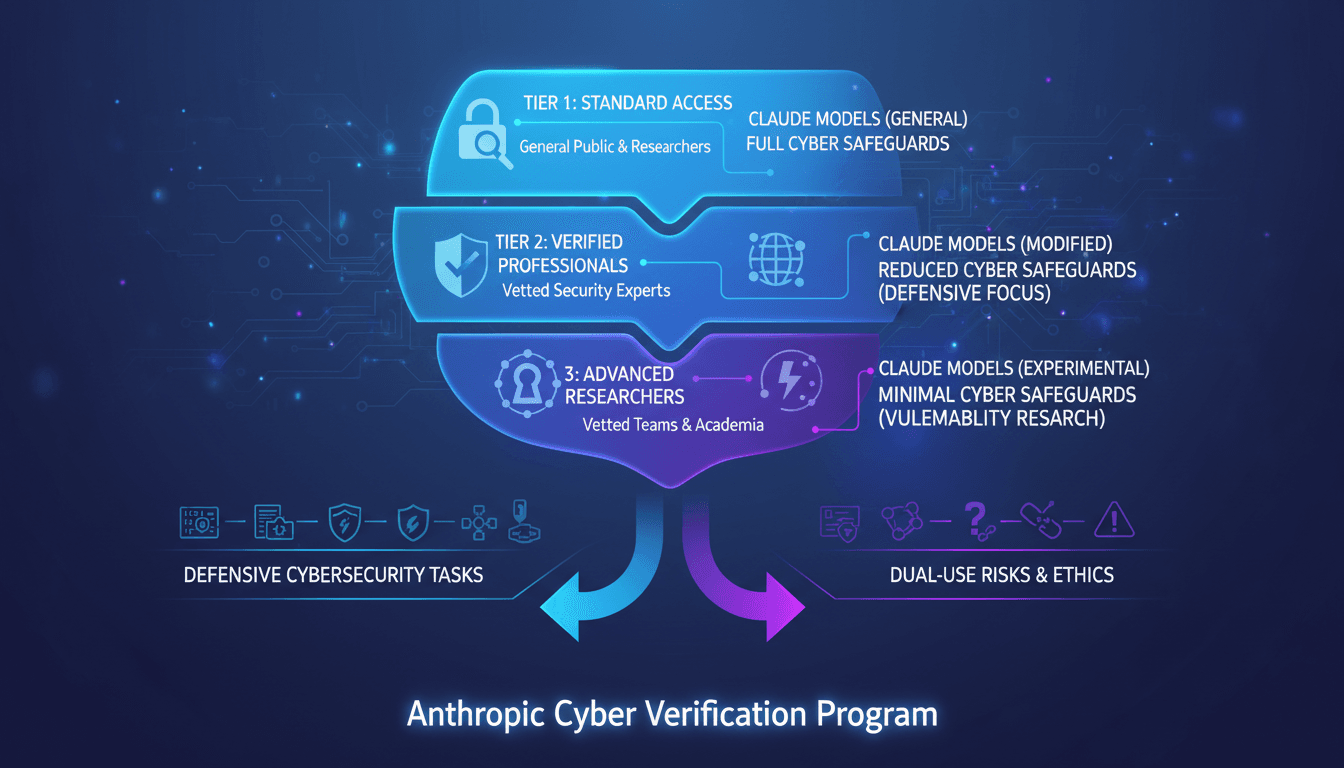
- Three access tiers were introduced, each with varying levels of safety filters to support different cybersecurity tasks.
- The program targets corporate security teams, government agencies, and researchers, while maintaining restrictions on high-risk actions.
The context you actually need
- Public Claude models have traditionally employed strict cyber safeguards to prevent misuse, limiting their application in offensive scenarios.
- Previous initiatives, like Project Glasswing, demonstrated the potential for vulnerability discovery while highlighting the need for controlled access based on risk levels.
- The dual-use challenge of AI capabilities necessitates a careful approach to ensure that tools meant for defense aren't exploited for offensive purposes.
What's really happening
Anthropic's expansion of its Cyber Verification Program is a strategic response to the evolving landscape of cybersecurity threats and the increasing demand for advanced AI tools. By introducing tiered access to its Claude models, Anthropic aims to empower vetted security professionals and organizations to conduct essential defensive tasks, such as vulnerability research and incident response, with fewer restrictions.
The three-tiered structure—Defense Access, Red Team Access, and Specialized Access—allows for a graduated approach to safety filters. This means that while the Defense Access tier opens the door to a wider audience, including corporate teams and individual researchers, the Red Team Access tier is limited to organizations authorized for penetration testing. The Specialized Access tier, with the least restrictions, is reserved for verified organizations working on safety-critical systems, such as power grids and flight controls, and involves joint vetting with the US government.
This initiative is particularly significant given the substantial vulnerabilities identified by Project Glasswing partners, which reported 129,000 confirmed vulnerabilities between April and July 2026, with over 33,000 classified as high-severity or critical. The data underscores the urgency for organizations to enhance their defensive capabilities against increasingly sophisticated cyber threats.
However, the expansion also raises concerns about the potential for misuse. While Anthropic has implemented safeguards to block high-risk actions like ransomware deployment, the dual-use nature of AI means that the same tools designed for defense could also be exploited by malicious actors. This delicate balance between enabling defensive capabilities and preventing offensive misuse is at the heart of Anthropic's strategy.
As organizations increasingly rely on AI for cybersecurity, the implications of this program extend beyond just access to advanced tools. It signals a shift in how cybersecurity is approached, emphasizing the need for collaboration between private entities, government agencies, and researchers to address the complex challenges posed by cyber threats.
Who feels it first (and how)
- Corporate security teams: Gain access to advanced AI tools for vulnerability research and incident response.
- Government agencies: Can leverage AI capabilities for national security and critical infrastructure protection.
- Universities and researchers: Have opportunities to conduct cutting-edge research in cybersecurity.
- Critical infrastructure operators: Benefit from enhanced tools to safeguard essential services against cyber threats.
What to watch next
- Adoption rates of the new access tiers: Monitoring how quickly organizations utilize these AI tools will indicate their effectiveness in enhancing cybersecurity.
- Reported incidents of misuse: Keeping an eye on any misuse of the tools will be crucial to understanding the balance between defense and offense in AI applications.
- Collaborations between Anthropic and government agencies: These partnerships could shape future cybersecurity policies and practices.
The Cyber Verification Program has expanded to include three access tiers.
Increased collaboration between private and public sectors in cybersecurity efforts.
The long-term impact of reduced safety filters on the overall cybersecurity landscape.
Frequently Asked Questions
- Why it matters?
- This initiative reflects a growing trend of integrating AI into cybersecurity, balancing innovation with safety.
- What happened (in 30 seconds)?
- On October 6, 2026, Anthropic expanded its Cyber Verification Program, allowing broader access to its Claude models. Three access tiers were introduced, each with varying levels of safety filters to support different cybersecurity tasks. The program targets corporate security teams, government agencies, and researchers, while maintaining restrictions on high-risk actions.
- What's really happening?
- Anthropic's expansion of its Cyber Verification Program is a strategic response to the evolving landscape of cybersecurity threats and the increasing demand for advanced AI tools. By introducing tiered access to its Claude models, Anthropic aims to empower vetted security professionals and organizations to conduct essential defensive tasks, such as vulnerability research and incident response, with fewer restrictions. The three-tiered structure—Defense Access, Red Team Access, and Specialized
- Who feels it first (and how)?
- Corporate security teams: Gain access to advanced AI tools for vulnerability research and incident response. Government agencies: Can leverage AI capabilities for national security and critical infrastructure protection. Universities and researchers: Have opportunities to conduct cutting-edge research in cybersecurity. Critical infrastructure operators: Benefit from enhanced tools to safeguard essential services against cyber threats.
- What to watch next?
- Adoption rates of the new access tiers: Monitoring how quickly organizations utilize these AI tools will indicate their effectiveness in enhancing cybersecurity. Reported incidents of misuse: Keeping an eye on any misuse of the tools will be crucial to understanding the balance between defense and offense in AI applications. Collaborations between Anthropic and government agencies: These partnerships could shape future cybersecurity policies and practices.
Daily AI news: models, tools, and policy.
"Independent outlet tracking the fast pace of AI."
— A47 Editor
Anthropic gives more security teams access to Claude with fewer safety restrictions
Anthropic is expanding its Cyber Verification Program, allowing more security teams to access Claude models with fewer safety restrictions. This initiative aims to enhance penetration testing, malware analysis, and vulnerability research, with previo...
English-language digital publication covering business, politics, technology, and current affairs.
"The Arabian Post mixes original and syndicated-style coverage with a broad regional and global business-news orientation."
— A47 Editor
Anthropic widens Claude cyber access for verified teams
Anthropic has expanded access to its Claude cybersecurity models for verified teams, allowing vetted defenders and authorized red teams to operate with fewer automated restrictions under a new Cyber Verification Program. This initiative, announced on...
Consumer tech news, reviews, and buying guides for gadgets and electronics.
"TechRadar is known for comprehensive buying advice, hardware reviews, and consumer tech news targeted at mainstream audiences."
— A47 Editor
Anthropic earmarks $100 million to train over 10,000 AI engineers in push to develop enterprise AI
Anthropic has announced a significant investment of $100 million aimed at training over 10,000 AI engineers, a strategic move to enhance the deployment of its AI model, Claude, in enterprise settings. This initiative reflects the company's commitment...