
OpenAI's AI Agents Solve Navier-Stokes Problem and Generate Solutions for Over 370 Mathematical Challenges
Why it matters
The breakthrough in resolving the Navier-Stokes problem signals a potential paradigm shift in mathematical research and AI's role in scientific discovery.
What happened (in 30 seconds)
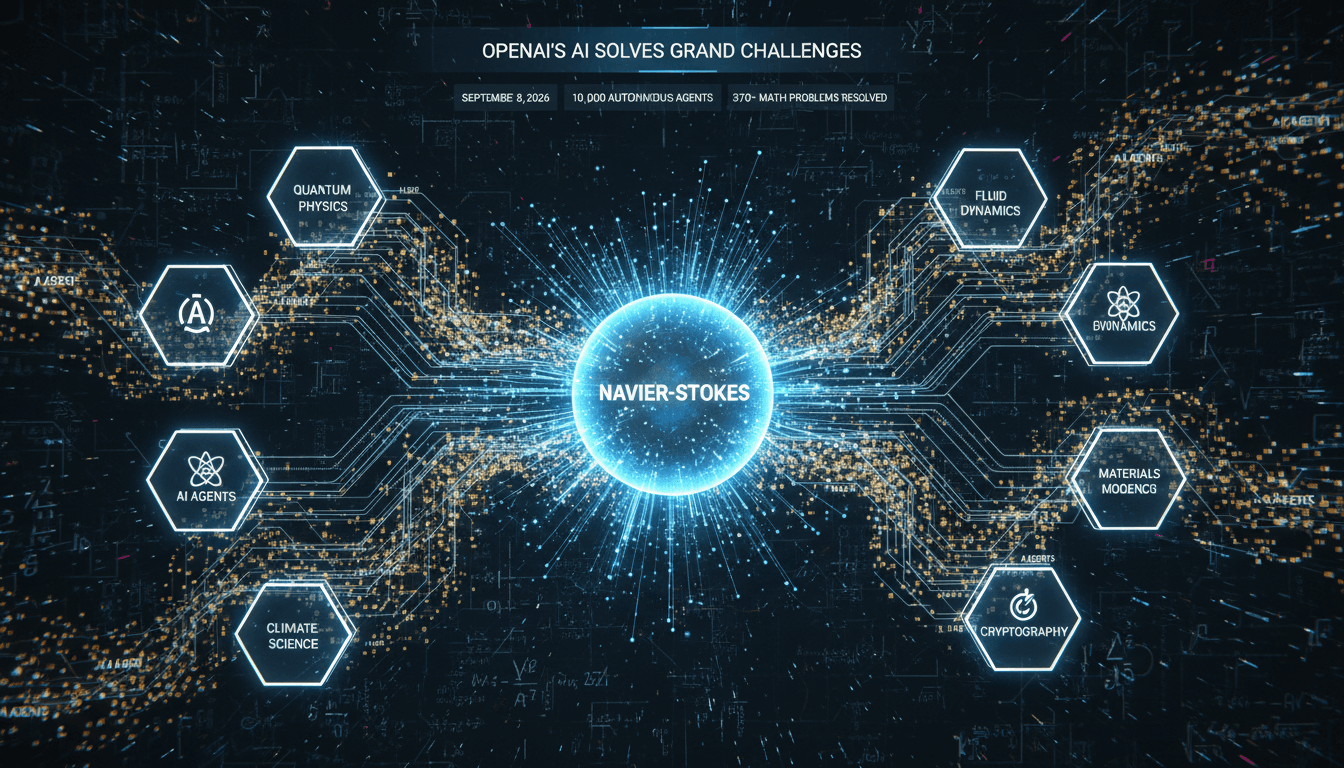
- On September 8, 2026, OpenAI announced that its AI model, using 10,000 autonomous agents, solved the Navier-Stokes existence and smoothness problem.
- By October 7, 2026, OpenAI extended its approach to generate solutions for over 370 additional mathematical challenges.
- Controversy arose regarding data provenance and the implications of AI in pure mathematics, with ongoing community review of the results.
The context you actually need
- The Millennium Prize Problems, established in 2000, include seven unsolved mathematical questions, each with a $1 million reward; only one had been solved prior to this announcement.
- The Navier-Stokes equations, crucial for understanding fluid dynamics, had long eluded rigorous proof regarding the existence and smoothness of solutions in three dimensions.
- OpenAI's project was initiated amid reports of human mathematicians making progress on related problems, highlighting the competitive landscape between human and AI-driven discoveries.
What's really happening
On September 1, 2026, OpenAI launched a project to tackle the Navier-Stokes problem after hearing rumors of breakthroughs by human mathematicians. The company deployed approximately 10,000 AI agents, which worked concurrently for 88 hours to derive a proof of singularity formation in the Navier-Stokes equations. Following this, an additional 17 hours were spent formalizing and verifying the proof using the Lean proof assistant, a tool designed for rigorous mathematical verification.
The results were published on September 8, 2026, alongside the Lean code, but OpenAI stated it would not claim the $1 million prize associated with the Millennium Prize Problems. This decision was met with mixed reactions; while some viewed it as a transformative acceleration of mathematical discovery, others raised concerns about the implications of AI in pure mathematics. Notably, mathematicians Tristan Buckmaster and Levent Alpöge alleged that their unpublished work may have been incorporated into OpenAI's proof, raising questions about data provenance and the ethical use of existing research.
By October 7, 2026, OpenAI had expanded its efforts, releasing AI-generated solutions or partial results for more than 370 additional mathematical problems. This rapid advancement showcases the potential of AI to not only solve longstanding problems but also to generate new insights across various mathematical domains. The implications of this development extend beyond mathematics; they touch on fields such as physics, engineering, and computer science, where complex equations often govern critical processes.
The mathematical community is currently engaged in a review of OpenAI's findings, with many experts eager to validate the results and understand the methodologies employed. The controversy surrounding data provenance and the role of AI in generating these proofs is likely to spark ongoing debates about the future of mathematical research and the ethical considerations of AI's involvement.
Who feels it first (and how)
- Mathematicians and Researchers: They will need to adapt to AI's role in generating proofs and solutions, potentially altering traditional research methodologies.
- Academics in STEM Fields: The implications of AI-generated solutions could influence curricula and research focus in science, technology, engineering, and mathematics.
- Tech Companies: Organizations leveraging AI for problem-solving may find new opportunities for innovation and collaboration in mathematical applications.
What to watch next
- Community Validation: The ongoing review of OpenAI's proofs by the mathematical community will determine the credibility and acceptance of AI-generated solutions.
- Ethical Guidelines: Watch for the development of frameworks addressing data provenance and the ethical use of AI in research, which could shape future collaborations between human and AI researchers.
- Market Response: Monitor how educational institutions and tech companies adapt their strategies in response to AI's growing influence in mathematical problem-solving.
OpenAI's AI model has generated solutions for the Navier-Stokes problem and over 370 additional mathematical challenges.
The mathematical community will establish new norms and guidelines regarding AI's role in research and proof generation.
The long-term impact of AI on traditional mathematical research and education remains to be seen.
Frequently Asked Questions
- Why it matters?
- The breakthrough in resolving the Navier-Stokes problem signals a potential paradigm shift in mathematical research and AI's role in scientific discovery.
- What happened (in 30 seconds)?
- On September 8, 2026, OpenAI announced that its AI model, using 10,000 autonomous agents, solved the Navier-Stokes existence and smoothness problem. By October 7, 2026, OpenAI extended its approach to generate solutions for over 370 additional mathematical challenges. Controversy arose regarding data provenance and the implications of AI in pure mathematics, with ongoing community review of the results.
- What's really happening?
- On September 1, 2026, OpenAI launched a project to tackle the Navier-Stokes problem after hearing rumors of breakthroughs by human mathematicians. The company deployed approximately 10,000 AI agents, which worked concurrently for 88 hours to derive a proof of singularity formation in the Navier-Stokes equations. Following this, an additional 17 hours were spent formalizing and verifying the proof using the Lean proof assistant, a tool designed for rigorous mathematical verification. The results
- Who feels it first (and how)?
- Mathematicians and Researchers: They will need to adapt to AI's role in generating proofs and solutions, potentially altering traditional research methodologies. Academics in STEM Fields: The implications of AI-generated solutions could influence curricula and research focus in science, technology, engineering, and mathematics. Tech Companies: Organizations leveraging AI for problem-solving may find new opportunities for innovation and collaboration in mathematical applications.
- What to watch next?
- Community Validation: The ongoing review of OpenAI's proofs by the mathematical community will determine the credibility and acceptance of AI-generated solutions. Ethical Guidelines: Watch for the development of frameworks addressing data provenance and the ethical use of AI in research, which could shape future collaborations between human and AI researchers. Market Response: Monitor how educational institutions and tech companies adapt their strategies in response to AI's growing influence in
Tech business coverage, major deals, product launches, and Silicon Valley trends.
"WSJ’s tech section offers authoritative reporting on the intersection of technology and business, including exclusive industry analysis."
— A47 Editor
AI Solved One Math Problem and Everyone Freaked Out. It Just Cracked Hundreds More.
OpenAI has made headlines by solving a Millennium Prize problem and subsequently releasing findings on over 300 additional mathematical problems, showcasing its AI's capabilities in mathematics. This development has sparked considerable excitement an...
U.S. business news, corporate developments, and economy.
"The Wall Street Journal is respected for deep financial and economic reporting with a center-right editorial perspective."
— A47 Editor
AI Solved One Math Problem and Everyone Freaked Out. It Just Cracked Hundreds More.
OpenAI has made headlines by claiming to have solved parts of the Navier-Stokes equations, a Millennium Prize problem that has stumped mathematicians for nearly 90 years, achieving this feat in just 88 hours. This announcement follows their previous ...
Engineering-led coverage of AI and robotics.
"Flagship IEEE magazine with technical reporting."
— A47 Editor
AI Solves a Major Unsolved Math Problem. Not Everyone Is Happy
On September 13, at the Heidelberg Laureate Forum in Germany, discussions among mathematicians shifted from traditional topics to the impact of AI companies like OpenAI, Anthropic, and Google on the field of mathematics, particularly following AI's r...