
Broadcom CEO Warns of Unsustainable AI Investment Practices Leading to Market Declines
Why it matters
The remarks from Broadcom's CEO signal a potential reevaluation of AI investment strategies, impacting market confidence and capital allocation.
What happened (in 30 seconds)
- On October 12, 2026, Broadcom CEO Hock Tan warned investors about a "casino" mentality in AI investing during a conference in Singapore.
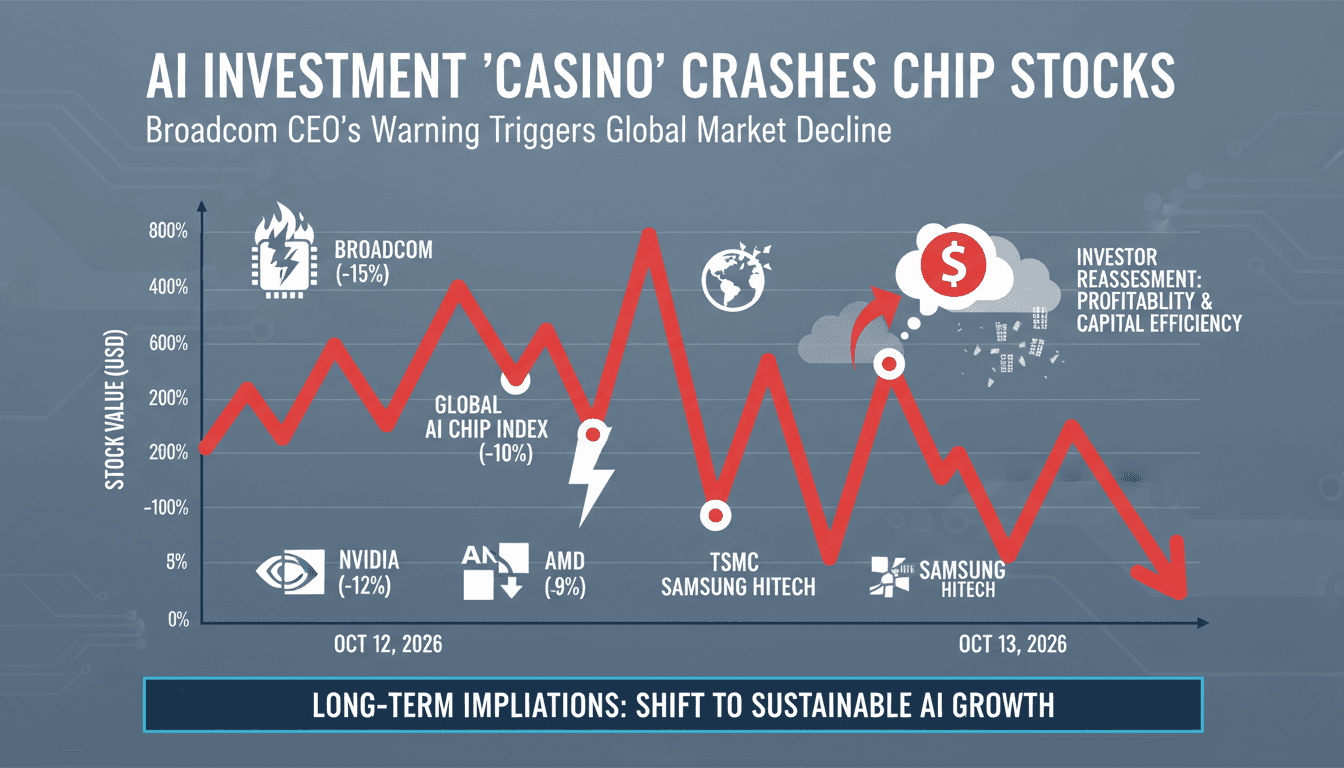
- Following his comments, chip stocks experienced significant declines globally, with Asian semiconductor equities dropping sharply on October 13.
- Tan highlighted that capital constraints are the primary hurdle for AI growth, questioning the sustainability of current investment levels.
The context you actually need
- AI sector growth: The AI industry saw rapid expansion in 2025-2026, driven by demand for advanced chips and data center infrastructure, leading to substantial revenue growth for companies like Broadcom.
- Profitability concerns: Despite high revenues, questions remain about the long-term profitability of AI model developers and the sustainability of elevated valuations amid high capital expenditures.
- Market volatility: The immediate market reaction to Tan's comments reflects a broader investor reassessment of risks associated with AI investments, particularly in the semiconductor sector.
What's really happening
Hock Tan's remarks at the DBS conference in Singapore on October 12, 2026, have ignited a wave of concern among investors regarding the sustainability of AI investments. He characterized the current state of AI investing as akin to gambling, where investors often set unrealistic expectations without fully understanding the underlying economics. This analogy resonates in a market that has seen rapid growth but is now facing scrutiny over its long-term viability.
Tan pointed out that while demand for AI products is robust—evidenced by OpenAI's projected $50 billion annualized revenue run-rate—there are significant costs associated with training AI models that could undermine profitability. He emphasized that capital constraints, rather than technical shortages, are now the primary barrier to AI development. This shift in focus from supply chain issues to financial sustainability is crucial for investors to understand.
The immediate aftermath of Tan's comments was a sharp decline in semiconductor stocks across Asian markets, with South Korea's KOSPI falling over 6% and Japan's Nikkei 225 dropping nearly 3%. Major players like Samsung Electronics and SK Hynix saw their shares plummet by up to 10.8%. This reaction indicates that investors are recalibrating their expectations and reassessing the risks associated with AI investments, particularly in the semiconductor sector, which is critical for AI infrastructure.
As the AI sector continues to evolve, the implications of Tan's warning extend beyond immediate stock prices. Investors may need to adopt a more cautious approach, focusing on companies that demonstrate sustainable business models and clear paths to profitability. The volatility observed in the markets serves as a reminder that while AI holds tremendous potential, the path to realizing that potential is fraught with challenges.
Who feels it first (and how)
- Tech investors: Those heavily invested in AI and semiconductor stocks will feel the immediate impact of market volatility.
- Semiconductor firms: Companies like Broadcom, Samsung, and SK Hynix may face pressure to justify their valuations and growth projections.
- AI startups: New entrants in the AI space may struggle to secure funding as investors become more cautious.
- Data center operators: Firms relying on AI infrastructure may need to reassess their capital expenditures and operational strategies.
What to watch next
- Market reactions: Monitor how semiconductor stocks perform in the coming weeks as investors digest Tan's comments and reassess their portfolios.
- Investment trends: Watch for shifts in capital allocation towards companies demonstrating sustainable AI business models and profitability.
- Regulatory developments: Keep an eye on any potential regulatory responses to the concerns raised about AI investment sustainability.
Broadcom's projected annual AI chip revenue is expected to reach $230 billion by fiscal 2028.
Continued volatility in semiconductor stocks as investors reassess AI investment risks.
The long-term impact on AI startups and their ability to secure funding in a more cautious investment environment.
Frequently Asked Questions
- Why it matters?
- The remarks from Broadcom's CEO signal a potential reevaluation of AI investment strategies, impacting market confidence and capital allocation.
- What happened (in 30 seconds)?
- On October 12, 2026, Broadcom CEO Hock Tan warned investors about a "casino" mentality in AI investing during a conference in Singapore. Following his comments, chip stocks experienced significant declines globally, with Asian semiconductor equities dropping sharply on October 13. Tan highlighted that capital constraints are the primary hurdle for AI growth, questioning the sustainability of current investment levels.
- What's really happening?
- Hock Tan's remarks at the DBS conference in Singapore on October 12, 2026, have ignited a wave of concern among investors regarding the sustainability of AI investments. He characterized the current state of AI investing as akin to gambling, where investors often set unrealistic expectations without fully understanding the underlying economics. This analogy resonates in a market that has seen rapid growth but is now facing scrutiny over its long-term viability. Tan pointed out that while demand
- Who feels it first (and how)?
- Tech investors: Those heavily invested in AI and semiconductor stocks will feel the immediate impact of market volatility. Semiconductor firms: Companies like Broadcom, Samsung, and SK Hynix may face pressure to justify their valuations and growth projections. AI startups: New entrants in the AI space may struggle to secure funding as investors become more cautious. Data center operators: Firms relying on AI infrastructure may need to reassess their capital expenditures and operational strategie
- What to watch next?
- Market reactions: Monitor how semiconductor stocks perform in the coming weeks as investors digest Tan's comments and reassess their portfolios. Investment trends: Watch for shifts in capital allocation towards companies demonstrating sustainable AI business models and profitability. Regulatory developments: Keep an eye on any potential regulatory responses to the concerns raised about AI investment sustainability.
Editor-curated FT homepage stories spanning markets, business, world, and opinion.
"The Financial Times is a globally respected business publication with a centrist/center-left tone and strong markets focus."
— A47 Editor
Chip stocks slide after Broadcom boss warns of ‘casino’ mentality in AI investing
Chip stocks, particularly those of Samsung and SK Hynix, have experienced significant declines, contributing to a sharp drop in Korea's Kospi index. This downturn follows warnings from Broadcom's CEO about a 'casino' mentality in AI investing, raisin...
News and features on AI from The Guardian.
"Progressive-leaning international outlet with critical AI coverage."
— A47 Editor
Chip stocks slide after Broadcom boss likens AI investing to ‘casino’
Shares in semiconductor companies, particularly in South Korea, fell sharply after Broadcom's CEO compared AI investing to gambling, leading to a significant drop in the Kospi index by 6.25%. This decline was exacerbated by CXMT's announcement of adv...
UK and international business news, economics, and corporate coverage.
"The Guardian’s business section covers finance and markets with a progressive editorial tone."
— A47 Editor
Chip stocks slide after Broadcom boss likens AI investing to ‘casino’
Shares in semiconductor companies, particularly in South Korea, fell sharply after Broadcom's CEO compared AI investing to gambling, leading to a significant drop in the Kospi index by 6.25%. This decline was exacerbated by CXMT's announcement of adv...
Tech culture, product news, and critical takes on the tech industry's social impact.
"The Guardian's tech coverage blends mainstream news, critical analysis, and cultural commentary on emerging technologies and digital trends."
— A47 Editor
Chip stocks slide after Broadcom boss likens AI investing to ‘casino’
Shares in semiconductor companies, particularly in South Korea, fell sharply after Broadcom's CEO compared AI investing to gambling, leading to a significant drop in the Kospi index by 6.25%. This decline was exacerbated by CXMT's announcement of adv...
Covers blockchain, cryptocurrency news, project analysis, and market insights.
"CoinDesk is a well-established cryptocurrency and blockchain news provider, offering comprehensive insights, market data, and industry research."
— A47 Editor
Bitcoin diverges from South Korean stocks as AI concerns deepen the Kospi selloff
South Korea's Kospi index has experienced a significant selloff, primarily driven by concerns over artificial intelligence (AI) spending and increased competition from Chinese firms, particularly affecting the country's chipmakers. In contrast, Bitco...
Markets desk coverage, trading insights, and investor updates.
"WSJ’s markets reporting provides in-depth analysis and context for investors."
— A47 Editor
European Chip Stocks Mixed After Korean Tech Selloff
European semiconductor companies began the week with mixed stock performances following a selloff in South Korean stocks linked to artificial intelligence. This downturn reflects investor concerns over the sustainability of AI investments and the imp...